
Answer in brief
The US SPARK programme intends to support 31 grid projects across 26 states. Its capacity and reliability gains are proposed outcomes, with final agreements and construction still needed to realise them.
SPARK grid upgrades start with project selection
The US Department of Energy announced on 24 September its intention to help fund 31 electricity-grid projects across 26 states through SPARK. The programme emphasises replacing conductors and applying advanced transmission technologies to existing infrastructure. For households and businesses following energy costs, the confirmed development is a portfolio of selected proposals. The announcement does not report that those upgrades are already operating or delivering measured savings.
The distinction matters because transmission improvements have several stages between a funding headline and useful service. Final agreements, engineering work, construction and operational acceptance each add evidence. Our interpretation is that the programme should be followed as a delivery effort with measurable milestones. The announced total provides a starting scale, while the value to customers will depend on what actually enters service.
The funding combines federal support with recipient spending
DOE describes $5.25 billion in total planned investment: $1.9 billion of federal funding and $3.35 billion in recipient cost sharing. The full total therefore is not a federal grant figure. The selected-applications document also says its project details come from applications and may change before formal financial assistance agreements are finalised. That qualification applies to interpreting the portfolio’s proposed scope and value.
The table separates the money from the expected engineering outputs. Mixing those categories can create misleading claims, such as treating all planned expenditure as already paid or treating a target as measured capacity. A useful future update would reconcile selected amounts with signed awards and delivered work. Those are our reporting criteria, not evidence that the programme has already reached any of those later stages.
| Measure | Published figure | How to interpret it |
|---|---|---|
| Combined project funding | $5.25 billion | $1.9 billion federal plus $3.35 billion recipients |
| Lines rebuilt or reconductored | More than 1,500 miles | Expected work across selected projects |
| Grid-enhancing technologies | Nearly 21,000 miles | Expected deployment coverage |
| Additional grid capacity | More than 23 GW | Programme target; not new power generation |
Existing corridors are the programme’s practical focus
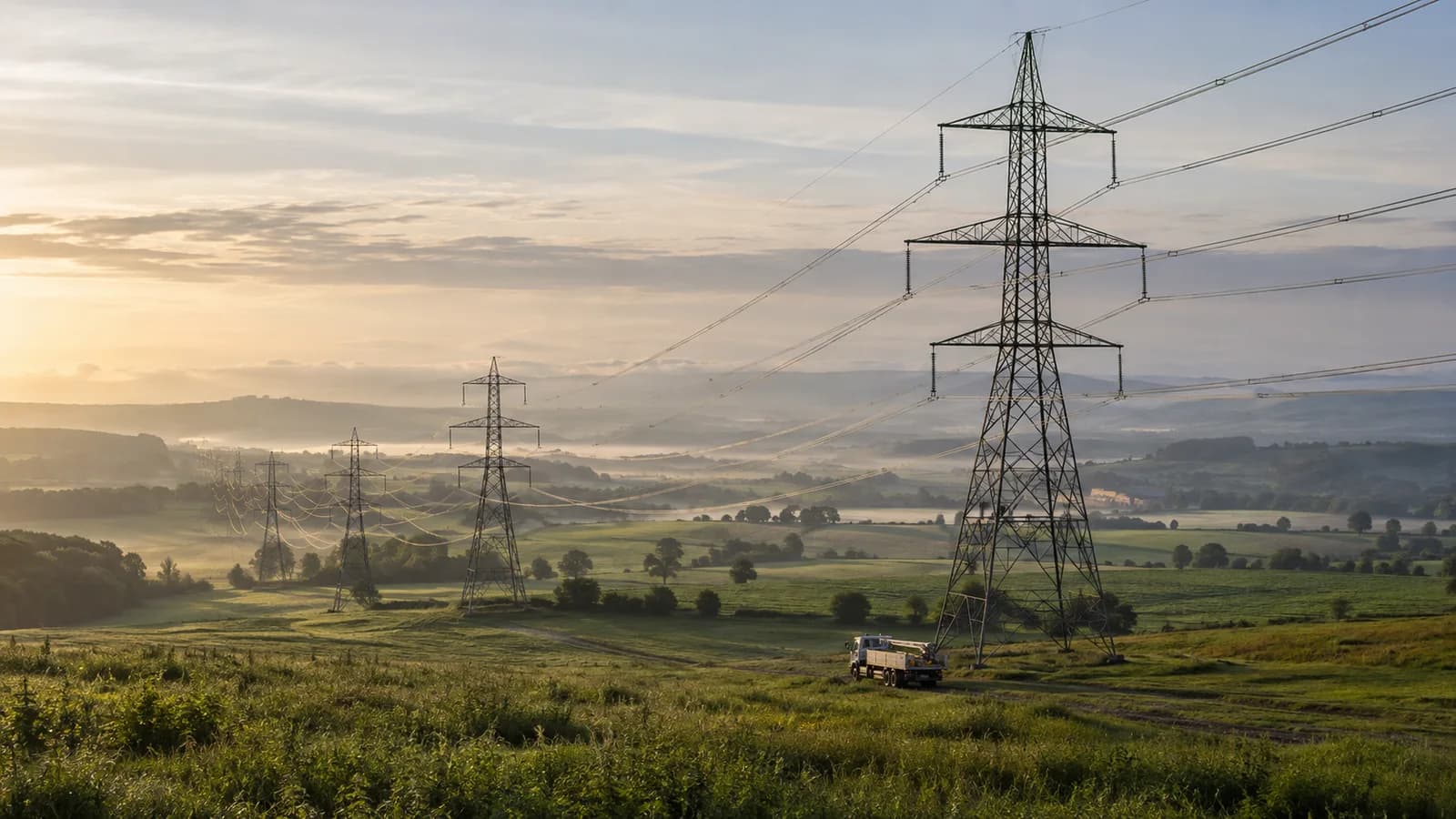
DOE expects recipients to rebuild or reconductor more than 1,500 miles of lines and deploy grid-enhancing technologies across nearly 21,000 miles. It describes reconductoring as replacing existing lines with higher-capacity conductors. The agency projects more than 23 gigawatts of additional capacity. These are expected results of the selected work. They are not a record of completed line mileage or a measurement taken from an operating programme.
Using an existing corridor changes the planning question from where to create an entirely new route to how much useful capability can be obtained from infrastructure already present. That is our reading of the strategy, without assuming every local obstacle disappears. A project still needs a defined scope and a workable delivery sequence. The national headline cannot establish the schedule of an individual line or substation.
Duke’s Carolinas proposal shows the selection conditions
Duke Energy’s own 24 September announcement confirms selection for $50 million in intended federal support. It identifies Greenville and Spartanburg counties in South Carolina and Henderson and Polk counties in North Carolina. The company pairs that support with approximately $151 million of its investment. DOE’s application summary lists the UNLOCK Carolinas proposal at $201,437,390 in total value, subject to final agreements.
Duke specifically places award funding after the finalisation of negotiations with DOE. It names advanced conductors and dynamic line ratings among the planned technologies. This recipient account makes the programme concrete, while preserving the conditional status of the funding. A selected application is meaningful progress, but it should not be converted into a statement that the utility has received every dollar or completed every proposed improvement.
More grid capacity and lower bills need separate evidence
DOE and Duke present lower costs and stronger reliability as intended benefits. Duke says federal support would offset part of the project expense otherwise borne by customers. That identifies a mechanism for reducing the customer-funded share. It does not quantify a universal reduction in a household’s next bill, nor does it establish that the complete electricity bill will fall after every other cost is considered.
The capacity figure also needs careful units. Gigawatts describe power capability; they are not an annual quantity of electricity and do not identify new generating plants. Our assessment is that readers should ask which constraint an upgrade addresses and how the operator will verify the resulting capability. That connects the headline to an operational outcome without inventing a conversion into guaranteed households served.
The next useful report should track delivery and operation
The most informative follow-up would identify signed awards, final scopes, completed construction and the date each upgrade enters service. Subsequent reporting could then compare the delivered capability and reliability with the original project objectives. These stages should be visible separately. A portfolio-wide target can guide expectations, but it cannot substitute for evidence that a specific upgrade has been accepted and is contributing to operations.
As of 1 October, SPARK has a selected portfolio, stated funding intentions and a set of engineering targets, supported by a detailed application list and a recipient example. The central proposition is to obtain more from existing transmission infrastructure. Its practical success will be established through completed projects and measured operation, with customer cost effects explained when the relevant evidence becomes available.
Questions and answers
Have the 31 grid projects already been completed?
The 24 September announcement concerns intended funding and selected applications. DOE’s project document says details remain subject to final financial assistance agreements; it does not report completed construction.
Does the 23 GW figure mean new power plants?
DOE presents more than 23 GW as additional capacity made available through grid improvements. It should not be described as new generation already built or as an annual amount of electricity produced.
Will a household’s next bill fall by a known amount?
The sources present lower costs as an intended benefit but do not publish a universal household saving or a guaranteed bill date. Actual outcomes depend on project delivery and how costs and benefits reach customers.