
Answer in brief
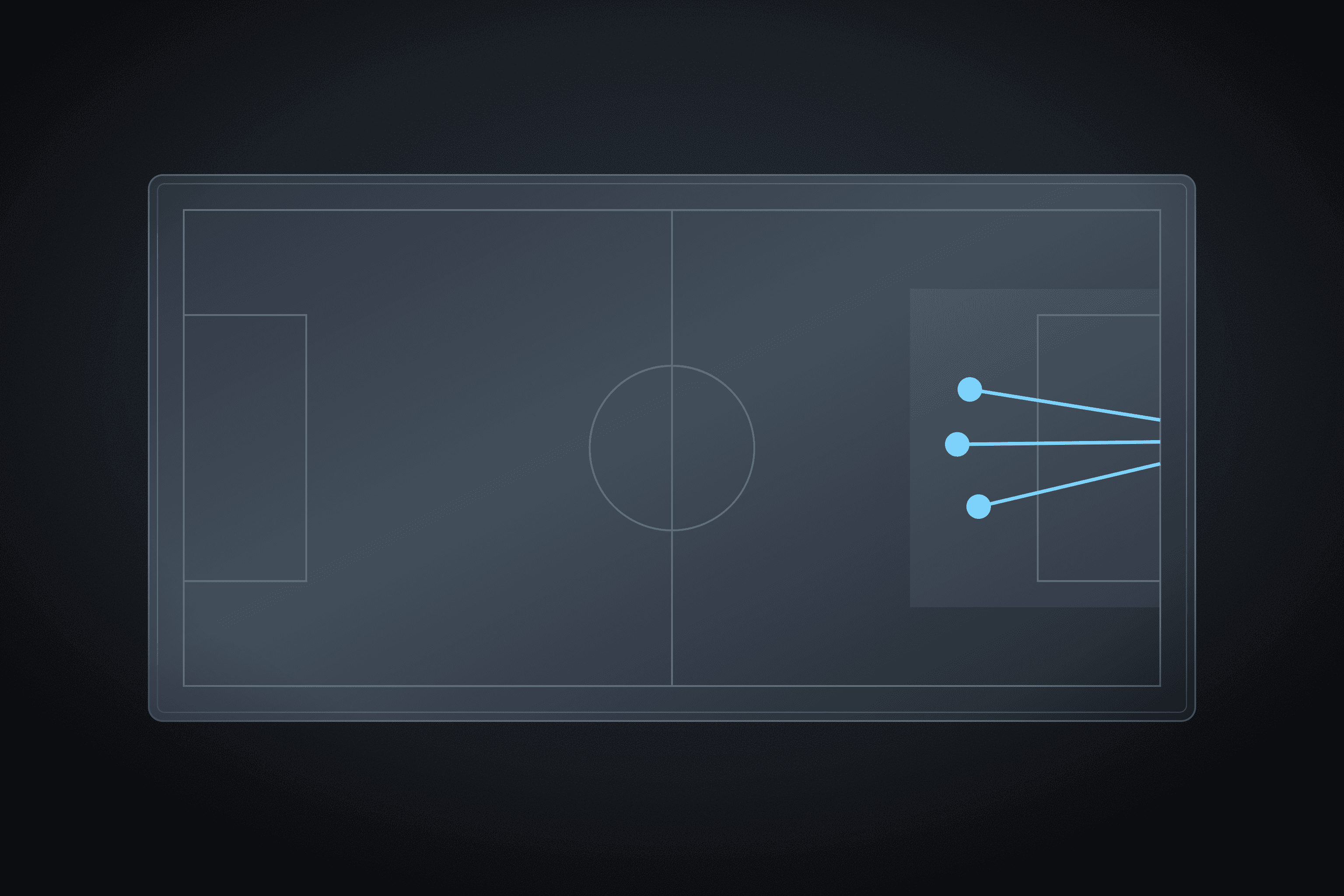
In the FA Cup tie against Liverpool, Haaland scored three goals from three shots on just 16 touches in 77 minutes — fewer than any other Manchester City starter. The three goals came about differently: a penalty, a headed goal after a Semenyo cross, and a goal under the crossbar after an O'Reilly cutback, while the goal in the 50th minute was scored by a teammate, Antoine Semenyo. The overall pattern — few touches under tight defensive pressure — is backed by Opta's season-long statistics, but the article does not analyse Haaland's specific off-the-ball movement from match footage.
Three Shots, Three Goals, 16 Touches: What One Match's Stats Show
On 4 April 2026, Manchester City thrashed Liverpool 4-0 in the FA Cup quarter-final at the Etihad. Erling Haaland scored three goals from three shots while recording the fewest touches of any City starter: just 16 in 77 minutes on the pitch before being substituted for Omar Marmoush, according to stats site Fotmob. Per Sky Sports' match centre, the teammates used for comparison played between 62 and 90 minutes, so the touch counts are not being compared over equal spans of time.
This is not a one-off. According to Opta analyst Ali Tweedale writing for PremierLeague.com, by mid-October 2025 — after 7 rounds of the 2025/26 season — Haaland was averaging 24.2 touches per 90 minutes: the third-lowest figure in the Premier League among players with 300-plus minutes at that point, behind only Sunderland's Wilson Isidor (18.5 touches) and Nottingham Forest's Chris Wood (21.1). Opta attributes those two forwards' low numbers to their teams spending most matches on the back foot. Over the same period, Haaland himself had covered 66.3km for the season — 10th among Premier League centre-forwards and wingers — and made 477 pressures, 7th in the league; yet with 9 goals in 7 matches he was the league's top scorer, three goals clear of the next-best, Antoine Semenyo.
The Liverpool match matters not because it proves a general rule on its own — one game's result shouldn't be projected onto every appearance — but because it offers three concrete, minute-by-minute episodes that show how a low touch count can coexist with a decisive scoreline.
The 39th-Minute Penalty: No Extra Touch Before the Shot
The scoring opened in the 39th minute: Virgil van Dijk clumsily fouled Nico O'Reilly inside the box — ESPN, Sky Sports and AFP independently call the foul clumsy, while Fotmob describes it without an evaluative adjective. The referee pointed to the spot, and Haaland sent the ball past goalkeeper Giorgi Mamardashvili from 12 yards, about 11 metres out. A penalty counts as a touch in the statistics — one of Haaland's 16 ball contacts in the match — but he needed no extra touch in the build-up: his entire contribution to the moment was the shot itself. Not every one of the three goals illustrates off-the-ball movement equally, and it is more accurate to say so directly than to force the episode to fit the article's overall thesis.
The Second Goal, Just Before Half-Time: Where Sources Agree and Where They Differ
City's second goal was more instructive for this breakdown. Antoine Semenyo provided the assist: per The FA's match report and Fotmob's statistics, Haaland headed home his cross in first-half stoppage time. ESPN's account adds that Haaland ran across defender Ibrahima Konate to head the cross into the corner of the goal (editorial translation) — the only attributed detail of off-the-ball movement that could be confirmed from the primary source text. The sources diverge on one detail: Sky Sports and AFP write that Semenyo received the ball from Rayan Cherki before the cross — in Sky Sports' wording, a Cherki trick sent Semenyo forward, while AFP's version has Cherki finding Semenyo's run with a pass (both phrasings are editorial translations). Neither The FA's report, Fotmob's article, nor Sky Sports' match centre records Cherki's involvement in this specific passage — that is a discrepancy between sources, not one agreed account. City assistant coach Pep Lijnders, commenting on the match, called this goal 'crazy' (editorial translation) and noted how Haaland attacks, how he flies, and still puts the ball in the corner.
City's Third Goal, in the 50th Minute — and Haaland Didn't Score It
Shortly after the restart, in the 50th minute, it was Antoine Semenyo, not Haaland, who made it 3-0: per The FA's report, he finished off a Cherki pass and calmly beat Giorgi Mamardashvili (editorial translation); Fotmob's account puts it five minutes after the break, with the ball chipped over the goalkeeper; AFP and Sky Sports add that Cherki's pass sent Semenyo into a run behind a hesitant Virgil van Dijk. Here the sources, including Sky Sports' match centre, agree: this was a teammate's goal built through the link-up with Cherki, without Haaland's involvement. Haaland completed his hat trick seven minutes later, in the 57th minute, meeting Nico O'Reilly's cutback and steering the ball in under the crossbar — by The FA's account, this was already City's fourth goal of the match. The match usually summarised in short as 'Haaland's hat trick, 4-0' in fact includes a teammate's goal, scored before the hat trick through that same Cherki link-up: City's attacking pattern worked in this game even without Haaland's direct involvement, not solely because of him.
Fewer Touches Isn't a Limitation — It's How the Striker Works
The Liverpool match fits the pattern described in an analysis published on Total Football Analysis on 1 April 2026: in the analysis's wording (editorial translation), Haaland consistently exploits a centre-back's blind side to find space, combining inside-out and outside-in runs. A caveat about source reliability is needed here: the article itself does not tie this movement trait to a specific season and does not name a data provider specifically for the figure of 103 touches inside the box — for other figures it cites FotMob and FBref — and the page also carries bookmaker advertising. So figures from this source — specifically, 103 touches inside the box as of 1 April 2026, the league's highest at the time — are not blended in this article with a different time slice, Opta's October 2025 data, into one 'season-long' picture: these are two measurements several months apart.
Opta analyst Ali Tweedale, writing for PremierLeague.com, shows the October 2025 picture from another angle: 69.6% of Haaland's touches at that point in the season came under high pressure — with an opposing defender within two metres — and by touches inside the box specifically under that pressure, 42 at the time, he trailed only Jack Grealish (48) in the league. Yet his pass accuracy under pressure dropped by only half a percentage point, from 63.2% to 62.7%. Opta's own analysis points directly to the mechanism: Haaland works with the ball mostly with his back to goal, fighting off defenders, and often only lays it off to a teammate if he gets a touch at all — at that point in the season he scored himself (nine goals) almost as often as he found a teammate with a forward pass (eleven times). Haaland's low touch count is not a result of passivity but of getting the ball rarely and almost always under a defender's immediate pressure; by the sheer number of touches inside the box he still ranks among the league's leaders, but that doesn't mean nearly every one of his touches happens there.
How the System Worked Under Guardiola — and Why It Can't Be Assumed Under Maresca
Total Football Analysis links Haaland's low touch count to how City's playing model was rebuilt under Pep Guardiola after Haaland joined the club in 2022: the club moved away from the false-nine setup, full-backs tucked into midfield, and Kevin De Bruyne supplied the wide crosses aimed at Haaland. A dating caveat matters here: the TFA article itself does not tie this description to a specific season, and De Bruyne left Manchester City back in June 2025 — on 12 June, Napoli announced his signing as a free agent. The part of this tactical description involving De Bruyne belongs to the earlier Guardiola period, 2022-2025, and cannot directly describe the system in the April 2026 match under discussion, in which De Bruyne no longer played for City.
On 29 June 2026, Reuters reported the appointment of Enzo Maresca as Manchester City's head coach: Maresca signed a three-year contract and was set to succeed Guardiola, who left the post in May 2026, from the start of the following, 2026/27 season. No independent confirmation of this news was found on the club's official site — only the agency's report was used. It would be premature to claim that Haaland's supply pattern has carried over unchanged under the new manager: there is no published tactical breakdown of the 2026/27 season comparable to Total Football Analysis's April piece as of this article's preparation — only individual match results and goals.
September 2026: Two Goals Under the New Manager, but No Touch Data
On 8 September 2026, in the new manager's first Champions League league-phase match, Manchester City beat Porto 2-0 away — again with two Haaland goals. The first came a minute and 34 seconds after the restart: according to The Analyst, an Opta analytics outlet, Rayan Cherki kept the ball in play and found Enzo Fernandez, who crossed for Haaland to head home from the left post. Haaland's second goal came in the 91st minute: Mateo Kovacic won the ball, released Rayan Ait-Nouri into space, who squared it for Haaland to strike into the bottom-right corner.
These two goals brought Haaland's Champions League tally for City to 36 in 40 matches — matching, but not beating, Sergio Aguero's club record: The Analyst states plainly that Haaland equalled the previous mark; since the 2022/23 season, only Kylian Mbappe (38) has scored more in the competition. By the match's final statistics, City generated 2.31 expected goals from 20 shots, 10 on target, against Porto's 0.22 expected goals and 5 shots. The Analyst does not give Haaland's personal touch count for this match, and it cannot be asserted: at least four of his goal-scoring chances in the game are documented — the two goals, a headed effort from a Phil Foden cross saved by goalkeeper Diogo Costa, and a right-footed shot in the 32nd minute, also parried by Costa. That is enough to speak of a high conversion rate on few chances, but not enough to say the April pattern of 'three goals from three shots' repeated numerically — the figures from the two matches are not identical.
Touches, Supplier, Conversion: Three Things to Track in Future Matches
Based on the episodes examined here, it makes more sense for readers to track three things rather than Haaland's overall touch count: exactly where on the pitch he receives the ball before shooting — in the goals examined, that's either the penalty spot or a touch near goal off a teammate's cross or cutback; who ultimately sets up his shooting position — across all four scoring passes examined in the article, it was a different player each time: Semenyo, O'Reilly, Enzo Fernandez and Ait-Nouri, while Rayan Cherki was involved in the early phase of the move in two of the five goals examined, and in one of those only according to Sky Sports and AFP, without being the final passer; and how many scoring chances come from the few touches Haaland does get in a match — three from three shots in the April hat trick and at least two goals from four chances in the September game against Porto.
Neither one season's statistics nor two productive matches at the start of the next one prove that the supply pattern will hold unchanged all year, especially under a new manager. This is a working model to keep testing against new matches as the 2026/27 season unfolds, not a finished conclusion.
Practical checklist
- Watch exactly where on the pitch Haaland receives the ball before shooting — from the spot, from the byline, or already in a touch near goal.
- Identify which teammate actually launches the attack into his zone — a specific player, not an abstract 'team'.
- Count how many shots come from the few touches he does get in a match.
- Check whether the supply pattern has changed under the new manager by comparing specific matches, rather than relying on a season-old breakdown.
- Judge whether a given match's touch count is representative or an outlier, given the opponent and the game's context.
Questions and answers
Does the penalty count among the 16 touches the statistics mention?
Probably yes: striking the ball is also a contact with it, so it makes sense that it's counted among Haaland's 16 touches. But this can't be confirmed directly: Fotmob doesn't publish a breakdown of those 16 touches by action type (receiving, controlling, shooting), so the penalty strike can't be isolated within them.
Since Wilson Isidor and Chris Wood have even fewer touches than Haaland, does that mean fewer touches by themselves lead to more goals?
No. When Opta's analysis was published, after 7 Premier League rounds in October 2025, Haaland was outright top scorer in the league with 9 goals, three clear of the next-best, Antoine Semenyo, while having more touches per 90 minutes than Isidor and Wood. Per Opta's explanation, the Sunderland and Nottingham Forest forwards have few touches because their teams play mostly on the back foot, while Haaland has few because he receives the ball in an attacking team almost always under tight defensive pressure; the touch count itself is not a measure of output.
Was the Liverpool hat trick Haaland's 28th career hat trick, or his first in a long time — which figure is correct?
Both figures are correct because they describe different things. The FA and, independently, AFP call this Haaland's 28th career hat trick — across all clubs and competitions, not just Manchester City. For City specifically, the figure is far more modest: per Fotmob, since his club debut in July 2022, this is his 12th hat trick in all competitions. ESPN adds that this is Haaland's first hat trick for City since August 2024 — that's about frequency, not the running total. The three figures don't contradict each other, but they shouldn't be mixed together in one sentence.
How does the 16 touches in the Liverpool match compare with Haaland's usual touch count per game?
16 touches in 77 minutes of the FA Cup match works out to about 18.7 touches per 90 minutes — this is the editorial team's own conversion, not a figure published by a stats provider. It is below Haaland's average per Opta's data for PremierLeague.com — 24.2 touches per 90 minutes as of mid-October 2025 — but that average covers only Premier League matches, not the FA Cup, so the comparison is approximate, across different competitions. There is no open-source data on his exact touch count in each individual match of the 2025/26 and 2026/27 seasons, so comparison is only possible against this published average, not against a full run of matches.