
Answer in brief
The NPS notice orders Halemaʻumaʻu Trail and part of Byron Ledge Trail closed by 5 p.m. local time on 7 October 2026. It does not establish a park-wide closure or confirm a new eruption; check current NPS access notices.
Which trails does the 7 October closure order name?
The NPS notice orders Halemaʻumaʻu Trail and part of Byron Ledge Trail closed by 5 p.m. local time on 7 October 2026. It does not establish a park-wide closure or confirm a new eruption; check current NPS access notices. The wording matters: it names one trail and a section of another. At the 8 October cutoff, this is an official closure order, not a separately inspected report of installed barriers. It should change plans that use those routes without being expanded into a claim that every trail, viewpoint or entrance in the national park is closed.
Why did NPS restrict these Kīlauea trails?
The National Park Service cites continuing inflation and increased seismicity at Kīlauea’s summit. USGS monitoring provides separate scientific context for changing summit conditions and associated hazards. Neither source should be turned into a precise forecast of when a new event will occur. A closure decision is useful visitor information even when the eventual volcanic outcome remains uncertain. Do not use a dramatic photograph of lava to assume that the named walking route currently contains an erupting flow. The access order and the scientific interpretation answer different questions.
How should you check every segment of a planned walk?
If your planned walk includes either affected route, examine its full sequence of trail segments before leaving. A loop can depend on a closed link even when its starting point remains accessible. Use current park mapping and access notices to check the route, rather than drawing a shortcut around an obstruction. Ask park staff about a suitable alternative for your party’s ability and available time. This is a planning method, not a verified replacement itinerary. We have not inspected trail junctions or established which alternative viewpoints are currently open.
Where can you check Kīlauea access and volcano activity?
The park’s Alerts & Conditions page is the place to review access restrictions; USGS volcano updates explain monitored activity. Read the date and local time of each update and avoid mixing reports from different days. A scientific map is not permission to enter a closed area. Equally, the absence of a new dramatic monitoring headline does not establish that a trail has reopened. Keep the access source and the scientific source together in trip notes, with each source’s role clear enough to check again before walking.
When will Halemaʻumaʻu and Byron Ledge reopen?
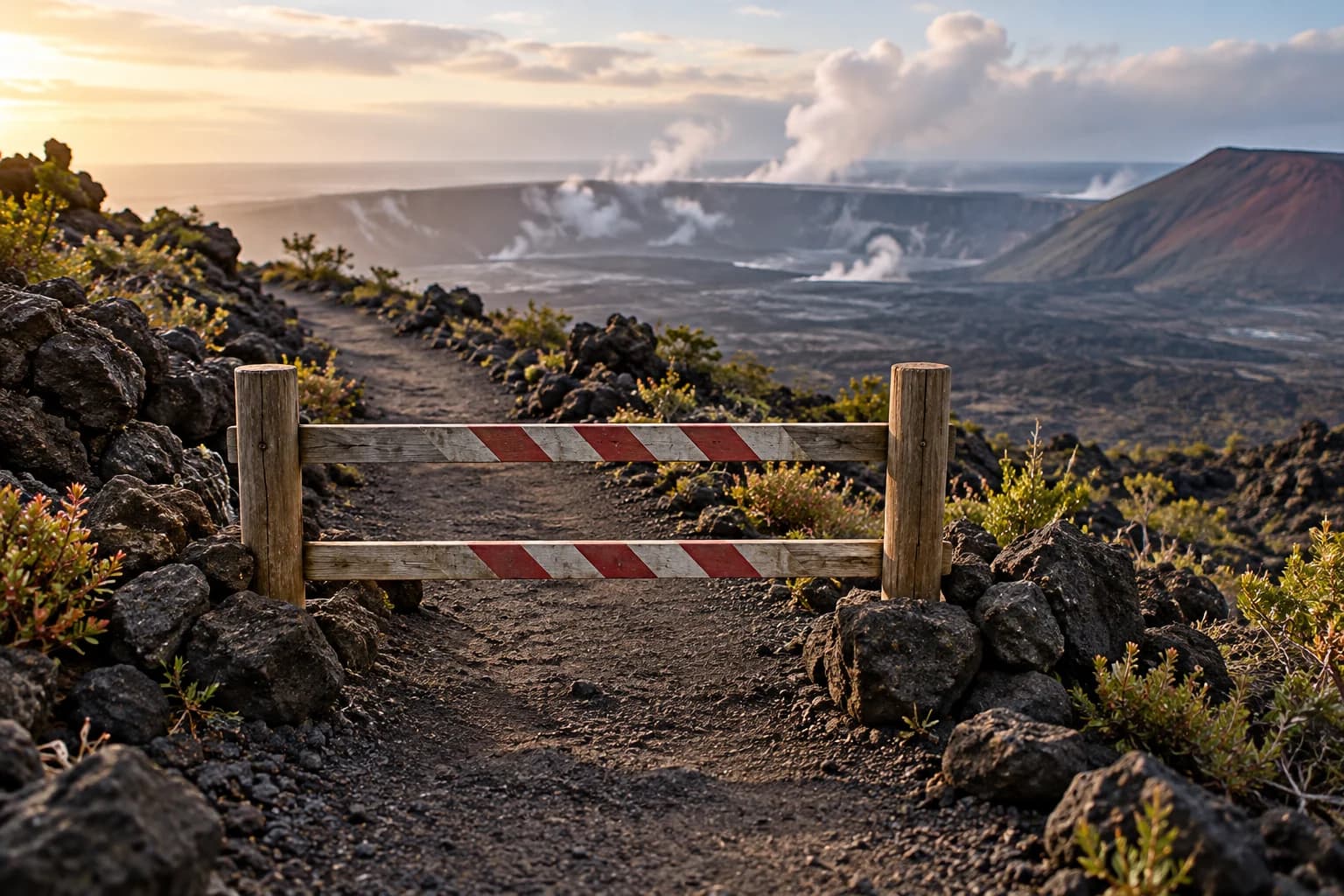
The reviewed notice does not supply a dependable end date for these closures. Plan around the published restriction until the park provides an update relevant to your visit. If changing plans, confirm the new route rather than assuming the rest of the itinerary is unaffected. The cover is a conceptual illustration, not evidence of the location or condition of a real barrier. The supported report remains narrow: named summit trails are subject to an official closure order, and current access must be checked against the park’s own information.
Questions and answers
Does the October 2026 notice close the whole national park?
The 7 October 2026 notice names Halemaʻumaʻu Trail and part of Byron Ledge, not a park-wide closure. It does not establish that every other area is open either. Consult the park’s current Alerts & Conditions page for your route and visit date. Do not expand or reduce the named restriction based only on this headline.
Do these trail closures confirm a new Kīlauea eruption?
No. The closure notice cites summit inflation and increased seismicity as reasons for restricting access. USGS provides scientific monitoring and discusses uncertainty. A trail closure is not itself evidence of a newly begun eruption. Read the current dated monitoring report for activity and the park notice for whether a particular route may be used.
Is there a reopening date for the affected trails?
The reviewed notice does not establish a reliable reopening date. Temporary describes the nature of the restriction, not a promise that it ends within a certain number of days. Recheck official park access information before your visit and follow the posted restrictions. This article has not inspected the trails or confirmed removal of any barrier.