
Answer in brief
European Sleeper’s Milan–Brussels service began on 9 September. Its first autumn timetable offers a direct overnight option, but departure days, the Milan station and later route changes need attention.
A September launch becomes an autumn travel option
The Milan–Brussels night train has moved from announcement to operation. European Sleeper’s inaugural train left Milano Porta Garibaldi on 9 September 2026; Italy’s tourism agency ENIT confirmed the launch in its report of 11 September. The operator published its own account on 16 September. As October begins, the news for travellers is a usable overnight link between northern Italy and Belgium.
This is a review of the service’s first autumn timetable, not a claim that the train launched on 1 October. The appeal is straightforward: travel continues while passengers spend the night on board, reducing the need to arrange a succession of daytime trains. Whether it suits a particular trip depends on the operating days, the chosen accommodation and what must happen after arrival.
Three departures each way shape the trip
The published pattern sends trains from Milan on Wednesdays, Fridays and Sundays, with departures from Brussels on Mondays, Thursdays and Saturdays. That is three services in each direction, rather than a daily connection. A short break should therefore be built around both ends of the journey. Choosing the outward departure first and assuming a matching return the following evening can produce a poor fit.
The date-specific timetable checked on 1 October displays ES 401 leaving Brussels-Midi at 19:06 that Thursday and reaching Milano Garibaldi at 11:40 on Friday 2 October. These are scheduled times for that departure, not permanent daily promises or observed punctuality. The operator asks passengers to consult the live planner and national railway information for the latest departure details.
| Service or period | Published pattern | Planning consequence |
|---|---|---|
| Milan → Brussels | Wednesday, Friday, Sunday | Check the return day separately |
| Brussels → Milan | Monday, Thursday, Saturday | No daily departure assumption |
| ES 401, 1–2 October | Brussels 19:06 → Milan 11:40 next day | Allow for arrival on a different date |
| From 13 December | Planned route via Antwerp, Breda and Eindhoven | Do not apply it to October tickets |
The Swiss route requires accurate station names
The checked southbound timetable runs through Cologne and Switzerland, including Aarau, Arth-Goldau, Göschenen, Bellinzona and Lugano, before Como and Milan. ENIT describes the Gotthard route in its inauguration coverage. Zurich is not listed as a stop on the opened October service. Older previews or a destination link elsewhere on a website should not replace the actual service’s station list.
In Milan, the important name is Porta Garibaldi. A traveller connecting from another station should include the transfer as its own stage, rather than treating the city name as a single interchange. The same discipline applies when meeting someone at Brussels-Midi. Save the station names exactly as shown on the booking so that local transport and any onward ticket point to the right place.
An overnight journey is also an accommodation choice
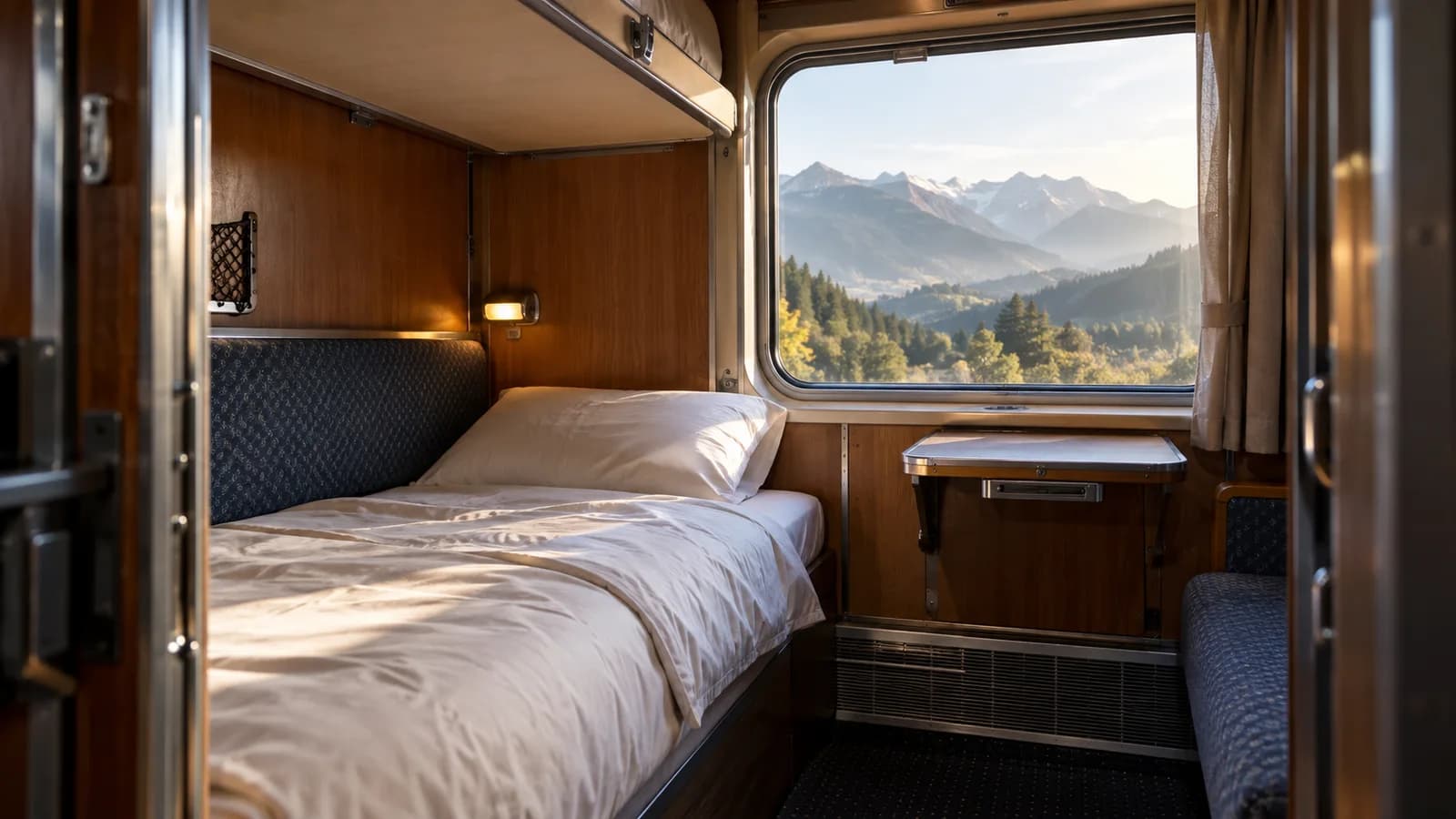
An overnight train combines transport with time spent in a compartment, so the booking deserves a different comparison from a simple seat on a daytime service. Inspect the accommodation description for the selected departure, the number of people sharing and the facilities included in the fare. Do not infer a private space, a particular meal or accessible facilities from a generic photograph or the word sleeper.
For a group, the useful question is whether the actual booked arrangement lets everyone travel together in the intended way. For a solo traveller, privacy and the ability to rest may weigh more heavily than a small fare difference. These are planning considerations rather than findings from a VJOURNAL test journey. The launch reports establish the connection; they do not prove every passenger’s sleep quality.
December’s route belongs to a separate calendar
European Sleeper says that from 13 December the route will run from Brussels through Antwerp, Breda and Eindhoven before continuing towards Cologne and Milan. As of this article’s 1 October evidence date, that is a future change. A passenger planning October should not expect those additional locations to appear simply because they feature in the operator’s description of the later service.
This creates two planning questions with different answers: where does the selected train stop now, and what has been announced for a later season? Keep the itinerary attached to the actual departure date. If a trip straddles a timetable change, check both directions independently. A familiar route name is not enough to establish that the outward and return trains use identical intermediate stations.
Compare the usable hours of the whole journey
Our interpretation is that the service’s strongest practical contribution is another way to arrange time. Compare the sleeper with alternatives using the complete journey: station access, accommodation, arrival time, onward connection and the flexibility of the fare. A night on board may replace a hotel night for some itineraries, but that is not an automatic saving if the arrival or return day creates additional accommodation needs.
Leave a sensible margin before a separately booked appointment or connection, and recheck operational notices before travel. Neither the operator’s launch account nor ENIT’s tourism report supplies a route-specific emissions calculation that supports a precise percentage saving here. The verified development is the direct, three-times-weekly service; its value to a traveller comes from fitting the actual timetable to a realistic itinerary.
Questions and answers
Does the service run every night?
No. The published pattern is three departures per direction each week. Check both travel dates before designing a short break around the train, and use the date-specific planner for times.
Which Milan station is used?
The service uses Milano Porta Garibaldi, shown as Milano Garibaldi in the timetable. Do not assume a connection arriving at another Milan station departs from the same place.
Is Zurich a stop on the checked October service?
The opened 1–2 October ES 401 timetable lists Aarau, Arth-Goldau, Göschenen, Bellinzona and Lugano in Switzerland, without a Zurich stop. Check the actual date rather than older route previews.