
Answer in brief
Old money style on a budget means buying twelve classic pieces in natural fibres and seven neutral colours, in a fixed order, then spending on tailoring and care rather than on brands. A first six-piece capsule costs under €200 at direct-to-consumer prices; VITON13's ready-made menswear looks run from $1,570 to $2,300.
What old money style actually means
Old money style is clothing that looks inherited rather than bought: classic cuts, natural fibres and muted colours, worn without visible branding. The name comes from families whose wealth predates the current generation, and whose dress codes were set by boarding schools, sailing clubs and country houses rather than by fashion cycles. Three ideas hold the look together: quality over quantity, discretion, and permanence, meaning a piece bought this year should still be in rotation a decade later.
Interest in the look has moved well beyond a niche. The query “old money style” draws about 22,200 searches a month in the United States, “old money outfit” about 12,100 and “old money clothing” about 3,600, according to DataForSEO keyword data retrieved through the SEOmatic connector in September 2026. That demand is why so many brands now sell the aesthetic, and why it pays to understand the rules before spending anything. Old Money Brand's own style guide reduces the code to five principles, starting with quality over quantity and natural fabrics over synthetics; every serious guide on the subject agrees on those two.
Old money versus quiet luxury: the difference that matters
Quiet luxury is a price point; old money is a set of habits. Quiet luxury, a term with roughly 6,600 US searches a month, usually refers to logo-free pieces from expensive houses: cashmere at four figures, tailoring at five. Old money style borrows the same restraint but does not require the same budget, because heritage families historically bought good things once and repaired them rather than replacing them.
In practice that means you can dress old money in a resoled loafer, a ten-year-old navy jacket and a knit that has softened over fifty washes. The look rewards patience and care far more than it rewards spending. If you already own classic pieces in the right colours, you are closer than you think, and the rest of this guide is about filling the gaps in the right order.
The seven-colour palette that makes every piece combine
Stick to seven colours and everything in the wardrobe will work together: navy, camel, cream, white, olive, grey and chocolate brown. Green Wedding Shoes' capsule guide recommends exactly this narrowing, camel, navy, ivory and black, because a short palette multiplies outfit options while keeping every combination calm. The VITON13 menswear capsule is built the same way, on navy, sand and cognac, so that ten pieces produce three complete looks.
Add colour sparingly and only through classic references: a burgundy loafer, a bottle-green polo, a pale blue shirt. Avoid neon, high-contrast prints and any logo larger than a shirt button. Hockerty's do's-and-don'ts table puts it plainly: neutral and earthy tones read as elegance, while garish colours and logo-heavy items undo it.
Fabrics to buy and how to care for them
Natural fibres are the non-negotiable part of the code, because they age well and synthetics do not. Four fabric families cover almost the whole wardrobe, and each has one care rule that decides whether the piece lasts a decade or a season.
Linen for shirts, trousers and shorts
Look for 100% linen rather than blends, because a blend keeps the creases without the softness. Wash cool, skip the tumble dryer and accept the wrinkles; they are the point. Linen softens with every wash, which is why a well-cut linen shirt improves for years. A men's linen shirt is one of the most searched items in the category, at about 14,800 US searches a month, so compare weight and stitching rather than price alone.
Cotton for polos, chinos and Oxford shirts
Pique and fine-gauge knits hold their shape better than jersey, and a mid-rise chino with a flat front sits better under a jacket than a low-rise one. Wash cotton at 30 degrees inside out, dry flat or on a hanger, and press with steam rather than a hot plate. The Old Money Lounge Set in the VITON13 women's line follows the same rule: a premium cotton-blend knit washed at 30°C on a gentle cycle and dried flat.
Wool and cashmere for knitwear, jackets and coats
Merino for everyday jumpers, cashmere for the one piece you will wear most, and a Super 120s wool for tailoring that has to hold a crease. Fold knitwear, never hang it, and store it with cedar. The Classic Tailored Suit in the VITON13 women's line, cut in Super 120s wool with a viscose and cupro lining, is dry-clean only and should be steamed gently and kept on a wide hanger away from sunlight.
Suede and leather for shoes, belts and gloves
Suede needs a protector spray before the first wear and a brass or crepe brush afterwards, and it must dry away from radiators. Smooth leather wants a damp cloth, a cream in the same shade and shoe trees. Buy loafers and derbies with a sole that can be replaced where the budget allows, because a glued sole cannot be repaired, and rotate two pairs so each rests for a day.
Twelve essentials for men, in buying order
Build in this order, because each piece works with the ones before it, and the first four alone already make a complete outfit. Mensfashioner's tiered brand guide makes the point that a mixed outfit, a good knit over an inexpensive Oxford over mid-priced trousers, reads more old money than a single-brand look at ten times the price; the list below is designed for exactly that kind of mixing.
Tailoring and shirts
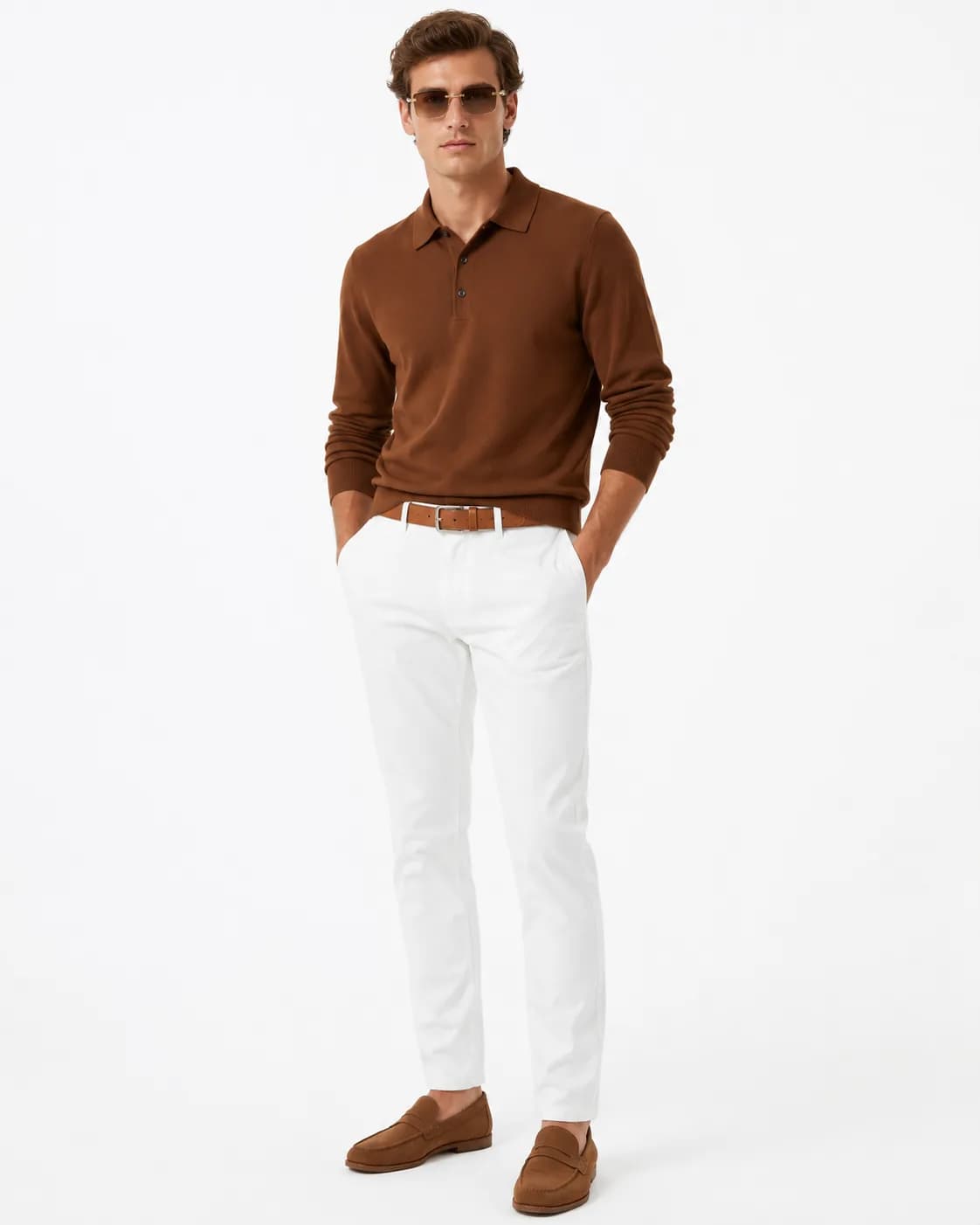
One: a navy jacket, unstructured and single-breasted, in wool or a wool-linen blend. Two: a white Oxford shirt with a button-down collar. Three: a linen shirt in white, beige or pale blue. Four: a knit polo in navy, cream or a warm brown, the piece VITON13 offers as the Cocoa Fine-Knit Polo at $460, with a three-button placket and fine ribbing at the cuffs.
Knitwear and trousers
Five: chinos in stone or white, flat front, mid rise; the White Tailored Chinos in the VITON13 capsule are $480. Six: pleated trousers in sand or beige for the warmer months, such as the $560 Sand Pleated Trousers with forward pleats and side adjusters. Seven: darker tailored trousers for the evening. Eight: a roll-neck or crewneck in navy or cream; the Navy Roll-Neck is $420.
Shoes, belt and outerwear
Nine: suede loafers or a plain derby in brown; the Brown Comfort Derby Shoes are $620. “Old money loafers” is a search term in its own right, at about 720 US searches a month, and almost every brand in the category leads with the loafer. Ten: a belt that matches the shoes, like the $290 Cognac Buckle Belt. Eleven: a coat or blouson in a warm neutral, for which VITON13 offers the Tobacco Suede Blouson at $980. Twelve: a simple watch on a leather strap and one pair of tortoiseshell or amber sunglasses.
The women's twelve: blazer to signet ring
Lindsay Nicholas New York's women's guide summarises the approach as tailored blazers, clean trousers, silk blouses and structured coats in neutral tones, with fabric quality placed above quantity. The twelve pieces below follow that logic and keep every item compatible with every other.
Tailoring and blouses
One: a tailored jacket in navy, camel or cream; in the VITON13 women's line that role is taken by the Classic Tailored Suit at $1,890, whose jacket works alone. Two: a silk or cotton blouse in ivory. Three: a linen shirt, worn tucked or knotted. Four: a cashmere or merino crewneck in a neutral.
Trousers, skirts and knitwear
Five: wide-leg or pleated trousers in beige, navy or grey; the Pleated Old Money Trousers in wool-blend twill are $420. Six: straight-leg jeans in a dark, clean wash for weekends. Seven: a midi skirt in silk or wool. Eight: a wrap cardigan for layering; both Knit Wrap Cardigans in the VITON13 line are $290.
Coats, shoes and jewellery
Nine: a trench coat or a structured jacket, such as the $420 Structured Eco-Leather Jacket. Ten: suede or leather loafers, plus ballet flats or a low block heel. Eleven: a structured leather handbag with no visible branding. Twelve: small gold jewellery worn daily, hoops, a chain, a signet ring.
Fit and tailoring: the rule most people skip
Fit does more for the look than fabric or brand. Old money style sits between slim and relaxed: trousers break once on the shoe, jackets close without pulling, shirts skim rather than cling. Budget for a tailor to hem trousers, shorten sleeves and take in a waist, and treat that cost as part of the purchase price. Hockerty's guide lists ill-fitting clothes as the single biggest error in the style, and every stylist will tell you the same.
Use the size guides rather than guessing. VITON13 publishes chest measurements for each men's size, from S at 96 to 99 cm to XL at 108 to 111 cm, and foot lengths for footwear from 25.4 cm at EU 40 to 28.6 cm at EU 45. For loafers and derbies, take your usual EU size and expect suede to give slightly across the width after a week of wear.
A priced starter capsule at two budgets
You do not need all twelve pieces at once. Six pieces in the palette above produce at least fifteen outfits, and the same six can be bought at two very different price levels: an entry tier from direct-to-consumer labels, and an investment tier where the fabric and construction are meant to outlast the decade.
Compared with heritage pricing, where Mensfashioner's guide lists a Brooks Brothers Madison-fit Oxford at about $140 and a Loro Piana or The Row cashmere crewneck at $895 to $1,290, both tiers below leave room for tailoring and for one investment piece, usually the coat.
Entry tier: what direct-to-consumer labels charge
On 16 September 2026 the Shopify storefront of the label Old Money listed a linen shirt at €54.95, linen trousers at €45.95 and suede loafers under €70, with the linen pieces discounted from full prices in the €58 to €72 range. At those prices a shirt, trousers and loafers come to well under €200, which is the realistic floor for a first capsule. What that tier does not tell you is the linen weight, the suede origin or the sole construction, so ask before ordering.
Investment tier: the VITON13 menswear capsule in dollars
The VITON13 men's edit prices its three ready-made looks from the current catalogue. The Navy Standard, a navy roll-neck, sand pleated trousers and brown derbies, comes to $1,600. The Cocoa Weekender, the cocoa knit polo, white chinos, amber sunglasses and the cognac belt, comes to $1,570. Tobacco After Dark, the suede blouson, navy roll-neck, black tailored trousers and leather gloves, comes to $2,300.
Each look can be bought as a set with every size chosen once, or piece by piece starting with the knit and the trousers. Compositions for the men's capsule are confirmed on request before dispatch, and the women's pieces list theirs on the product page: Super 120s wool for the suit, wool-blend twill for the pleated trousers, a cotton-blend knit for the lounge set.
Where the aesthetic goes wrong
Four mistakes undo the look faster than a small budget does. Visible logos, even one embroidered emblem, break the discretion rule. Trend-led cuts, cropped jackets, ultra-wide trousers and oversized knits, will date within two seasons. Synthetic fabrics do not soften, do not breathe and photograph shiny. And too much newness gives the game away: wash linen before wearing it, break loafers in at home, and let knitwear pill once and be de-pilled.
The last mistake is buying everything at once from the same reference. The failed version of this style is too matched and too visibly correct. Mix price tiers, mix seasons of purchase, and let one piece be older than the rest; that is what makes a wardrobe look inherited rather than assembled last month.
Practical checklist
- Hold the cloth to the light: a proper weight does not show through.
- Check that the composition is stated, or confirm it in writing before paying.
- Look for a stitched or resoleable sole on loafers and derbies; a glued sole cannot be repaired.
- Compare the size guide in centimetres with a garment you already own rather than trusting a letter size.
- Count the colours in your basket: if more than two fall outside the seven-colour palette, put one back.
- Set aside part of the budget for a tailor before you spend it on a second piece.
Questions and answers
Can I dress old money with jeans?
Yes. Dark, straight-leg jeans without distressing pair with a navy jacket, an Oxford shirt and loafers. Hockerty's guide confirms that well-fitted dark-wash denim fits the aesthetic when it is worn with tailoring rather than with trainers.
What shoes count as old money?
Suede or leather loafers, penny or driver style, plain derbies and Oxford shoes for formal wear. Clean white leather trainers pass only for sport. Chunky sneakers, flip-flops and anything with a visible logo do not.
Is old money style expensive to start?
No. The style rewards fewer, better-chosen pieces in natural fabrics; direct-to-consumer labels list linen shirts and trousers at €45 to €55, while an investment-tier knit polo at VITON13 is $460. Tailoring and care matter more than the price tier.
How is preppy different from old money?
Preppy is louder: brighter colours, madras, crests and go-to-hell trousers. Old money keeps the same references, the club blazer, the loafer, the Oxford shirt, but in muted colours and without the emblems.
How do I make inexpensive clothes look expensive?
Buy natural fabrics, keep to the seven-colour palette, have everything tailored, steam or press before wearing, and maintain shoes with trees and polish. Fit and care account for most of the perceived value, which is why a $290 belt worn with pressed trousers reads richer than an unpressed designer look.