
Answer in brief
The short answer: camera clothing is judged on different criteria
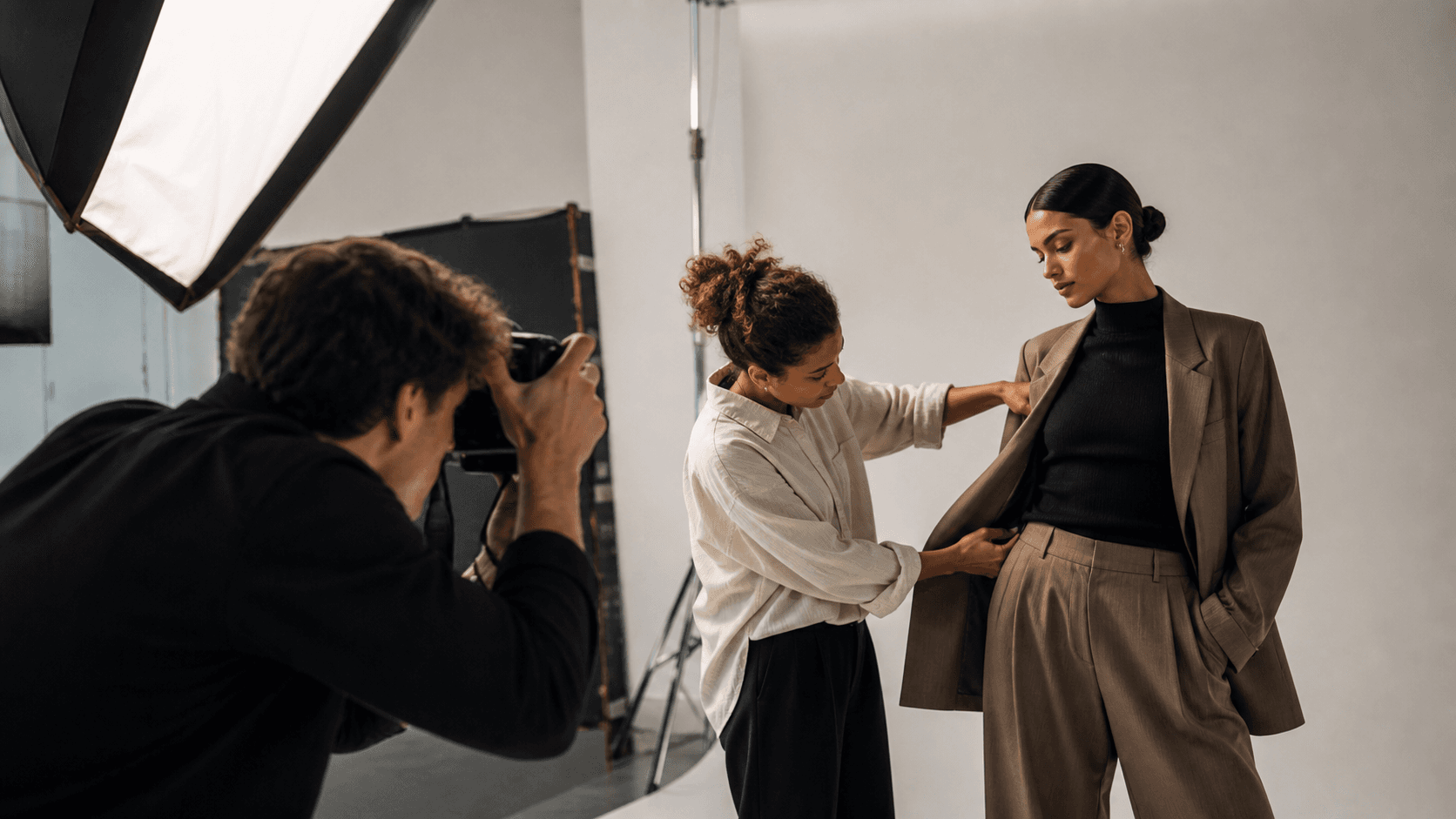
A stylist preparing a shoot builds looks for a specific camera, a specific light and a specific frame, not for a room. Every piece is judged on how its colour reads under the chosen source, how its texture survives the shooting distance, and how the silhouette behaves in movement.
In a room, clothing is seen whole, under diffuse light, from whatever distance the other person picks. On camera none of that holds: the frame is fixed, the light is directional, and the colour passes through a codec before anyone sees it. A jacket that is faultless in a meeting can behave differently on screen.
The practical consequence is that shoot preparation is its own task with its own inputs. Frame format, the character of the light, the background and the number of scenes all need to be known before the wardrobe is opened, not after the crew has arrived on location.
The rest of this article walks through what gets checked: colour, tone, pattern, texture, framing, movement, sound, background and takes. At the end you will find which VITON13 packages cover this work, what they cost and what they leave out.
Colour under light: the source changes the shade
The colour of a fabric is the product of dye and light spectrum. Daylight, tungsten and an LED panel emit different spectra, so the same jacket reads warmer or cooler depending on nothing more than what is illuminating it that day.
Metamerism sits next to this: two garments that match in daylight separate under an artificial source. The familiar case is a navy bottom with a black top, a pairing that stops looking like one outfit at the exact moment the lights come up.
The fix is unglamorous. Check the outfit under the light the shoot will actually use rather than by a window. When the location is already chosen, photographs of the room and the type of fixtures are enough to rule out the risky combinations early.
White balance is set once per setup and it acts on skin and fabric together. That is why garment colour is chosen alongside the background tone and the subject's complexion, rather than apart from either of them.
White and black: where the frame loses detail
A camera records a limited range of brightness. A large white field clips easily: the shirt flattens into a single wash, seams and folds disappear, and automatic exposure may pull the whole image down and darken the face to compensate.
Deep black produces the opposite loss. A black jacket against a dark background gives up its construction, so lapels, darts and the shoulder line merge and the viewer is left with a silhouette. Shadow areas also carry more visible sensor noise.
The working move is to step in from the extremes: ivory, ecru or light grey instead of pure white; graphite or navy instead of dense black. The garment keeps its intended tone and the camera keeps the evidence of how it was made.
This is not a ban on white and black, it is a question of area. A small white accent near the face works as a reflector, while a full white field across the frame takes the exposure with it.
Fine pattern: moiré and the stripe that shimmers
A fine, regular pattern — a narrow stripe, a herringbone, a tight check — falls into step with the pixel grid of the sensor. The result is moiré: coloured bands drifting across the cloth and travelling with the person wearing it.
Distance makes it worse. The further the subject sits from the lens, the fewer pixels each repeat of the pattern occupies and the more likely the two frequencies are to collide. A jacket that behaves in close-up starts to swim in the wide shot.
Some cameras suppress this with an optical low-pass filter in front of the sensor, which softens the image very slightly. Many current bodies leave that filter out in order to keep resolution, and the responsibility for pattern then moves to the wardrobe.
A usable test: the pattern should still read as a pattern from two metres away. If at that distance it collapses into a vibrating grey mass, the frame will show the same thing, only more insistently.
Texture and distance: what survives the wide shot
In close-up the camera resolves the weave, and tweed, linen, corduroy and knit are all distinguishable from one another. At a medium distance the texture simplifies. In a wide shot it disappears entirely and each garment becomes a single flat tone.
So at distance the difference between pieces rests on silhouette and on tonal value, not on surface. Two garments of the same lightness merge into one shape even when the fabrics have nothing in common with each other.
That gives a rule for assembling looks: view the outfit in greyscale, either mentally or in an editor. If the top and the bottom differ only in hue and not in lightness, the frame loses its structure at the first wide shot.
Texture still earns its place where it lands close to the lens: the collar, the lapel, the cuff, the knit sitting near the face. Those are the zones worth pointing the material budget at.
Frame and format: horizontal, vertical and the lower third
Interviews and corporate video live mostly in medium shots, with the subject visible from the waist or the chest. Shoes and trouser hems never enter that frame, while the collar, the shoulders and the neckline are working in every second of it.
A vertical format for social platforms cuts the frame at the sides. Wide shoulders, large lapels and voluminous sleeves occupy a greater share of a narrow frame, and the background around the figure almost vanishes from view.
The same outfit is therefore assembled differently for 16:9 and for 9:16. If the material will be edited into both versions, that is settled before the shoot rather than discovered in the edit suite.
The lower third of the frame carries name captions and subtitles. The tone of the clothing in that band decides whether white text placed over it can be read, which makes wardrobe part of the page layout and not only of the shooting day.
Movement and fit: the garment during a conversation
A shoot is not a pose. It is many minutes of speech and gesture. A jacket buttoned while standing opens when the subject sits, an unstructured collar folds under itself, a skirt changes length the moment someone takes a chair.
Garments are tried in the positions the frame will actually contain: seated on a backless stool, hands on a table, torso turned. The creases that appear in those positions are exactly the ones directional light will pick out.
Directional light amplifies everything a room hides — a crease at the elbow, a pulled thread, pilling, an uneven hem. Soft fabric with no internal structure starts to look slept in within half an hour under a key light.
Transparency deserves a check of its own. A thin blouse passes more light under a backlight than under ordinary room lighting, and that is verified on the location or in a test frame, not in a fitting room.
Fabric and microphone: noise you cannot remove later
A lavalier microphone is clipped to the chest, and it hears the cloth around it. Stiff synthetics, starched cotton and heavy silk rustle with every movement, and that noise lands directly on the voice track.
Layers repeat the same problem. A scarf, an open jacket or a pendant knocks against the capsule. There is also the practical question of where the cable runs and what the transmitter hangs from when the subject wears a dress with no defined waist.
A talking-head look therefore contains a mounting point by design: a lapel, a shirt placket, the edge of a neckline. That is not a restriction on taste, it is a requirement on the construction of the garment.
Removing that noise in post is difficult because it shares frequencies with speech. Choosing a different fabric costs less than cleaning the track afterwards or calling the scene back for another session.
Background, chroma key and separating the figure
A figure reads because it differs from what sits behind it. A dark suit on a dark wall becomes a silhouette; a pale shirt on a pale background loses its edges. Both are settled while the looks are chosen, not during the edit.
On a chroma key the background colour leaves the wardrobe entirely: a green detail on a green screen is cut away along with the screen. The same applies to blue when blue is the key colour.
Shiny fabrics on a chroma key throw the screen colour back onto skin and shoulders as spill. Matte surfaces behave predictably and keep the work of combining the layers straightforward.
When the background is a real interior, its tone and pattern join the brief. Striped wallpaper behind the subject stacks with a striped jacket in front of it. A photograph of the location closes that question in advance.
Takes, continuity and spare pieces
A shooting day is made of takes and of scenes recorded out of order. The edit assembles them into one continuous moment, so the garment has to be the same garment throughout: a second shirt in the same colour shows at the cut.
Hence duplicates. Not something else to change into, but an identical copy: same model, same size, same shade. A coffee mark or sweat across the back does not stop the day when the copy is hanging beside the set.
The spares extend to small things: a second pair of socks, a fresh undershirt, extra buttons, a lint roller and an iron or steamer on site. All of that belongs in the plan rather than in improvisation.
On a long day across several locations, continuity is recorded photographically: a full-length frame of the look at the start of every scene. The same photograph later serves as the reference for pick-up shots.
What to book for a shoot: packages, timelines and prices
Look Audit at $33 AI-assisted / $53 human-led is a review of the current wardrobe, image notes and priority recommendations, delivered in 1 working day with 1 round on the written notes. The clothing budget itself is not part of the package.
Event Look at $53 AI-assisted / $73 human-led builds one complete look for a named occasion, and a shooting day is exactly that kind of occasion. The client's own wardrobe is used first, then a shopping list with links and sizes is added. The timeline is 2 working days with 1 round; purchases, alterations and on-the-day dressing are not included.
Capsule Wardrobe at $73 AI-assisted / $93 human-led suits a day with several scenes: it gives a capsule structure, a shopping list and look combinations in 1-2 working days, with 2 rounds on the capsule list. It does not cover the clothing budget or any tailoring.
Styling Day at $93 AI-assisted / $113 human-led is one session, scheduled within 3 days, covering occasion styling, look planning and visual continuity. It is remote by default, and travel is agreed and quoted separately. The package includes 1 round on the look plan before the day and can be booked within 48 hours on the Express slot; the clothing budget and alterations stay outside it.
The limits of the service and the life of the footage afterwards
The boundaries are worth stating plainly: VITON13 does not buy the clothes and does not do alterations. The stylist describes what is needed, where to look for it and which size to take; payment and any sewing work stay with the client.
Presence on set is not a default either. Styling Day runs remotely, with travel agreed and quoted separately, and Event Look excludes dressing on the day. If someone is needed beside the camera, that is planned in advance rather than assumed.
After the shoot the footage lands on a page, where a different rulebook applies. WCAG 2.2 asks for captions on prerecorded video with audio and sets a minimum contrast of 4.5:1 for normal text, and the tone of clothing in the lower third decides whether a caption over the image can be read.
The service itself is described on the site in Schema.org terms, as a Service with a priced offer attached to it. For a client that means one thing: what a package contains, how long it takes and what it excludes are fixed on /services/styling rather than in a message thread.
Practical checklist
- Ask for the frame format, the lighting type and photographs of the background before assembling anything.
- Test each outfit under the same light the shoot will use.
- View the looks in greyscale and separate the top and the bottom by lightness.
- Screen out fine regular patterns by checking them from two metres away.
- Try every look seated, with hands on a table and the torso turned.
- Pack identical duplicates of the key pieces along with a lint roller and a steamer.
Questions and answers
How is preparing for a shoot different from ordinary outfit styling?
The location adds inputs: frame format, lighting type, background and the number of scenes. A garment is checked not only for fit and appropriateness but for colour under the chosen source, pattern scale, how the fabric moves and how it sits next to a lavalier microphone.
Which package fits a single shooting day with two or three looks?
Capsule Wardrobe at $73 AI-assisted / $93 human-led. It gives a capsule structure, a shopping list and look combinations in 1-2 working days, with 2 rounds on the capsule list. The clothing budget and any tailoring are not part of it.
Can I film in a white shirt?
Yes, the question is area and tone. A full white field across the frame clips and pulls the exposure with it, which darkens the face. Ivory, ecru or light grey keep seams and folds visible, while a small white accent near the face works as a reflector.
Why does a striped jacket shimmer on video?
That is moiré: the frequency of a narrow stripe coincides with the pixel grid of the sensor, and coloured bands drift across the cloth. The wide shot makes it more visible because fewer pixels cover each repeat. The test is simple: the pattern should still read as a pattern from two metres away.
Will a stylist come to the set?
Not by default. Styling Day at $93 AI-assisted / $113 human-led is one session, scheduled within 3 days, and it is remote by default; travel is agreed and quoted separately. Event Look does not include dressing on the day either.