
Answer in brief
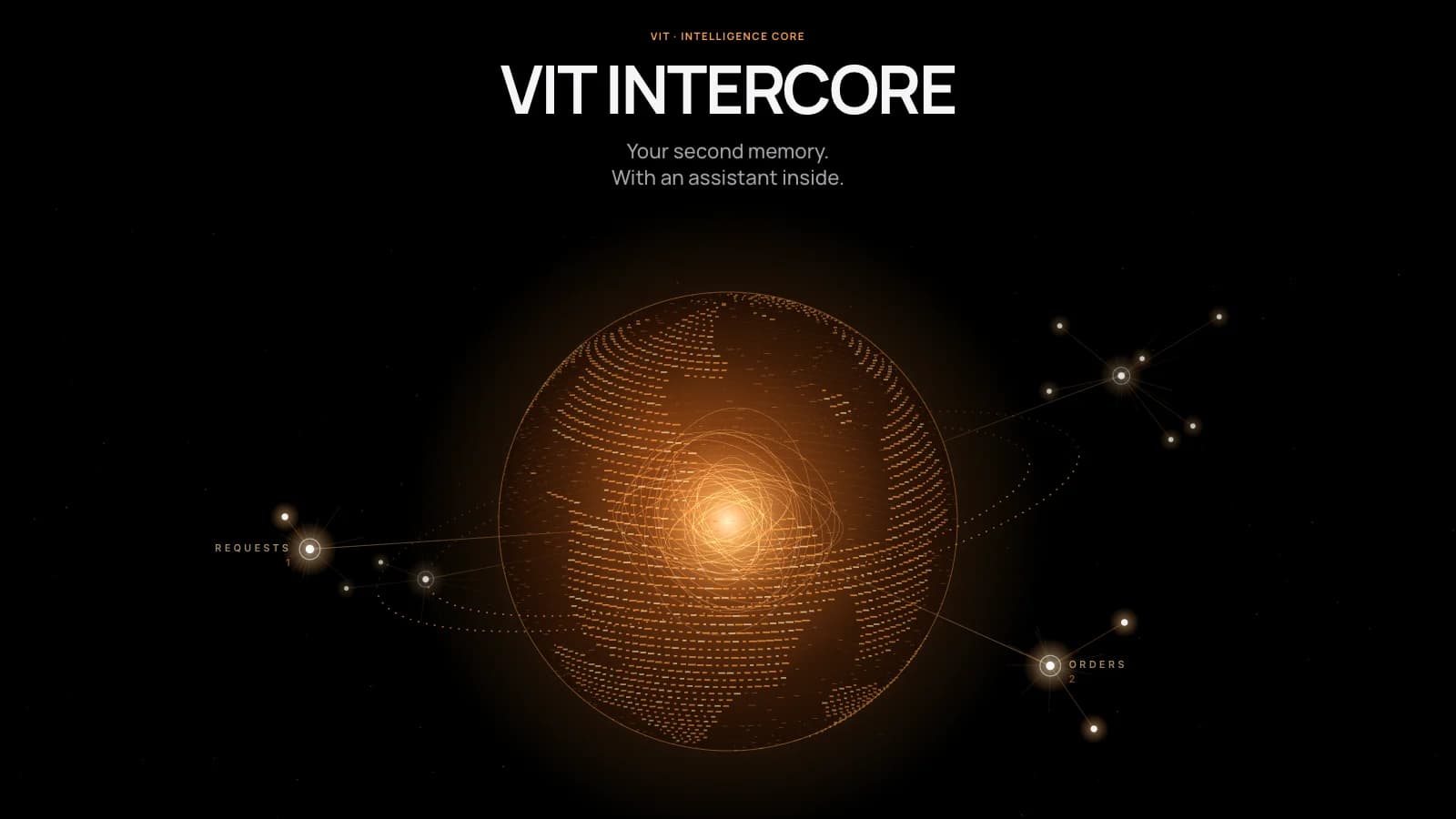
VIT INTERCORE is VITON13’s own AI assistant with memory. In the VITON ID cabinet it draws a member’s own records as a planet with a graph of nodes around a bright core. The plan costs $130 a month and is connected by request: the site charges nothing, the studio writes back and switches the core on. The full version with hand gestures stays private.
Your memory is scattered, and that costs you every day
Count the places where your own decisions live. A receipt in one inbox, a size in a chat with a seller, a brief in a document nobody opens, a saved article behind a login you forgot. None of it is lost. All of it is simply somewhere else when you need it, and the price is paid in minutes: you search, you scroll, you ask the same question twice.
An assistant does not fix that by being clever. A clever assistant with nothing to remember answers like a stranger: politely, generally, and wide of the mark. What makes help personal is memory, and memory has to be kept somewhere you can see. VIT INTERCORE starts from that end. First the memory, in one place and in plain sight. Then the assistant, placed inside it.
One planet instead of forty open tabs
Open VIT INTERCORE and there are no windows, folders or dashboards. The screen holds one object: an amber planet drawn with short strokes of light, turning slowly in the dark. Around it hangs a graph. Each bright point is a node, a single thing that is remembered, and thin threads tie the nodes into groups. You do not read a list. You look at a shape and recognise your own affairs in it.
The picture is not decoration. A list hides how much there is and how things belong together; a graph shows both at a glance. Five orders sit together as one cluster. A long run of questions grows into a visible arm. An empty side of the planet says, without a word, that a part of your life has not been brought here yet.
In the member version every group carries its name and a number: Profile, Orders, Requests, Saved, Conversations. Point at a node and the planet tells you what it holds. Under the picture the same records are printed as ordinary text, because a beautiful object should never be the only way to find out what a system knows about you.
The bright core in the middle is the assistant
At the centre of the planet there is a core: a knot of light with paths turning inside it. That is where the assistant sits. The order matters. You do not speak to a chat window that later tries to recall who you are. You speak to the middle of your own memory, and what stands around it is what the answer is made from.
Cinema imagined this kind of helper long ago and called it Jarvis: a voice that knows the house, the work and the owner. The idea was never the voice. It was the fact that nothing had to be explained twice. VIT INTERCORE is built on the same demand, an ai assistant with memory rather than a clever stranger, and it treats the memory as the product and the conversation as the way in.
Built first for the studio’s own desk
VIT INTERCORE was not designed as something to sell. VITON13 built it for its own daily work, and that version is still private. In it the planet is made of 76,000 fragments of light. The build filmed on 7 October 2026 held 387 memory nodes joined by 656 links: people, the company, systems, skills and music. An open palm in front of the camera wakes the core, a pinch turns the view, and the microphone waits for the word “Vit”.
The private version goes further than memory. It has a workbench with real depth where smart glasses and a watch are assembled step by step, by hand or by voice, and six drills that train the hand. Hand tracking runs on the computer itself with MediaPipe, and no camera frame is stored. The planet, the graph and every part are drawn in code with three.js; there are no 3D model files behind the picture.
The member version: your records, and nothing invented
From 10 October 2026 the VITON ID cabinet has a VIT INTERCORE tab in place of the earlier VIT LIVE one. The planet there belongs to the member. It is assembled from five kinds of records the account already holds: the profile, orders, requests to the studio, saved VJOURNAL stories and the questions the member put to the assistant. One record makes one node, and the counter under the planet is an honest count.
Two rules were set before the first line of code. Nothing is invented to make the planet look full: a new member sees a small graph, and it grows only with what they actually do. And the planet is private. Email and phone never become nodes, the assistant’s answers do not become nodes, and other members cannot open someone else’s core. What they can see of a person is a separate public card.
Connecting it: $130 a month, and a person on the other side
The plan costs $130 a month. There is one button, “Connect”, and it does not take money. It leaves a request, the cabinet shows “Request sent”, and the studio writes to the email of the VITON ID. Payment is agreed in that conversation. After it the studio switches the core on by hand, and the status in the cabinet changes to “Connected” with the date.
The plan is described in three words on the page: memory, brain, voice. Memory is the planet and everything in it. The brain is the core that thinks a question over, looks things up and answers to the point. The voice is its own: the core answers aloud. These three arrive together, with the subscription, and they are connected for the member by the studio, not unlocked by a script.
The free part stays free. The same tab keeps the text chat called VIT ASSISTENT, which answers from the VITON13 catalogue of products and studio packages before it turns to a language model. A member who never connects the plan still gets the planet of their records and that chat. The subscription is for people who want the core to work for them every day.
Limits we state before you pay
The cabinet version is the planet of memory with its core. It does not include the hand gestures or the workbench of the private build, and the trailer on the page shows that full build, not the cabinet. In the film the hands are scripted tracks sent through the product’s own pointer, spoken commands appear as text on screen, and personal records were replaced with demo data before filming.
Connection is not instant, because a person does it. The private build has no public demo and no download. VITON13 publishes no accuracy figures, no speed tests and no user numbers for the assistant, and this article does not supply them either. If a decision depends on a measured result, ask the studio for it in the same conversation in which the plan is agreed, and decide on the answer rather than on the picture.
Three checks before you press Connect
First, open the tab and read the list under the planet. If it is nearly empty, the first weeks will be spent filling it, and the free cabinet does that on its own as you order, ask and save. Second, write down two or three questions you ask yourself every week and cannot answer quickly. Those are the test: a second memory is worth paying for when it removes exactly that searching.
Third, decide who the core is for. A founder who lives in orders and briefs, a buyer who wants every purchase in one place, a person who simply forgets where things are: each will use it differently, and the studio will ask. Then press the button. Nothing is charged at that moment. A request is a conversation, and the planet in your cabinet is already yours either way.
Practical checklist
- Open the VIT INTERCORE tab in the VITON ID cabinet and read the list of records under the planet.
- Write down two or three questions you ask yourself every week and cannot answer quickly.
- Decide what the core is for: work, purchases or everyday memory.
- Press “Connect”: a request is sent and nothing is charged on the site.
- Agree the payment and the start date with the studio by email.
Questions and answers
What is VIT INTERCORE in one sentence?
It is VITON13’s own assistant with memory: a planet built from your records, with a core in the middle that thinks, searches that memory and answers.
How much does VIT INTERCORE cost for a member?
The plan costs $130 a month. The button in the cabinet only sends a request; the site charges nothing, and payment is agreed with the studio by email.
Which data does the planet in the cabinet show?
Only your own VITON ID records: your profile, orders, requests to the studio, saved VJOURNAL stories and the questions you asked the assistant. Email and phone never become nodes.
Can I try the full version with gestures?
No. The full version with hand gestures and a workbench is VITON13’s private build. There is a one-minute trailer filmed from its real interface, and no public demo or download.
Does the free text chat disappear after the change?
No. The VIT ASSISTENT text chat stays in the same tab and stays free. The plan adds the brain and the voice of the core to your planet.