
Answer in brief
According to Breaking The Lines' analysis, in one specific attack against Bayern, Hakimi joined a five-man attacking line; per UEFA data, he made the pass at 56:32 that led to Kvaratskhelia's goal at 56:46. The claim that the same positioning caused Bayern's later goals remains one outlet's interpretation that cannot be confirmed without video.
One episode, not a whole playing style: what is confirmed here and what is not
This piece follows one PSG attacking move against Bayern — from the turnover to the goal — using UEFA's match centre data and several independent match reports. Separately, it presents one tactical outlet's account, Breaking The Lines, of why Bayern came back: that account conflicts with how independent reports describe the next two goals, so it is attributed by name rather than treated as an established fact. The editorial team has not reviewed footage of these episodes, and the text does not claim a causal link that can only be established from video.
What happens to Hakimi's position when PSG attack with numbers
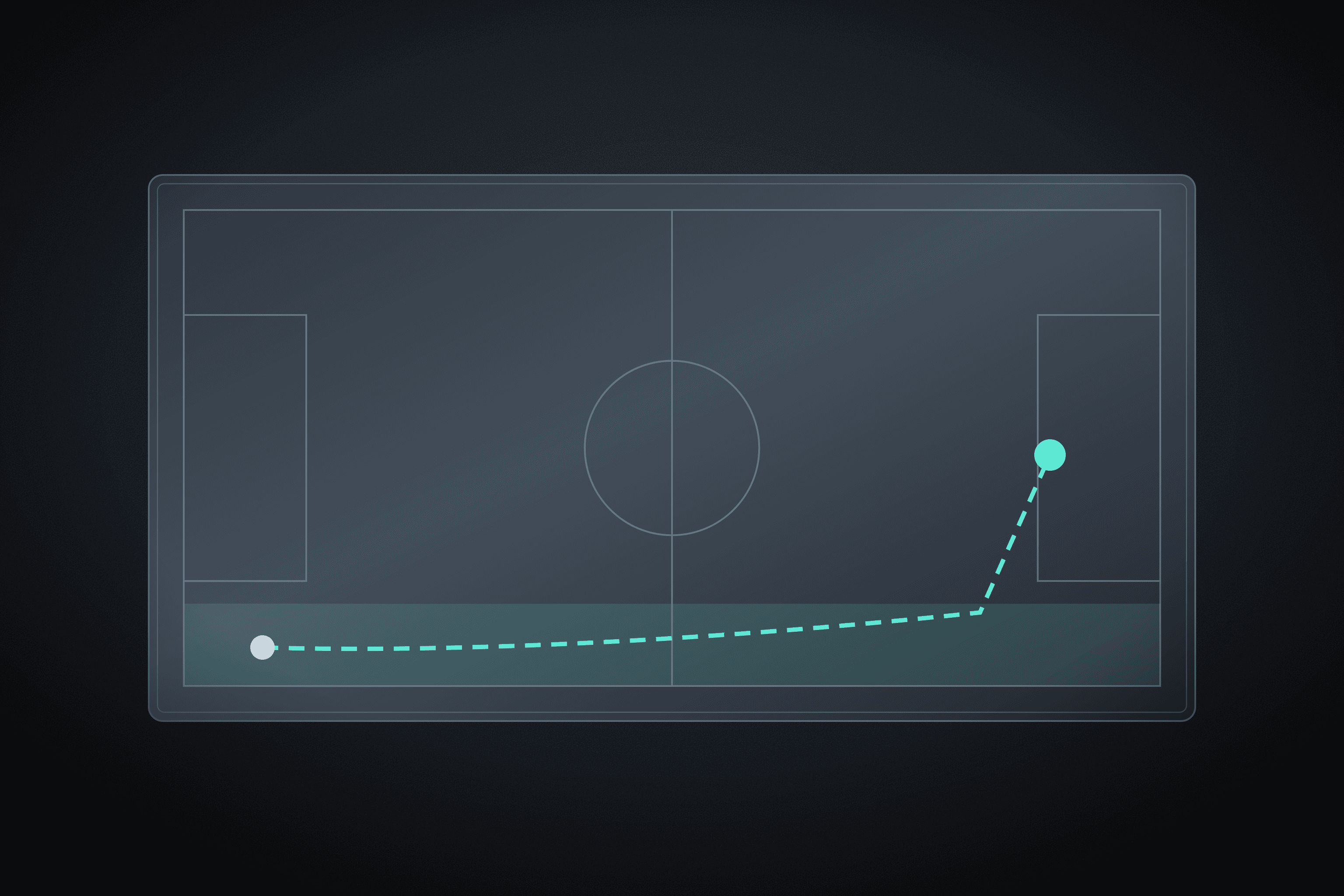
Against Bayern, Luis Enrique's PSG shifted its attacking shape from the starting 4-3-3 into a 3-2-5, with right-back Achraf Hakimi pushing into the front line as an effective fifth attacker while three defenders held the back. That is how tactical outlet Breaking The Lines describes one specific, documented episode: the Champions League semi-final between PSG and Bayern Munich on April 28, 2026. The same source calls Hakimi's advanced position a risk the club consciously accepted; neither this nor the other sources used here say whether the same restructuring appears in other PSG matches — this piece covers one documented game rather than characterising Hakimi's overall style of play. Below: the move from Bayern's turnover to Khvicha Kvaratskhelia's goal, followed by the disputed claim that the same space almost cost PSG the match.
The match behind the analysis: PSG vs Bayern, April 28, 2026
PSG won the first leg of the 2025/26 Champions League semi-final 5-4 at the Parc des Princes — per Opta Analyst, the nine goals made it the highest-scoring semi-final in European Cup/Champions League history, tying the record set by Rangers 3-6 Eintracht Frankfurt in 1959/60; CNN calls it the highest-scoring Champions League semi-final specifically. Hakimi had joined PSG from Inter on July 6, 2021, and made his 200th appearance for the club on April 3, 2026, 25 days before facing Bayern. Per the club, Hakimi is PSG's most productive defender since 2011, ahead of Marquinhos, with 66 goal involvements since 2021 (28 goals and 38 assists), nine of them in the 2024/25 Champions League campaign. According to tactical outlet Breaking The Lines' analysis, this is the match that shows how the same advanced Hakimi position produced a goal — and, by the same outlet's account, opened space for an opposing attack in that same game.
How the move built up before PSG's fourth goal
According to Breaking The Lines' analysis, Kvaratskhelia's 56th-minute goal — PSG's fourth, making it 4-2 — was the result of a specific combination, not a random run. PSG won the ball back; Désiré Doué drifted toward the centre, drawing Konrad Laimer with him, who by then had come on for full-back Alphonso Davies at the 46th minute. Hakimi, meanwhile, did not take the obvious wide route — per the source, he attacked a narrow channel that Bayern's system had not accounted for. PSG's shape at that moment was no longer 4-3-3 but 3-2-5: three defenders held back, two holding midfielders worked ahead of them, and five attacking players pushed forward, including the advanced Hakimi.
The run into the channel and Bayern's defensive hesitation
According to Breaking The Lines' analysis, Bayern defenders Dayot Upamecano and Jonathan Tah could not decide whether to step out, hold the line, or track Dembélé while Hakimi ran into the space that opened up. Hakimi received the ball in that channel in the 56th minute and played what Opta describes as a low pass into the centre, to Kvaratskhelia, who finished it for his second goal of the match, making it 4-2. CFBayernInsider's report describes the moment as Hakimi reacting sharply and threading an inviting pass into a dangerous area, without naming a minute; the competition's own data records the pass at 56:32 and the goal at 56:46. All goal, substitution and card minutes in this match are given per UEFA's match centre data.
Who covers the flank while Hakimi operates in the opposition's third
While Hakimi was forward, his defensive zone in the early part of this passage was covered not by a designated deputy but by two teammates shifting across as needed: centre-back Marquinhos moved wider toward the touchline, while Warren Zaïre-Emery dropped from midfield to cover the space in front of him. Breaking The Lines describes that cover as reactive and never fully secure — meaning it formed in response to the opponent's attack rather than being assigned to one player in advance. That description applies to the state of play in the 56th minute: in the 64th, Zaïre-Emery was substituted for Fabián Ruiz, and, per the same source, the nature of that cover changed afterward.
The disputed side of the episode: Breaking The Lines' account versus the match record
Per Breaking The Lines' assessment, the space Hakimi vacated by pushing forward became Bayern's route back into the game: the outlet writes that Luis Díaz deliberately attacked that zone, stretching Marquinhos, and calls this the reason for Bayern's comeback from 5-2 to 5-4. Independent match reports describe those two goals differently. The goal that made it 5-3, in the 65th minute, was scored by Dayot Upamecano with his head, from a Kimmich free kick delivered onto his head — not from a flank attack. The next goal, making it 5-4 in the 68th minute, was scored by Luis Díaz: running onto a Harry Kane through pass, he got ahead of Marquinhos and scored; Opta and CFBayernInsider both separately note that the goal was initially disallowed for offside and stood only after a VAR review. The independent report does not connect this episode to Hakimi's position on the pitch. By this point, Warren Zaïre-Emery — named above as the second player covering Hakimi's zone — was already off the pitch, replaced by Fabián Ruiz four minutes earlier, in the 64th minute. Whether there was a direct link between Hakimi being in the opposition's third and this specific goal can only be established from video of the episode; none of the text sources establishes that link, and this article does not claim it.
The cost of the risk: Hakimi's injury and the missed return leg
The match against Bayern cost Hakimi more than a disputed episode involving Díaz. In the same game, he suffered what club sources cited by beIN Sports and FOX Sports call a right-thigh injury, while Breaking The Lines describes it as a hamstring strain. The official match report contains no separate injury event, so the exact minute of the injury cannot be established from it; Breaking The Lines' reference to the 84th minute does not describe the moment of injury but an episode in which an already-injured Hakimi stopped a Bayern counterattack through positioning rather than pace. Hakimi played out all 90 minutes — there was no substitution in his position. Because of the injury he missed the return leg — reported even before that match by Bavarian Football Works, FOX Sports and beIN Sports; per UEFA's match centre, the second-leg semi-final was played on May 6, 2026, and its match report does not list Hakimi in either the starting eleven or on the bench. That single evening gave PSG a decisive goal for this passage of play in the 56th minute, a disputed defensive episode, and the loss of a first-team player for the next match in the tie.
A year earlier, a similar run produced a goal in another final
Hakimi joining the attack in the box is not new to the 2025/26 season. In the Champions League final on May 31, 2025, in Munich, PSG beat Inter 5-0, and Hakimi opened the scoring in the 12th minute. Per World Soccer Talk's description, the goal came from a Désiré Doué pass, and tactical outlet Coaches' Voice separately notes that Hakimi's late run into the box was decisive for the move. The 5-0 final score by itself shows that Inter could not organise a second-half comeback comparable to Bayern's a year later. None of this article's sources offers a separate tactical breakdown that would explain that difference specifically through the positional model rather than the general gap in quality between two different finals — the comparison of the two matches here is limited to the scoreline, not a conclusion about the safety of the manoeuvre itself.
Why this role cannot be treated as a proven, permanent trait of Hakimi's
The only source that analyses PSG's positional model in this match in detail describes Hakimi's advanced position as a risk the club consciously accepted, not as a mistake. That is not the same as a claim that it is only situational: Breaking The Lines does not write that the club uses this model only occasionally, and this article does not attribute that claim to it either. How often PSG shifts into a 3-2-5 with Hakimi advanced in other matches across the 2025/26 and 2026/27 seasons cannot be established from the sources used in this article — that is a limitation of this piece, not a fact about how often the manoeuvre occurs. Per UEFA data, in the final of the same Champions League campaign, on May 30, 2026, against Arsenal, Hakimi started in his usual position at right-back (No. 2) and converted his kick in the penalty shoot-out, which PSG won 4-3 after a 1-1 draw following extra time; this article's sources do not analyse PSG's shape in that match, so Hakimi's role there cannot be compared to the April 28, 2026 match on that basis. PSG's only goal in regular and extra time of that final was scored by Ousmane Dembélé from the penalty spot in the 65th minute, and UEFA named Vitinha player of the match. Neither that match nor the other sources used in this article provide material to compare how often, and in which games, PSG deploys this advanced Hakimi role — this text analyses one documented match rather than passing judgment on how frequently the manoeuvre occurs overall.
Practical checklist
- As Breaking The Lines describes the episode: the attack came in a 3-2-5 shape rather than the starting 4-3-3 — three defenders behind, two holding midfielders ahead of them, five attackers up front.
- Désiré Doué drifted inside and drew Konrad Laimer with him — Laimer had replaced Alphonso Davies on that flank at the 46th-minute break.
- Hakimi did not stay out wide; he ran into the narrow channel that opened up.
- Upamecano and Tah failed to agree in time on who should cover that zone — the source calls it a decision crisis.
- Defensive cover in that moment came from Marquinhos, who shifted across, and Zaïre-Emery, who dropped back; eight minutes after the goal, Fabián Ruiz replaced him on the pitch.
Questions and answers
Is this a permanent Hakimi role or a one-match adjustment?
The sources used in this article cannot answer either way. Breaking The Lines describes the advanced position as a risk PSG consciously accepted in this specific match, but does not say how often the club uses the same structure elsewhere. This article covers one documented match and claims neither permanence nor a one-off.
Did Hakimi score in the 2026 Champions League final against Arsenal?
Not in regular or extra time. The match finished 1-1 after extra time, and PSG's only goal in that span came from Ousmane Dembélé's 65th-minute penalty. Hakimi started the final at right-back and converted his attempt in the shoot-out, which PSG won 4-3.
Why does the breakdown of the move rely on a single tactical source?
Independent match reports — Opta, CNN, CFBayernInsider — record the score, minutes and scorers but do not walk through the sequence itself. Only Breaking The Lines provided a step-by-step read of the 56th minute, so that part of the text is explicitly attributed to it rather than presented as an editorially verified fact.