
Answer in brief
Sources confirm Doué can operate between the lines, but that doesn't mean a fixed position: across four 2026/27 starts his role changed on record from the flank to centre-forward, and in a fifth match he came on from the bench.
Désiré Doué's background, and why his play gets called ‘between the lines’
Désiré Doué was born on 3 June 2005 in Angers; he has played for PSG since August 2024, after moving from Rennes, and wears the number 14 shirt. In the 2025 Champions League final against Inter (5-0), Doué scored twice, and that same year he won the Golden Boy award as the best young footballer. PSG's official profile describes him as an ‘elusive and versatile attacking player’ (editorial translation) — that description refers to Doué's first two Ligue 1 seasons, meaning his time at Rennes, not directly to his current role at PSG.
In coverage of PSG, Doué's play is often called work ‘between the lines’ — a term that is easy to confuse with one-on-one dribbling or with a fixed position in the line-up; the two are separated below. What follows is what tactical sources say about the term specifically as applied to Doué, and a breakdown of his starting positions — documented from official UEFA data and structured ESPN data — across the first four Ligue 1 rounds and the UEFA Super Cup final of the 2026/27 season.
What tactical sources mean by playing ‘between the lines’
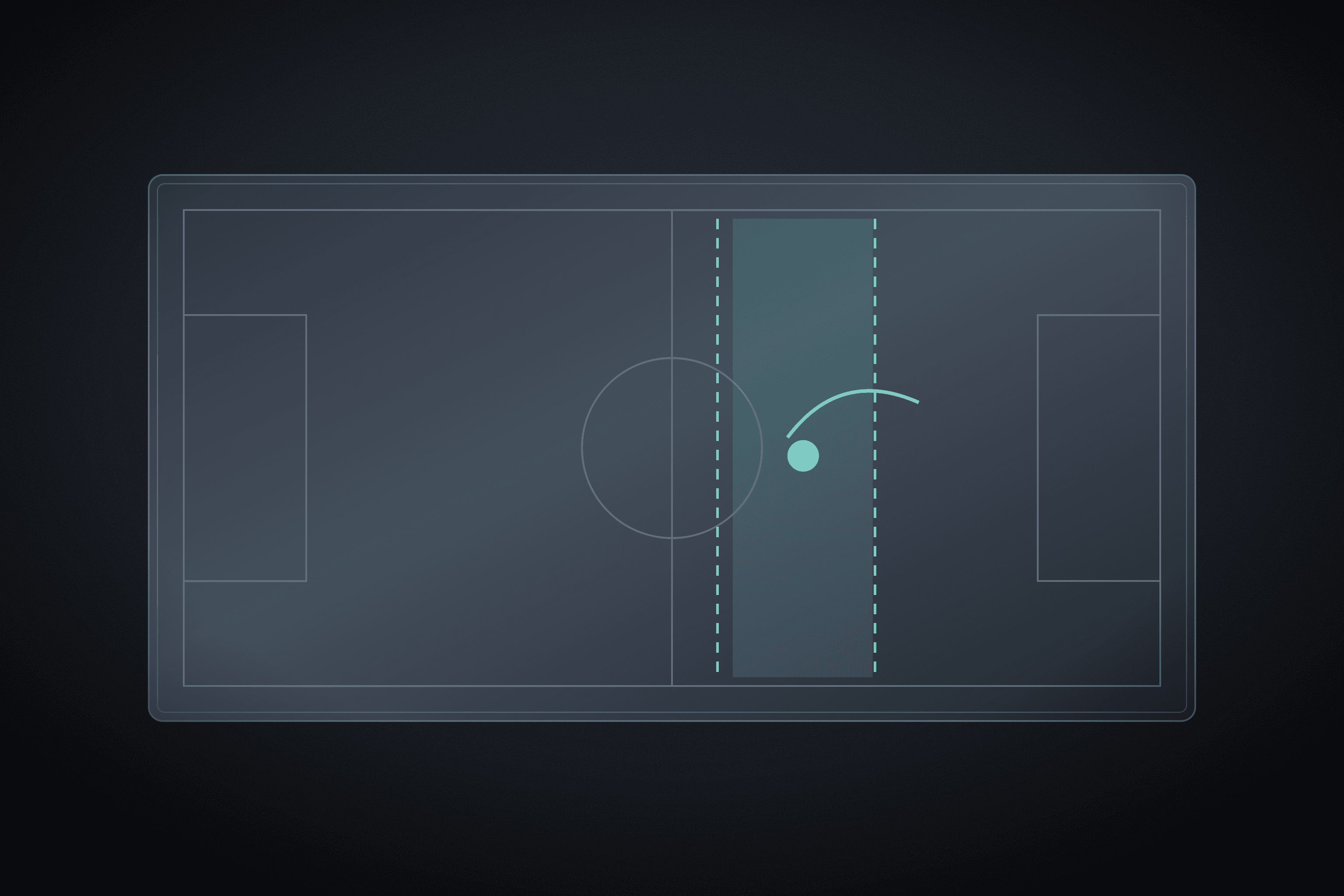
In football analysis, ‘between the lines’ describes the space between an opponent's midfield line and defensive line — a zone that, in a standard team shape, is not the personal responsibility of any one defender; this is an editorial explanation, not a quote from a source. Applied to Désiré Doué, the term is used by his player profile on Soccer Herald: according to the outlet, at PSG he ‘can operate between the lines, from the left or right flank, depending on the tactical setup’ (editorial translation). An earlier Total Football Analysis scout report confirms the same function in different words: even after shifting to a wide role, Doué, in the outlet's assessment, retained the ‘vision and technical ability’ to operate between the lines (editorial translation).
The same Soccer Herald profile describes Doué's general manner of handling the ball under pressure: he ‘can receive the ball under pressure, turn quickly and carry it through contact’ (editorial translation) — a characterization of his style overall, not an account of a reception specifically in the between-the-lines zone. Separately, the source describes not a reception but one-on-one dribbling: Doué uses short touches to shield the ball and, in the source's wording, ‘waits for the defender to shift their weight and attacks the lane that opens up,’ which makes him ‘hard to read in one-on-one duels’ (editorial translation). That is a description of dribbling, not of receiving the ball between the lines — the two should not be confused.
Doué's role per the 2024/25 scout report — and why it cannot be carried over to this season
Total Football Analysis's scout report, published on the site with the date ‘3 June 2025’ (the page's schema.org markup carries an earlier date, 6 April 2025), records that Doué's role had shifted: he ‘previously played as an eight or a ten but has moved toward a left-winger role’ (editorial translation), while retaining the ability to ‘operate effectively both wide and as a central attacking midfielder’ thanks to his vision and technical skill between the lines (editorial translation; the original uses the word ‘effectively’ without specifying ‘equally’). The same piece cites Doué's percentiles for that period — 87.0 for passes received per 90 minutes and 84.2 for progressive passes — as a sign of a player heavily involved in building attacks; the counting methodology is not disclosed in the text, so the figures are best read as that outlet's assessment for the 2024/25 season, not as a metric for the current campaign.
Carrying these conclusions over to the start of the 2026/27 season without checking would mean conflating a past nominal position with his actual position on the pitch now. Which position Doué actually occupies now is established by the records of specific matches — the next section is devoted to them.
Where Doué started across five matches at the start of the 2026/27 season
Rather than the unqualified label ‘a permanent part of the front three,’ below is a breakdown of Doué's starting positions — documented from official UEFA data and structured ESPN data — across the first four Ligue 1 rounds and the UEFA Super Cup final. It shows that both the formation and Doué's point on the pitch change from match to match, and that a pre-match line-up prediction does not always match what actually happens on the pitch.
UEFA Super Cup, 12 August — centre-forward
In the UEFA Super Cup final against Aston Villa, PSG played a 4-3-3, and, per official UEFA data and Wikipedia, Doué started as the centre-forward — between right forward Maghnes Akliouche and left forward Khvicha Kvaratskhelia. Ousmane Dembélé, Bradley Barcola and Fabián Ruiz all started that match on the bench; Dembélé came on at half-time.
Rennes, 23 August — right forward
In the opening Ligue 1 round against Rennes (2-2), PSG played a 4-3-3, and Doué started as the right forward, playing the full match without being substituted.
Lille, 28 August — left forward, substituted at half-time
In the second round against Lille (2-2), PSG again played a 4-3-3, but Doué took up the left-forward position — and was replaced by Kvaratskhelia at half-time, in the 45th minute.
Monaco, 4 September — a different shape, a different spot
In the third round against Monaco (a 1-2 defeat), PSG switched to a 4-1-2-1-2, with Doué taking the right-sided role of the two central forwards alongside Kvaratskhelia; Ferran Torres replaced him in the 63rd minute.
Brest, 13 September — bench first, then a substitution
In the fourth round against Brest (a 1-0 away win for PSG), PSG returned to a 4-3-3, but the front three that started were Torres, Kvaratskhelia and Dembélé — not Doué: a pre-match preview had predicted him in that trio, but in fact he started the match on the bench and came on for Kvaratskhelia in the 66th minute.
Across the five matches examined, Doué started four times and came on as a substitute once; his position changed from the right flank to centre-forward across different formations. The Brest case illustrates a broader rule: a pre-match line-up prediction is not the same as the record of the match actually played, and for tactical conclusions it is the record that matters.
Why zero Ligue 1 output does not cancel out Doué's involvement
By 13 September 2026, after four Ligue 1 rounds, Doué had neither a goal nor an assist in that competition — a point confirmed by the records of all four matches. A pre-match preview for the Brest game frames this as no goals or assists ‘in all competitions’ and immediately notes that Doué had both scored and assisted in the UEFA Super Cup — meaning the preview itself is talking about the season overall, not Ligue 1 alone; the Ligue 1 zero specifically is separately confirmed by the structured ESPN data for all four matches.
The absence of goals in one competition does not mean an absence of involvement in play. In the Monaco match, Doué had two first-half shots — both stopped by goalkeeper Lukas Hrádecký — and his combination with Kvaratskhelia led to an Akliouche effort off the crossbar, although by that point, per the match report, an offside flag had already been raised that would have ruled the goal out anyway. A similar principle — not confusing output with a player's functional role on the pitch — is examined by another VJOURNAL piece on how to assess a pressing forward when the goals are not coming; that piece deals with different pressing and off-the-ball metrics, but the underlying logic of the distinction is the same.
Doué's Super Cup goal and assist — what the sources actually confirm
Doué's goal in the UEFA Super Cup final against Aston Villa on 12 August 2026 put PSG ahead 2-1. Per official UEFA data, it came in the 61st minute. An Al Jazeera report drawing on AP material describes the moment as follows: Doué ran onto a pass from Ousmane Dembélé — the source does not specify what kind of pass it was — the goal was initially disallowed for offside but stood after a VAR check found that Villa defender Matty Cash had ‘marginally’ played Doué onside. Wikipedia's article on the match adds a detail: Doué received the pass from the right from substitute Dembélé and shifted it onto his left foot before shooting.
None of these sources describes which zone of the pitch, relative to the opponent's midfield and defensive lines, Doué received the ball in before that shot — so calling the moment a ‘reception between the lines,’ or conversely a ‘run in behind the defensive line,’ without watching the footage would be speculation; no such conclusion is drawn in this piece. Separately, Doué's own assist is worth noting: per Wikipedia, the final's opening goal in the 20th minute was scored by Kvaratskhelia, who received the ball from the left from Doué — that Super Cup output (a goal and an assist) is also indirectly confirmed by the preview for the Brest match. UEFA named Doué player of the match.
What text sources lack for mapping between-the-lines decisions
Everything above confirms two things: ‘between the lines’ is a phrase used by independent sources specifically for Doué's manner of play, not an editorial metaphor, and his actual position on the pitch in the 2026/27 season changes from match to match. But no source describes exactly how Doué receives the ball within specific episodes: which way his body is turned at the moment of reception, how many touches before he turns, or the exact moment a defender loses position. Match reports record the start of an episode and its outcome, not the mechanics in between — and without that, a map built from several comparable decisions cannot be constructed. That kind of analysis requires watching footage of a specific match, not another retelling of the sources.
Practical checklist
- Can operate between the lines, starting attacks from either flank — per the direct description from Soccer Herald.
- Even after a formal shift toward the flank in the 2024/25 season, retained, per Total Football Analysis's assessment, functionality both centrally and out wide — the 2026/27 season confirms this on the record: four different starting positions across four starts out of five matches.
- Able to receive the ball under pressure and continue the attack through contact — per the source's general description of his style, not an analysis of a specific between-the-lines reception.
- More detailed traits — the number of touches before turning, body orientation, the moment a defender loses position — are not described by the sources: the passage about short touches and waiting for the defender to shift weight refers, in the source, to one-on-one dribbling, not to receiving the ball between the lines.
Questions and answers
What does the phrase ‘playing between the lines’ mean?
It refers to operating in the space between an opponent's midfield line and defensive line — a zone that, in a team's shape, is not the personal responsibility of any one defender; this is an editorial explanation. Doué's player profile on Soccer Herald applies the term directly to his style of play: he ‘can operate between the lines, from the left or right flank’ (editorial translation).
How does Doué's current role differ from the left-winger role recorded by the 2024/25 scout report?
The scout report from June 2025 recorded a shift toward a left-winger role while he kept his between-the-lines function — but that is a snapshot of the 2024/25 season. Across four starts in 2026/27, Doué has appeared as right forward, left forward, one of two central forwards and centre-forward in the Super Cup, and came on from the bench in the fifth match — meaning the role is still not fixed to one flank.
Can Doué's position in PSG's front three be considered permanent?
No: based on the documented line-ups of five matches at the start of 2026/27, it changed from game to game. The Brest match is a telling case — a pre-match preview predicted Doué in the front three, but he actually started on the bench and only entered the game in the 66th minute; a line-up prediction and the actual match record do not always match, and for tactical conclusions it is the record that matters.
Does the lack of goals and assists in Ligue 1 mean Doué is not useful to the team?
No: output and functional role on the pitch are different measures. As of 13 September 2026, Doué had no goal or assist in Ligue 1 this season, but, for example, in the Monaco match he had two shots on goal, and his combination with Kvaratskhelia led to Akliouche's effort off the crossbar.