
Answer in brief
Henri Kagan and Kenso Soai won the 2026 Nobel Prize in Chemistry for work on nonlinear effects and autocatalysis in asymmetric organic synthesis. Announced on 7 October, the award recognises earlier research on molecular handedness; it does not approve a new medicine.
Who won the chemistry Nobel in 2026?
Henri Kagan and Kenso Soai have received the 2026 chemistry Nobel, according to announcements published on 7 October by the French Academy of Sciences and ACS’s Chemical & Engineering News. The recognised work concerns nonlinear effects and autocatalysis in asymmetric organic synthesis.
Those terms describe ways of controlling which three-dimensional form a reaction produces. The announcement recognises a research history. It does not mean a new drug was discovered that morning, or that a treatment has passed clinical trials. Understanding the distinction helps explain both the prize’s scientific reach and its limits.
What does molecular chirality mean?
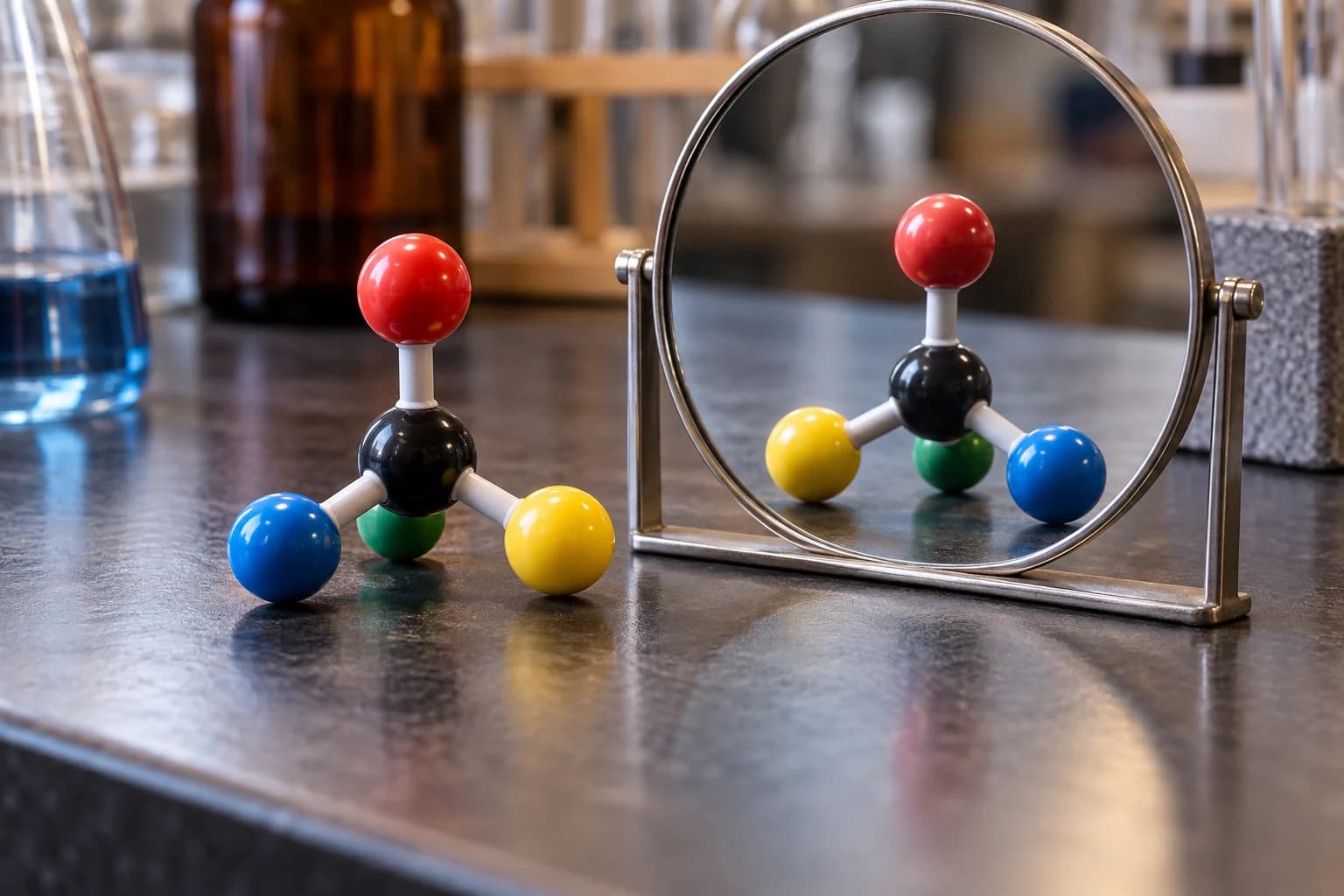
Hold your hands together with the palms facing the same direction. Their outlines resemble one another, but rotating one does not make it fit perfectly over the other. Some molecules have a comparable property: the same atoms and connections can form structures that are nonsuperimposable mirror images.
These paired forms are called enantiomers. A flat chemical formula can therefore leave out information that matters in a three-dimensional encounter. A biological binding site also has a shape. The useful question is whether each form fits and behaves alike, rather than whether their ingredient lists match.
How can a small imbalance grow during synthesis?
Asymmetric synthesis aims to favour one handed form instead of producing both equally. A catalyst helps steer the reaction without simply being consumed as an ordinary ingredient. Its own handedness and the product’s handedness need not follow a straightforward one-to-one relationship.
Kagan’s nonlinear-effects research and Soai’s asymmetric autocatalysis address that relationship in different ways. In autocatalysis, a reaction product helps promote further production. Think of amplification, not of molecules making conscious choices. A small initial imbalance can become a much stronger preference under suitable reaction conditions; that is a chemical mechanism, not a universal rule for every reaction.
Does controlling chirality make a medicine safe?
FDA guidance on stereoisomeric drugs explains why developers need to identify and study the forms present. Enantiomers can differ in how the body handles them and in biological effects. An ability to manufacture a selected form answers a production question, but leaves therapeutic questions to investigation.
Purity, activity, dose and safety are separate parts of the evidence. It would be misleading to declare every single-enantiomer medicine superior to every mixture. The appropriate comparison concerns the particular substance and indication, supported by relevant experiments and clinical results rather than by the Nobel label alone.
How to assess a claim about mirror-image molecules
When a chemistry story describes an enriched product, look for three pieces of information: the molecular forms being compared, the reaction conditions and the measure of selectivity. A diagram should show spatial arrangement, not just two differently coloured versions of an identical flat structure.
Then identify the result’s level. A synthesis demonstration, an explanation of amplification and a clinical benefit are different achievements. This year’s award makes an important body of chemistry easier to discuss, but the most useful reader takeaway is precise: controlling shape can be essential, while knowing how to control it does not settle every question about what the resulting molecule does.
Questions and answers
Who won the 2026 Nobel Prize in Chemistry, and why?
Henri Kagan and Kenso Soai won the 2026 Nobel Prize in Chemistry, according to the French Academy of Sciences and ACS reporting dated 7 October. Their work concerns nonlinear effects and autocatalysis in asymmetric organic synthesis. The award recognises a body of research; it does not certify a particular medicine or consumer product.
Do mirror-image molecules always behave differently in the body?
Not every pair will behave differently in every setting. The distinction becomes relevant when the surrounding system is itself sensitive to three-dimensional arrangement, as biological binding sites often are. Each substance needs appropriate testing. Sharing a formula is insufficient to establish identical biological effects, but opposite handedness alone does not tell you which form is useful or harmful.
Does the 2026 chemistry Nobel mean a new treatment is available?
No treatment approval follows automatically from a chemistry prize. Selective synthesis can help researchers obtain and examine a chosen molecular form, which is valuable during development. Availability for patients requires separate evidence and the applicable regulatory process. The announcements discussed here establish the award and research subject, not a new indication, dose or clinical benefit.