
Answer in brief
The thorium-229 clock uses feedback from a nuclear transition to correct its laser frequency. In the study published on 7 October 2026, TU Wien reports stable operation for more than 24 hours without intervention. That duration does not establish a new accuracy record.
What changed in the 2026 thorium clock experiment?
A Nature paper published on 7 October reports a thorium-229 nuclear clock with a feedback loop. TU Wien’s accompanying announcement describes stable operation for more than 24 hours without intervention. The development is that the nuclear reference now steers the laser, instead of merely being examined using a reference supplied elsewhere.
A clock needs more than a promising transition. It must repeatedly interrogate that transition and keep its working oscillator aligned with it. This makes the result a useful step from observing a physical property towards operating a timekeeping system. It remains a laboratory experiment with supporting equipment.
How is a nuclear clock different from an atomic clock?
An ordinary clock counts recurring events: swings, electrical oscillations or another repeatable process. In an optical clock, a laser is compared with a sharply defined transition. The thorium approach uses a transition in the atomic nucleus, rather than the electronic transition used in an optical atomic reference.
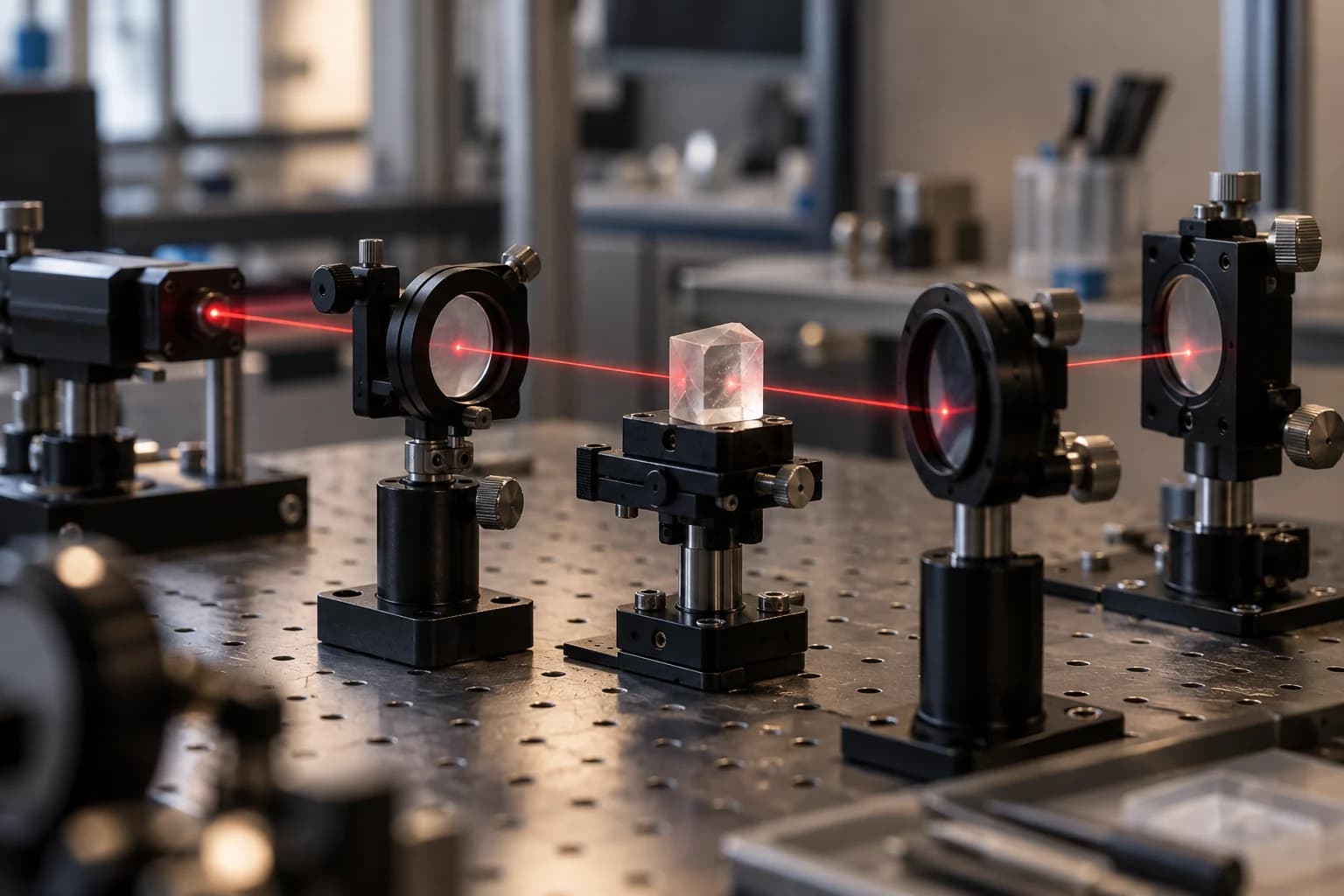
The crystal therefore is not a tiny mechanical clock visibly ticking on a bench. Its role is to provide something against which the laser frequency can be checked. The experiment still needs optics, measurements and control electronics. Calling it nuclear identifies the reference; it does not mean that a nuclear reactor powers each tick.
How does laser feedback stabilise the clock?
Imagine trying to keep a musical note aligned with a tuning reference while the instrument slowly drifts. Listening once would establish agreement only at that moment. A feedback loop checks repeatedly and applies a correction when the reference and the working signal diverge.
That analogy describes the control task, not the experiment’s exact circuitry. In this clock the measured response of the thorium transition guides the correction. The distinction is between a laser maintained by an unrelated reference and one steered by the transition being used for timekeeping. A successful loop must respond to useful information rather than simply chase every fluctuation.
Does a longer runtime mean greater accuracy?
A run lasting beyond a day tells us that the system can maintain operation over that interval. Stability concerns fluctuations over a defined period. Accuracy concerns how closely the reported frequency corresponds to the intended reference after systematic effects are accounted for.
Those properties should not be collapsed into a single claim that the device is the best clock. A long run can be valuable without establishing superior accuracy. Meaningful comparisons require the same kind of measure, a stated averaging interval and an uncertainty budget. The verified announcement does not justify saying this prototype outperforms the best existing optical atomic clocks.
What should a future clock comparison measure?
For a later clock result, ask what acts as the reference, how the feedback is implemented and which disturbances have been assessed. Then identify whether the reported improvement concerns continuous operation, stability, systematic uncertainty or sensitivity to a particular physical effect.
A portable product or a replacement for national time standards would require evidence beyond this demonstration. The present result is narrower and still significant: a nuclear transition participates in running the clock itself. Reading that precise achievement gives the experiment credit without attaching an unsupported record or an imagined deployment date.
Questions and answers
How is a thorium nuclear clock different from an atomic clock?
The distinction concerns the reference transition. Optical atomic clocks use electronic transitions, whereas this approach uses a transition in thorium-229 nuclei. Both still require equipment to interrogate the reference and generate a usable signal. The word nuclear therefore does not imply a miniature reactor, a mechanical tick inside the nucleus or a clock requiring no external apparatus.
How does self-stabilisation work in the 2026 thorium clock?
It means feedback from the nuclear transition steers the laser used by the clock. If the measured response indicates a frequency deviation, the control system can adjust the working signal. This differs from only measuring a transition using a laser tied to another reference. Self-stabilising does not mean immune to disturbance or capable of operating without laboratory support.
Does running for more than 24 hours prove greater accuracy?
No. Operation over an interval, short-term fluctuations and systematic accuracy are separate properties. A day-long run supports a claim about sustained function, not an automatic ranking against other clocks. A valid accuracy comparison requires defined measures and assessed uncertainties. The article therefore reports the operating milestone without claiming a record over the best optical atomic clocks.