
Answer in brief
A four-person crew is preparing for the station. A completed rehearsal supports readiness, while launch, docking and research outcomes remain future milestones.
The scheduled moment is still ahead
NASA lists Crew-13 for 11:10 a.m. Eastern daylight time on October 1, or 18:10 in Moscow. The Canadian Space Agency calls this the earliest launch opportunity, and notes that weather can shift it. At 01:35 Moscow the same day, the correct description is a target, not a launch outcome. The four-person flight is planned to take Jessica Watkins, Luke Delaney, Joshua Kutryk and Sergey Teteryatnikov to the International Space Station.
What the preparation establishes
Canada reports that the crew began quarantine on September 17, reached Kennedy Space Center on September 26 and completed a dry dress rehearsal on September 29. The rocket and spacecraft had been rolled to the pad and the launch vehicle had undergone a static-fire test. Those steps let teams check procedures and vehicle systems before flight. None substitutes for the final launch decision, ascent or docking, each of which has its own operational checks.
The research promise depends on time in orbit
The agency expects roughly six months aboard the station, where Kutryk is due to conduct experiments and technology demonstrations alongside the wider crew’s work. Canada says this would be its first astronaut flight through NASA’s Commercial Crew Program. That institutional milestone is meaningful if the planned mission proceeds, but a launch alone produces no experimental result. Investigations require installed hardware, functioning protocols, samples or measurements, and later analysis.
What to watch after the countdown: NASA lists Crew-13 for 11:10 a.m. Eastern daylight time…
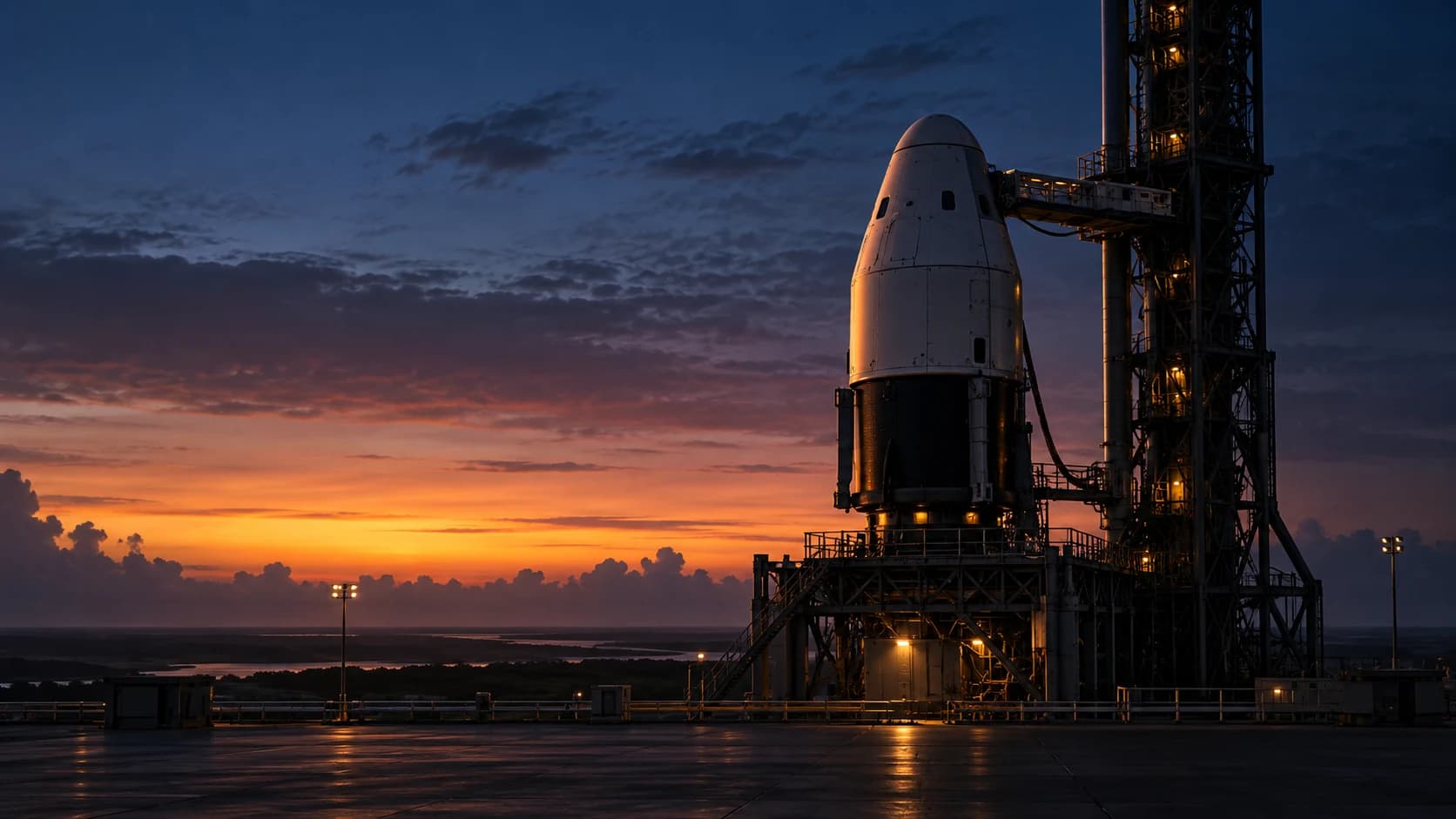
The first verifiable milestones are NASA’s launch confirmation, arrival and docking, followed by station handover. Specific science results will need named investigations and published data rather than a generic promise that space research helps life on Earth. A delay should be reported as a schedule change, not a failed experiment. The image accompanying this preview is an invented, unmarked pad scene and cannot serve as evidence of the actual vehicle or launch.
Questions and answers
Has Crew-13 launched?
No. At this article’s 01:35 Moscow evidence cutoff on October 1, the target launch time was still ahead and could change.
Does a successful rehearsal prove the science mission will succeed?
No. It tests prelaunch procedures; launch, docking, experiment operations and data analysis are separate steps.