
Answer in brief
Self-study works when it follows how memory works: spread reviews of new words over several days, test yourself instead of rereading, and read and listen to material you mostly understand. Add a little speaking and writing every day. Speed comes from hours of practice, not tricks, and the one thing self-study lacks is feedback on how you speak and write.
Learning English by yourself means running your own lessons
Most people who search how to learn english by yourself already own a textbook, an app and good intentions. What they miss is a method that survives a busy week. Self-study means you run the lessons: you choose the material, plan the reviews, check the answers and notice when you are stuck. That is many roles for one person, but memory research gives fairly clear rules for them.
Start with a map. The Common European Framework of Reference for Languages, published by the Council of Europe in 2001, splits ability into six levels from A1 to C2. As the Wikipedia article on the framework puts it, for each level it describes what a learner should be able to do in listening, reading, writing and speaking. At A2, for example, you can describe your background and immediate surroundings in simple terms. Aim for the next level, not the last one.
Spaced repetition: why new English words need several short visits
In 2006 Nicholas Cepeda and colleagues pooled 839 assessments of spaced practice from 317 experiments in 184 articles and published the review in Psychological Bulletin. Across all the retention intervals they examined, people recalled 47.3% of the material after spaced study and 36.7% after massed study. The authors conclude that separating sessions by at least one day is extremely useful for long-term retention.
They add a detail that matters for a language: the best gap between reviews grows with how long you need to remember, and for material kept for months or years it is likely well over a day. A workable rhythm is the next day, a few days later, then a week or two, each successful recall earning a longer pause.
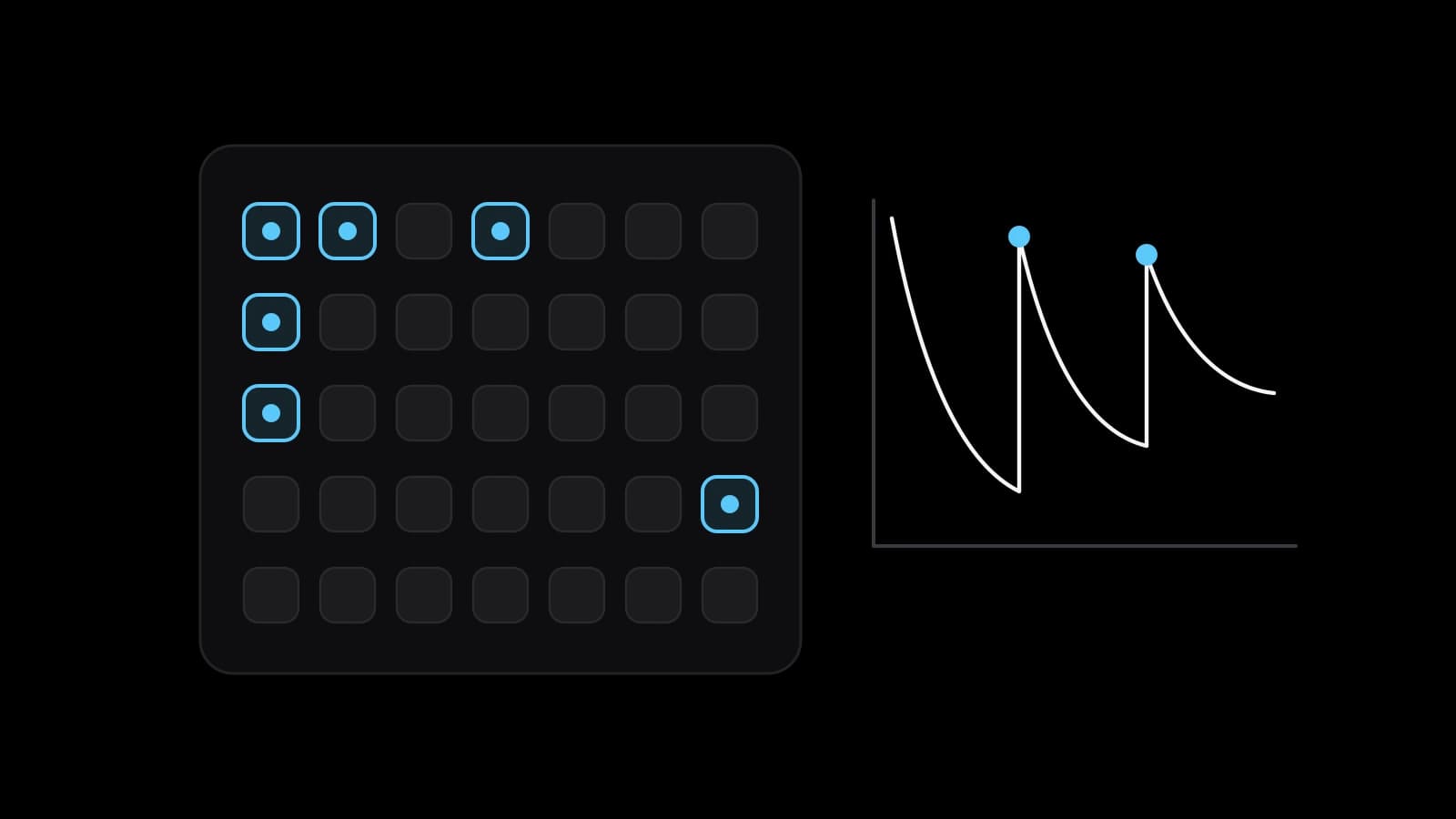
Nobody has to calculate those gaps by hand. The open-source project FSRS, short for Free Spaced Repetition Scheduler, describes itself as a modern algorithm that learns your memory patterns and schedules reviews. It tracks each item with three variables: difficulty, stability and retrievability, the probability of recalling it at a given moment. The project’s guide calls a desired retention between 70% and 97% reasonable and warns that a higher target means more reviews every day.
Recall English from memory instead of rereading the page
The second rule concerns what you do during a review. In a 2006 paper in Psychological Science, Henry Roediger and Jeffrey Karpicke had students read short prose passages and then either reread them or write down all they could remember, without feedback. After five minutes the rereaders led, 81% against 75%; after a week the tested group recalled 56% and the rereaders 42%. In a second experiment, four readings left 40% after a week and one reading with three recall attempts left 61%, though the repeat readers felt more confident.
That confidence is the trap of rereading a textbook: the page looks familiar, so it seems learned. For English, turn every review into a small test. Cover the translation and say the word, then check. Build the English version of a sentence from your own language before looking at the original, and retell yesterday’s text in three sentences without opening it. All of this is harder than reading, and that effort is what the experiments rewarded.
Reading and listening a little above your English level
Drills for words and grammar are only half the diet. The linguist Stephen Krashen argued, in hypotheses developed in the 1970s and 1980s, that a language is acquired by understanding messages in it. The Wikipedia summary of his input hypothesis calls the right material i+1: i is your current stage and +1 the next one. The input must be comprehensible, because noise you cannot follow teaches little. Some researchers criticise the theory as hard to test, so treat it as a useful idea, not a law.
Choose texts and audio where you follow the story without a dictionary and meet only a handful of new words per page: graded readers, news written for learners, podcasts at your level, series with English subtitles. Play an episode twice, once for meaning and once with the transcript. If you need the dictionary on every line, the material is too hard, so step down and return to it in a month.
Speaking English without a partner: shadowing and recordings
Speaking worries self-learners most, yet it offers more options than they expect. Shadowing is the best known. According to Wikipedia, speech shadowing was created as a research technique by the Leningrad group led by Ludmilla Chistovich and Valerij Kozhevnikov in the late 1950s: people repeat speech as they hear it, with a slight delay. Language learners borrowed it to practise speaking, and the same article links that use to greater accuracy in pronunciation and pitch.
Take a short recording with a transcript and read the transcript once. Then play the audio and speak a fraction of a second behind the speaker, copying the rhythm, the stress and the rise and fall of the voice. Work on one minute at a time until it feels easy, then record yourself on the phone and play it next to the original. The difference you hear is tomorrow’s homework.
The second habit is talking to yourself on purpose: describe what you do while cooking, plan tomorrow out loud, retell a film in two minutes. The linguist Merrill Swain proposed that producing language makes learners notice the gap between what they want to say and what they are able to say. Each time a missing word stops you, write it down for the next review. A notebook of such gaps beats any generic word list.
Writing short English texts that move words into active use
Writing is speaking slowed down, which suits a learner working alone. The framework sets a modest goal for B1: a learner can produce simple connected text on familiar topics and describe experiences and events, dreams, hopes and ambitions. For a daily habit, five to eight sentences about your day, your work or a plan, using two or three words from this week’s reviews, are enough, and short texts finished daily beat a long essay that never gets written.
Here self-study meets its limit. In Swain’s account, output also tests hypotheses: each sentence is a guess about the language, and feedback from the person you talk to shows whether it was right. Alone you get no such reply. Model answers, a learner’s dictionary and rewriting the paragraph a week later narrow the gap. Still, a reader who sees your text and hears you speak catches errors you cannot see.
How fast English comes depends on hours, not tricks
People also search how to learn english fast, and the honest answer is a number of hours. The Wikipedia article on the CEFR collects estimates from educational bodies: for English, Cambridge Assessment puts the cumulative hours of instruction at 180–200 for A2, 350–400 for B1 and 500–600 for B2, counted from zero. The article notes that these figures assume learners whose native language is European. They describe hours of instruction, and your own pace can differ either way.
Do the arithmetic before believing any promise. An hour a day is 365 hours a year, which reaches the B1 range only if those hours are real work. Spacing and self-testing make each hour count for more; they do not turn a hundred hours into five hundred. What matters is a routine that survives bad weeks: a fixed moment of the day, a ten-minute minimum for the worst days, and a simple table of minutes that shows within a month whether the plan matches the numbers.
What to practise alone this week and what an English course adds
This week you can start without buying anything. Make a review deck of the twenty words you actually need, go through it daily and test yourself instead of rereading. Pick one text and one recording a little above your level. Shadow a minute of speech every day, record yourself on the first and the seventh day, and write five sentences each evening. By Sunday you will know which parts were easy to keep and which you skipped.
A structured course takes the planning off your hands. VITON13 SCHOOL runs the online course “English in 113 Days” for Russian speakers: every explanation is in Russian, so it suits readers who read Russian. It has 113 levels, one a day. Each brings 13 new words with sound, transcription and an example, a short grammar rule with the typical mistake of Russian speakers, a short text with translation and three questions, dictation and phrase building, a short piece of your own writing with a model answer, and a mini-game.
Words come back through FSRS spaced repetition, and the lessons make you recall rather than reread. The levels follow the CEFR, covering the core of A1 to B2 and opening a bridge to C1; the course does not promise C1 or native-like speech, and IELTS and TOEFL iBT need their own preparation. The browser voices the words and, where it can recognise speech, checks your pronunciation. The first three levels are free, even without signing in. Either way, how to learn english by yourself comes down to hours you can keep.
Practical checklist
- Choose the next CEFR level as your target and write down what it lets you do.
- Review new words over several days on a schedule instead of cramming them in one sitting.
- Turn each review into a test: cover the translation and recall the word before checking.
- Shadow one minute of English audio a day and record yourself once a week to compare.
- Log study minutes in a table and compare the monthly total with the hours your target level needs.
Questions and answers
Can you really learn English by yourself without a teacher?
Much of it, yes: vocabulary, grammar, reading and listening respond well to spaced reviews, self-testing and regular input. The weak spot is feedback on speaking and writing, because nobody tells you when a sentence sounds wrong. Model answers, recordings and occasional checks by another person narrow that gap.
How many new English words a day should a self-learner take on?
There is no single right number, and the reviews matter more than the new words. Every new word adds future reviews, so the right pace is one you can still review the next day and the following week. If the daily review takes longer than the time you have, slow down the new words for a while.
Is rereading my English notes a waste of time?
Not a waste, but a weak use of time. In Roediger and Karpicke’s experiments, rereading helped on a test five minutes later and then lost clearly after a week to recalling from memory. Read once, close the notes, try to reproduce the main points, and only then check.
How long does it take to reach B1 in English on your own?
Cambridge Assessment’s estimate, quoted in the Wikipedia article on the CEFR, is 350–400 cumulative hours of instruction from zero. Self-study hours are not identical to lessons, so treat the figure as a guide: at an hour a day it means roughly a year of steady work.
Does shadowing help English pronunciation if nobody corrects me?
It helps you copy rhythm, stress and intonation from a model speaker, which is the part of pronunciation a recording can teach. Record yourself and compare with the original to hear the difference. Sounds you cannot yet hear as different may still need a teacher or a speech-recognition check.