
Answer in brief
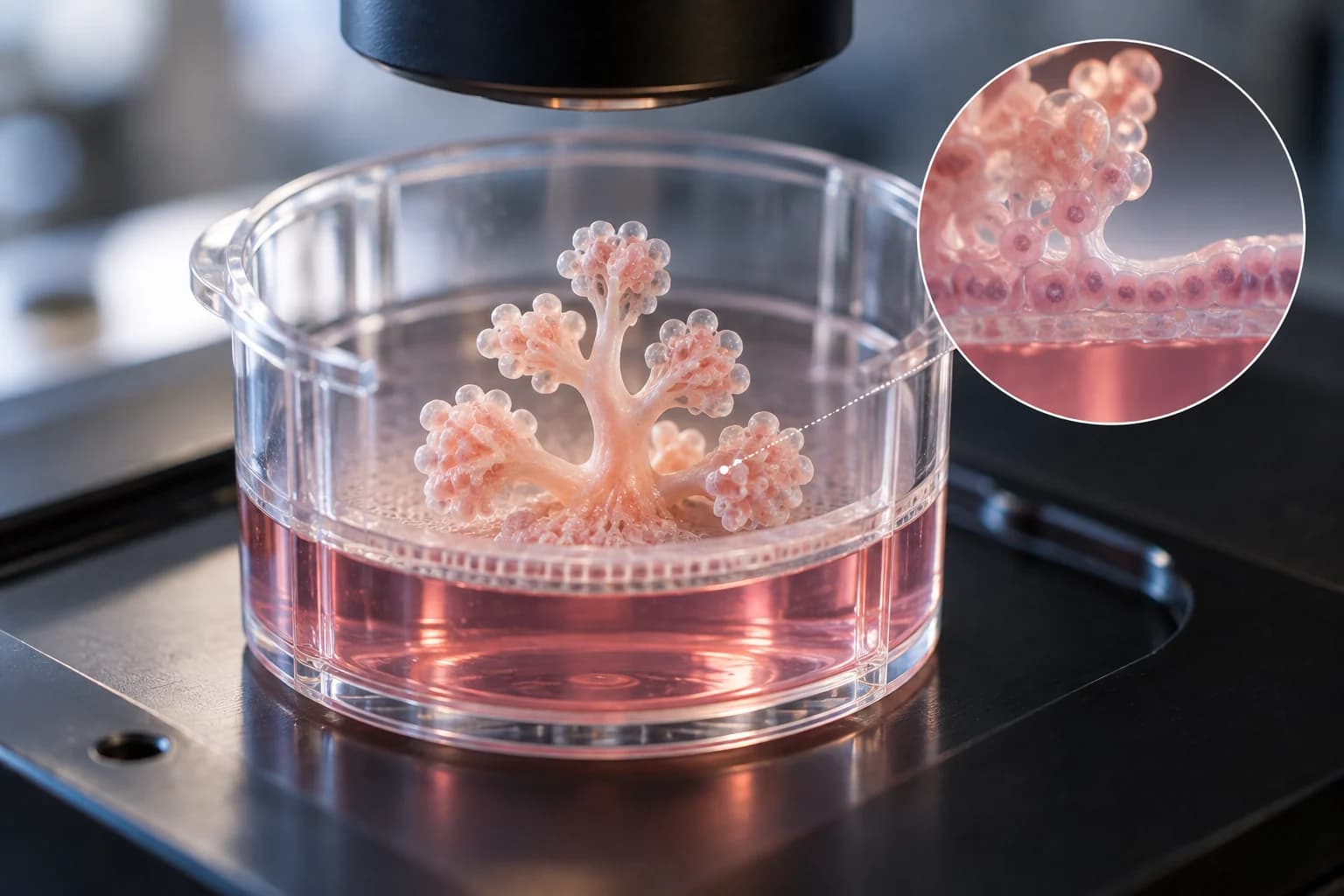
The lung organoids in the 7 October 2026 Nature study retain resident immune cells, allowing researchers to examine local antiviral responses in culture. NIH reports tissue from more than 220 donors. The model is not a replacement lung, and its experiments do not establish vaccine efficacy in people.
What are the lung organoids in the 2026 study?
A Nature study announced by NIH on 7 October describes human lung organoids that retain resident immune cells. NIH reports tissue supplied by more than 220 volunteers and cultures maintained for months. The researchers examined antiviral responses within this donor-derived laboratory system.
An organoid is an experimental tissue model, not a full organ ready for transplantation. The valuable feature here is the ability to examine lung tissue alongside immune populations already present within it. That brings an important interaction into view without turning a culture dish into a complete human body or a clinical trial.
How does an air–liquid interface support the model?
The study uses three-dimensional cultures at an air–liquid interface. In practical terms, a tissue model needs access to suitable support while preserving conditions relevant to the surface being studied. This arrangement helps investigators examine interactions at a respiratory tissue interface rather than only isolated cells in a liquid suspension.
The phrase describes the culture design, not a claim that the miniature tissue performs every function of breathing. A useful model preserves the features required for its research question. Understanding which components are present matters more than whether its appearance resembles an entire lung in a publicity illustration.
Why keep resident immune cells in lung organoids?
Some immune cells reside in tissues instead of merely passing through them. Their presence allows an experiment to investigate responses that occur at the site of infection. The study reports virus-specific T-cell responses and laboratory experiments in which prior stimulation with viral fragments reduced subsequent infection.
That provides a way to examine local immune memory. It does not show that immunity everywhere in the body is unnecessary. A tissue culture excludes many influences that a living person experiences, including interactions with other organs. The model’s strength is a defined question under controlled conditions; those boundaries are also why its findings require careful interpretation.
Can an organoid experiment prove vaccine efficacy?
Giving a culture viral fragments before infection can test whether a response changes within that system. It is not equivalent to administering a vaccine to people, determining a clinical dose or measuring protection across a population. Similar words can describe very different levels of evidence.
An intervention would need further evaluation for its intended use. Effectiveness, safety and the durability of protection cannot all be established by one organoid experiment. The findings supply a research platform and a rationale for investigation. They should not be turned into a headline claiming an approved nasal vaccine, an available treatment or guaranteed protection from respiratory disease.
How to assess results from this lung model
Ask which donor material was used, which cells persisted and what the experiment measured. A reduction in infection within a culture is different from fewer symptoms, fewer hospital admissions or better survival in patients. Each outcome requires evidence suited to that outcome.
Then check whether the comparison concerns the same conditions and whether the proposed application lies within the model’s scope. Human tissue models may complement other research and may replace some evaluations, but no one platform answers every question. The useful advance is a more informative way to study local lung immunity, with the experimental boundary kept visible.
Questions and answers
Are lung organoids with immune cells complete replacement lungs?
No. They are donor-derived tissue models used for laboratory research. Their value is in preserving relevant tissue structures and immune populations for a defined question. They do not constitute complete lungs suitable for implantation, nor do the reported experiments establish a transplant treatment. A convincing image of branching tissue should not be mistaken for evidence of a fully functional organ.
Why retain immune cells in a human lung organoid?
Keeping resident immune cells allows researchers to examine how the tissue and its local defences interact during infection. A response observed in isolated tissue may otherwise miss those relationships. The approach still does not represent the entire immune system or every organ. It is useful because it studies a particular interaction, not because it reproduces all human biology.
Do the 2026 lung organoid experiments prove that a local vaccine works?
They show responses in a laboratory model and support further investigation of local vaccination strategies. They do not demonstrate clinical efficacy, establish an approved product or determine how a vaccine should be used in people. A culture experiment and a human trial address different questions. Protection, safety and lasting benefit need additional evidence appropriate to the intended intervention.