
Nine discs over the Cascades
On 24 June 1947, shortly before three in the afternoon, amateur pilot Kenneth Arnold was flying his own plane from Chehalis to Boise. Above the Cascade Range he saw nine gleaming objects in a chain, dipping and climbing between the peaks. He told a reporter in Pendleton that they moved “like a saucer would if you skipped it across the water.”
Note what he compared to a saucer: the way they moved, not their shape. Newspapers took him literally, and two days later headlines about “mystery discs” ran across the country. By 8 July the Army announced it had found the wreckage of a disc near Roswell, and the next day it withdrew the claim: the debris belonged to a balloon.
Official explanations came later. The Air Force concluded that Arnold may have mistaken a mirage or lens-shaped clouds over the mountains for discs. He himself described shining, metallic craft. The argument had no wreckage and no recordings behind it, and it launched the whole modern history of UFOs.
What a UFO is, and why officials now say UAP
A UFO is an unidentified flying object: any sight an observer could not explain. The word says nothing about what the thing is, yet in everyday speech “unidentified” instantly turns into “alien.” American agencies now write UAP, “unidentified anomalous phenomena,” and the term covers not just the sky but space and the sea.
So what do we know? No official investigation has confirmed that a single case involved extraterrestrial technology. The Air Force’s Project Blue Book collected 12,618 reports, and 701 stayed unexplained. In 2021 US intelligence reviewed 144 cases and confidently explained one: a deflating balloon. In 80 of those 144 cases several sensors recorded the object, and those are the files that make it hard to dismiss everything as imagination. The Pentagon’s 2024 historical report found no evidence of extraterrestrial technology.
But “not explained” does not mean “alien.” Most often analysts simply lack data: a blurry video, one dot on a radar, one witness’s story. The loudest stories live in exactly that gap, because an empty spot on the map always begs to be settled.
2026: the archives open, the comet leaves
On 8 May 2026 the Pentagon launched a public database called PURSUE and posted the first batch of declassified UFO material: photographs, video, accounts from service members, and photos and transcripts from the Apollo lunar missions. Six batches had appeared by 18 September, several hundred files in all. The official wording is careful: these are “unresolved cases,” not proof, and people may draw their own conclusions.
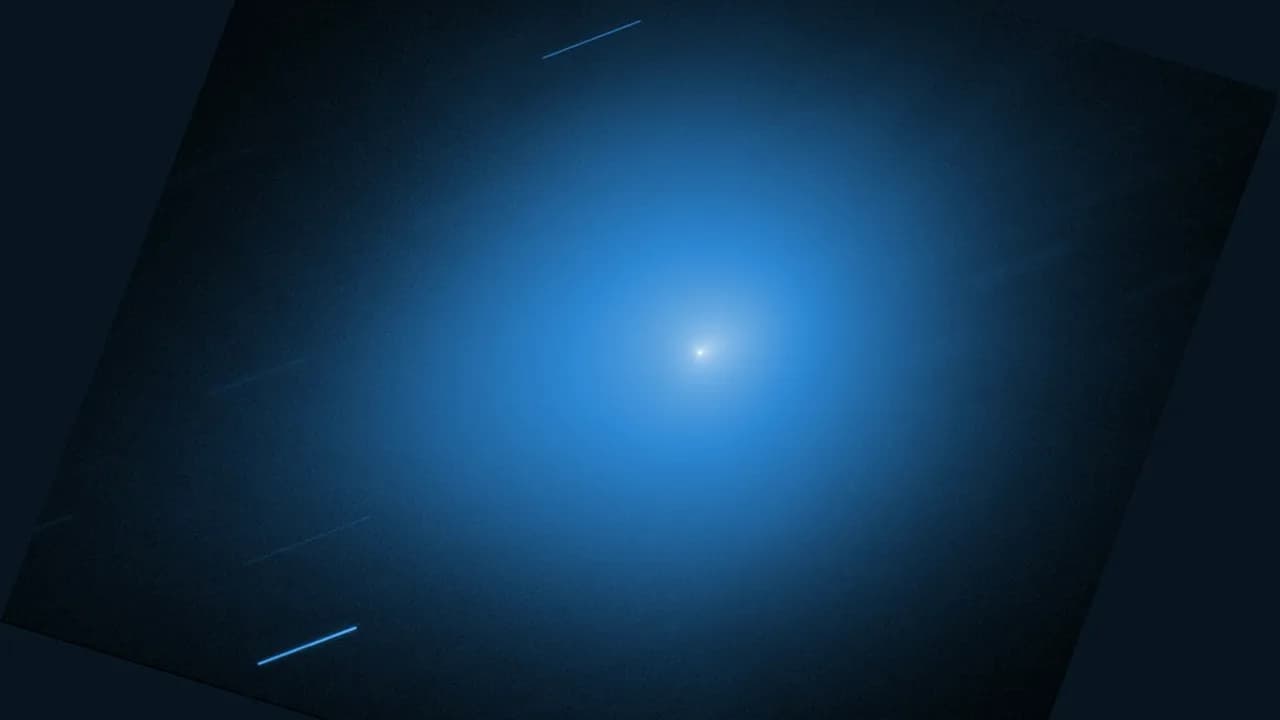
At the same time a real interstellar visitor was crossing the Solar System: 3I/ATLAS, only the third object from beyond it ever found, discovered on 1 July 2025. In July 2025 Harvard astrophysicist Avi Loeb and co-authors published a paper allowing that it might be technological. NASA, the Hubble and Webb telescopes and a radio telescope run by the SETI Institute saw a comet: an unusual one, very ancient, but a comet.
The movies, of course, keep pace: in June 2026 Steven Spielberg’s “Disclosure Day,” about the revelation of extraterrestrial life, reached cinemas. But a film is fiction and the Pentagon’s files are documents, and documents should be read with one question in mind: who wrote this down, when, and on what basis?
Where the facts end
Since 1947 the plots have repeated themselves: a pilot sees the inexplicable, a photograph “goes missing,” an officer “knows more than he says.” The locked materials take each plot apart document by document. What the Pentagon actually funded under the name AATIP, and who really owned that name. What was said in Congress and what David Grusch’s testimony rests on. Why the argument over ʻOumuamua ended against the “solar sail,” and why 3I/ATLAS never became a ship. And what remains unanswered, which is more than skeptics or believers would like.