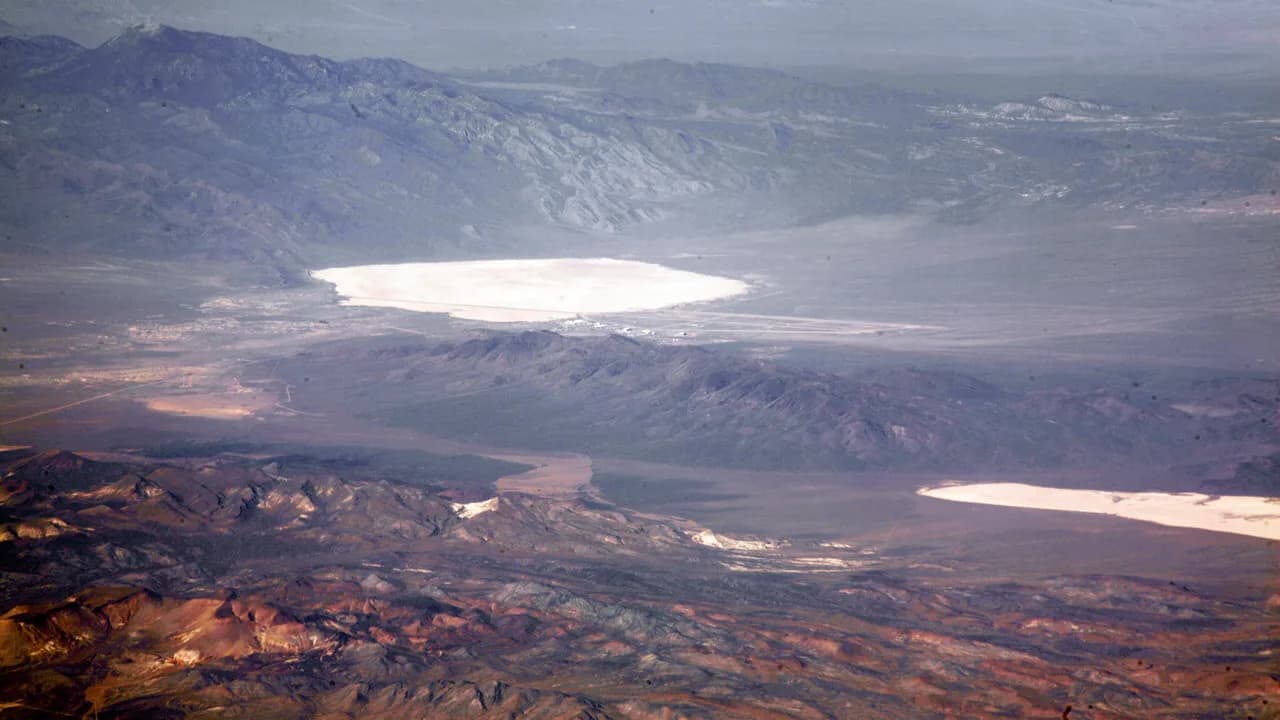
- Where
- Nevada, USA, Lincoln County, beside Groom Lake
- Founded
- 1955, for the U-2 spy plane
- Status
- Active U.S. Air Force site, closed to the public
- Confirmed
- U-2, A-12, captured MiGs, stealth aircraft
- Not confirmed
- Aliens and their craft: no documents exist
Where Area 51 is and what it is
On 12 April 1955 a small Beechcraft flies low over the Nevada desert. Four men are aboard: Richard Bissell, head of a secret CIA project; Air Force Colonel Osmund Ritland; Lockheed designer Kelly Johnson; and test pilot Tony LeVier. They are looking for a place to hide an aircraft that does not yet exist in any factory on Earth. Below them lies a dry salt lake called Groom Lake and an abandoned strip.
LeVier puts the plane down on the lakebed itself, and that may have saved all four of them. As the CIA's own history puts it, the wheels would probably have sunk into loose dust on the old strip, the plane would have nosed over, and the key people of the project would have been killed or injured. A few months later a base stands on the spot.
The name “Area 51” is no codeword but a plot number on a map of the U.S. Atomic Energy Commission. The base lies in southern Nevada, in Lincoln County, beside the northeast corner of the Nevada Test Site. The nearest settlement, Rachel, is about 20 miles (some 30 km) to the north, and from Rachel it is over two hours by road to Las Vegas. In official papers it is “the Air Force's operating location near Groom Lake.”
What was really built there
The first U-2 arrived in July 1955 in pieces, wrapped in tarpaulins, and flew in early August. Airliners then cruised at 10,000 to 20,000 feet and combat aircraft stayed below 40,000, while the spy plane climbed past 60,000. Later the same site tested the A-12, project OXCART, which was specified to fly at Mach 3.2.
In January 1968 a MiG-21 that Israel had obtained after an Iraqi pilot defected was brought here, and Americans flew it over Nevada for two and a half months. In the 1970s and 1980s the base worked on low observability, the technology behind the F-117 stealth aircraft. The government admitted the F-117 existed only in November 1988.
Where the aliens came from
Reports of “saucers” over Nevada began almost at once, and not by chance. When U-2s climbed above 60,000 feet, airline crews started noticing a strange object in the evening sky and reporting it to controllers. By the CIA's own estimate, U-2 and later A-12 flights account for more than half of all UFO reports of the late 1950s and most of the 1960s.
A second wave came in 1989. A man calling himself a physicist, Bob Lazar, told Las Vegas television that he had seen nine flying saucers at a site called “S-4” near Area 51. Roswell, an incident of 1947 in another state, got attached to his story, as did the 1996 film Independence Day, in which wreckage from Roswell is stored at a base in Nevada.
What was declassified in 2013 and 2019
In August 2013 the National Security Archive published a history of the U-2 and OXCART programs that the CIA had written back in 1992. Where black bars used to be, the words “Area 51” and “Groom Lake” now appeared. Headlines said the CIA had “acknowledged Area 51,” but the truth is subtler: the name had been public for years, and the document says nothing about aliens.
The locked dossier holds a chronology from 12 April 1955 to September 2019, with documents and figures. It tests which parts of Lazar's story can be checked and which cannot, shows how a 1947 “saucer” left Roswell and what the U.S. Government Accountability Office wrote about it. It also answers why only about a hundred and fifty people reached the base gate out of the millions who clicked “going,” and where exactly the line between document and legend runs.
The open archive
The r/conspiracy archive holds only 44 posts about Area 51, and none in August and September 2013, when the CIA’s history of the base came out. The rumours were louder in video: 123 clips and about 76 million views.
- posts on r/conspiracy, 2008–2018
- 44
- comments under those posts
- 2,833
- the first post in the archive
- 30 July 2010
- YouTube recommendations of 123 videos
- 10,519
- views of those YouTube videos
- 75,912,414
Posts on the topic, year by year
- 20080
- 20090
- 201014 per 1,000 posts of the forum
- 20110
- 201232.6 per 1,000 posts of the forum
- 201341.7 per 1,000 posts of the forum
- 201410.4 per 1,000 posts of the forum
- 201530.8 per 1,000 posts of the forum
- 201620.4 per 1,000 posts of the forum
- 2017131.2 per 1,000 posts of the forum
- 2018172.3 per 1,000 posts of the forum
The busiest months
- August 2018 · 3 posts
- January 2018 · 3 posts
- October 2017 · 3 posts
Counted from research archives: the popular text posts of one English-language forum, a study of YouTube recommendations and lists of conspiracy websites. What came of it is in the dossier.
The archives:r/conspiracy text-post archive, 2008–2018 (reddit-html-archiver)Faddoul, Chaslot, Farid. A longitudinal analysis of YouTube’s promotion of conspiracy videos, 2020Hanley, Kumar, Durumeric. A Golden Age: Conspiracy Theories’ Relationship with Misinformation Outlets, News Media, and the Wider Internet, 2023
Dossier for readers
The dossier
What is inside the locked materials of this chapter:
- 12 April 1955: how Groom Lake was chosen
- The aircraft that made the sky “unidentified”
- OXCART, the fence and leaky secrecy
- Trophies and invisible aircraft: MiGs, HAVE BLUE, F-117
- Bob Lazar and the birth of a legend
- Roswell: another state, another decade
- 2013 and 2019: how a secret became a meme
- “Storm Area 51”: a joke that millions answered
- The month the document came out and the forum stayed silent
- Timeline: 13 dates
- Proven and invented: the verdict
- What to read next
Checking your reading permission…
Questions
Where is Area 51?
In the desert of southern Nevada, in Lincoln County, beside the Groom Lake salt flat. The nearest settlement, Rachel, is about 20 miles (some 30 km) to the north. The site is closed: it is a U.S. Air Force facility, and in 1995 the AP reported signs authorising the use of force.
Are there aliens in Area 51?
No document says so. The CIA's declassified history is about U-2 and A-12 aircraft, and the National Security Archive describes tests of captured MiGs and stealth aircraft there. Some details about the site remain classified.
Which films about Area 51 are worth watching?
Fiction: “Area 51” by Oren Peli (2015, horror) and “Independence Day” (1996). The documentary “Bob Lazar: Area 51 & Flying Saucers” (2019) retells Lazar's version, whose claims have not been confirmed.
Sources
- The Secret History of the U-2 and Area 51 (Electronic Briefing Book No. 434)National Security Archive, George Washington University, 2013
- The Central Intelligence Agency and Overhead Reconnaissance: The U-2 and OXCART Programs, 1954–1974, Chapter 2Central Intelligence Agency (published by the National Security Archive), 1992
- The Area 51 File: Secret Aircraft and Soviet MiGs (Briefing Book No. 443)National Security Archive, George Washington University, 2013
- Government Records: Results of a Search for Records Concerning the 1947 Crash Near Roswell, New Mexico (GAO/NSIAD-95-187)U.S. General Accounting Office, 1995
- Project BLUE BOOK – Unidentified Flying ObjectsU.S. National Archives
- On the Road to Nowhere: ‘Extraterrestrial Alien Highway’Los Angeles Times (Associated Press), 1995
- Are Aliens Real?: How UFO Culture Took Over AmericaRolling Stone, 2020
- ‘Storm Area 51:’ About 75 people gather at Area 51 gate, 2 people detainedABC7 News (Associated Press), 2019
- IUPAC is naming the four new elements nihonium, moscovium, tennessine, and oganessonIUPAC, 2016
Contents of the book