
Answer in brief
Perseverance found igneous rocks where scientists expected ancient lake sediments. A new study reconstructs three episodes of water-driven change, while their absolute ages and any link to life remain unresolved.
Jezero water history becomes a sequence of different processes
A study published on 21 September in Communications Earth & Environment gives Mars’ Jezero Crater a more complicated water history. Using Perseverance observations of the Margin unit, the researchers identify three main episodes of alteration in rocks of igneous origin. The finding changes the explanation of a location initially considered a possible ancient shoreline deposit. It reconstructs processes preserved in minerals, rather than observing water flowing there today.
The immediate significance is that one visible rock unit can contain evidence from several environments and times. For readers following the search for ancient habitability, this means that the presence of a water-related mineral is a starting question: which episode produced it? Our interpretation is that separating those episodes makes the site more informative, because it reduces the temptation to assign every mineral to one lake.
The rover tested an expectation formed from orbit
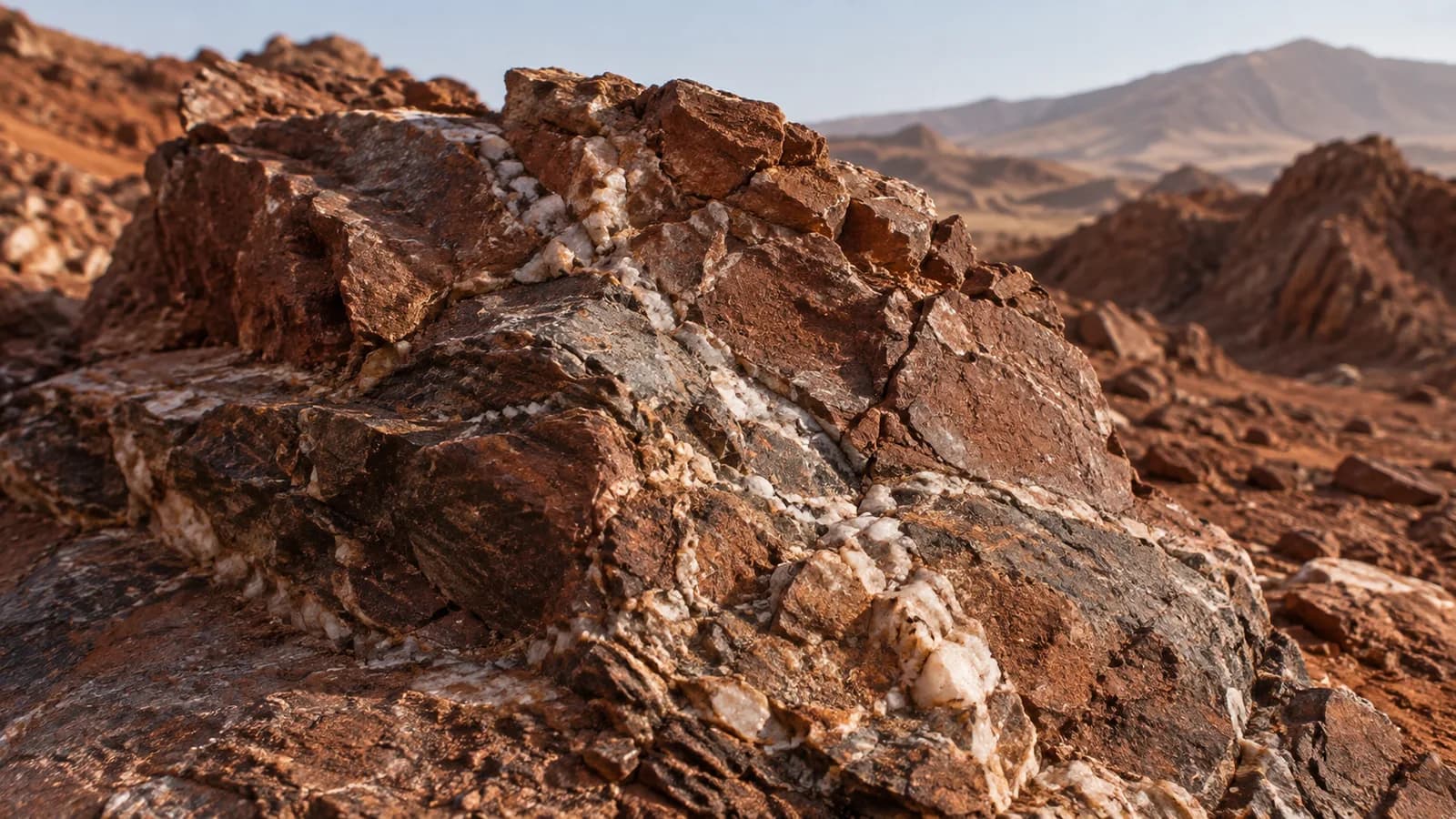
JPL explains that Perseverance reached the Margin unit in September 2023. Orbital carbonate signals and the apparent shoreline setting had encouraged expectations of sedimentary material. The rover instead encountered igneous rock. The 2026 publication is the new research event; the arrival and the October 2023 panorama used to illustrate the announcement are historical observations, not a new visit made this September.
SuperCam analysed more than 185 bedrock targets, while the rover explored approximately 265 metres of elevation across the unit. These figures describe the investigation’s coverage, not the duration or volume of ancient water. The distinction is useful: numerous measurements strengthen comparisons between locations, but no count of laser targets can by itself supply the dates of the geological processes that changed those rocks.
Minerals distinguish three main alteration episodes
The paper’s first episode involves carbon-dioxide-rich fluids circulating through the bedrock and producing carbonate-rich material later exposed as resistant ridges. The second involves renewed redistribution of carbonate and deposition of silica, potentially linked to the ancient lake or changes in groundwater. A later hydrothermal episode left fluorite-bearing calcium-sulfate veins in younger fractures. The sequence follows evidence in rock relationships and chemistry.
The table preserves the alternative explanation for the second episode because it is scientifically consequential. Assigning that entire stage confidently to lake water would make the reconstruction appear more settled than the paper does. A useful reading distinguishes the observed alteration pattern from the proposed source of its fluids. Both can be informative even when one part of the interpretation remains open.
| Episode | Mineral or structural evidence | Interpretation and limit |
|---|---|---|
| Earlier groundwater interaction | Carbonate-rich ridges | CO₂-rich fluids altered bedrock |
| Subsequent alteration | Carbonate redistribution and silica | Lake exposure or changed groundwater fluids |
| Later hydrothermal interaction | Fluorite-bearing calcium-sulfate veins | Hot fluids in younger fractures; absolute age unresolved |
Igneous origins and water alteration answer separate questions
At higher elevations, the study describes coarse, crystalline, olivine-rich rock with little evidence of substantial water exposure. Its texture points to slow cooling. Lower exposures preserve more extensive alteration. A rock’s original formation and its later interaction with fluids can therefore require separate explanations. Finding an igneous origin does not remove the water story; it changes the material through which that story must be reconstructed.
This distinction also improves how uncertainty is discussed. Researchers can infer that one fracture or mineral association came after another without knowing the calendar age of either. JPL explicitly says the team can determine the sequence but not the ages of the water interactions. An ordered history is valuable evidence, while claims about exact dates or continuous wet conditions would require additional support.
Habitability remains a question of conditions and preservation
The authors describe the unit as a site of astrobiological interest. JPL notes that interactions between water and olivine on Earth can produce hydrogen, and that carbonate and silica can preserve traces of past microbial activity. These relationships help explain why researchers care about the altered rocks. They do not establish that Martian microbes existed or that the measured minerals were produced by living organisms.
Our interpretation is that the layered history makes context essential when evaluating any future candidate signal. A feature associated with the earlier groundwater could have a different explanation from material deposited by later hot fluids. Before asking whether something looks biological, researchers need to understand its geological setting. The present study contributes to that setting rather than announcing a biological conclusion.
The next questions concern timing and links between locations
A useful follow-up would refine the ages, fluid conditions and connections between the observed features. Readers should distinguish measurements that directly characterise a mineral from broader reconstructions about where its water came from. The published sequence provides a framework for those questions. It does not establish that every part of Jezero experienced the same processes or that all three episodes had equal duration or extent.
As of 1 October, the result is a more detailed geological account supported by rover measurements and a published paper. The surprise is productive: rocks that challenged the original shoreline expectation preserve a richer set of water interactions. The next advances will come from testing that reconstruction against further evidence, with separate attention to what formed first, when it formed and what conditions it could support.
Questions and answers
Did Perseverance find water flowing today?
The study reconstructs ancient interactions recorded in rock chemistry and textures. It does not report present-day flowing water at the Margin unit or a newly filled Martian lake.
Why does the second episode remain uncertain?
The paper interprets carbonate remobilisation and silica formation as possibly caused by the ancient lake or by changes in groundwater fluids. The evidence supports alteration while retaining more than one explanation for its source.
Do these minerals prove there was life?
They help identify environments and preservation settings of astrobiological interest. Water-related minerals can form without biology, so the reported sequence is not evidence that organisms actually lived there.