
Answer in brief
Beginners can develop strength with machines, free weights or both. The choice depends on the movements they want to learn and how progress is measured. The cited trials do not establish one category as universally better for muscle growth or safer for everyone.
What should a beginner’s strength training achieve?
Beginners can develop strength with machines, free weights or both. The choice depends on the movements they want to learn and how progress is measured. The cited trials do not establish one category as universally better for muscle growth or safer for everyone. A machine press, a dumbbell press and a barbell bench press use related muscles but remain different tasks. Getting stronger in one does not produce the same performance number in another. Choose an exercise you can learn and practise, then keep its setup and assessment consistent rather than treating every displayed load as a universal strength score.
This distinction separates strength-test specificity from muscle growth. If your goal is to become more capable at a barbell squat, practising that movement has a direct learning role. If your immediate goal is regular resistance training in a manageable setup, suitable machines may be a practical starting point. Neither statement requires declaring one equipment category universally better. Equipment choice belongs inside a programme, alongside exercise selection, progression and consistency.
The evidence reviewed by 8 October 2026 includes two existing randomised studies published in 2020. They are not new discoveries announced today. Their populations, durations and measurement methods matter: a short beginner trial cannot establish a lifetime outcome, and a muscle-size measurement is not the same as a guarantee about how someone's body will change.
A guided path changes the setup, not whether you are training
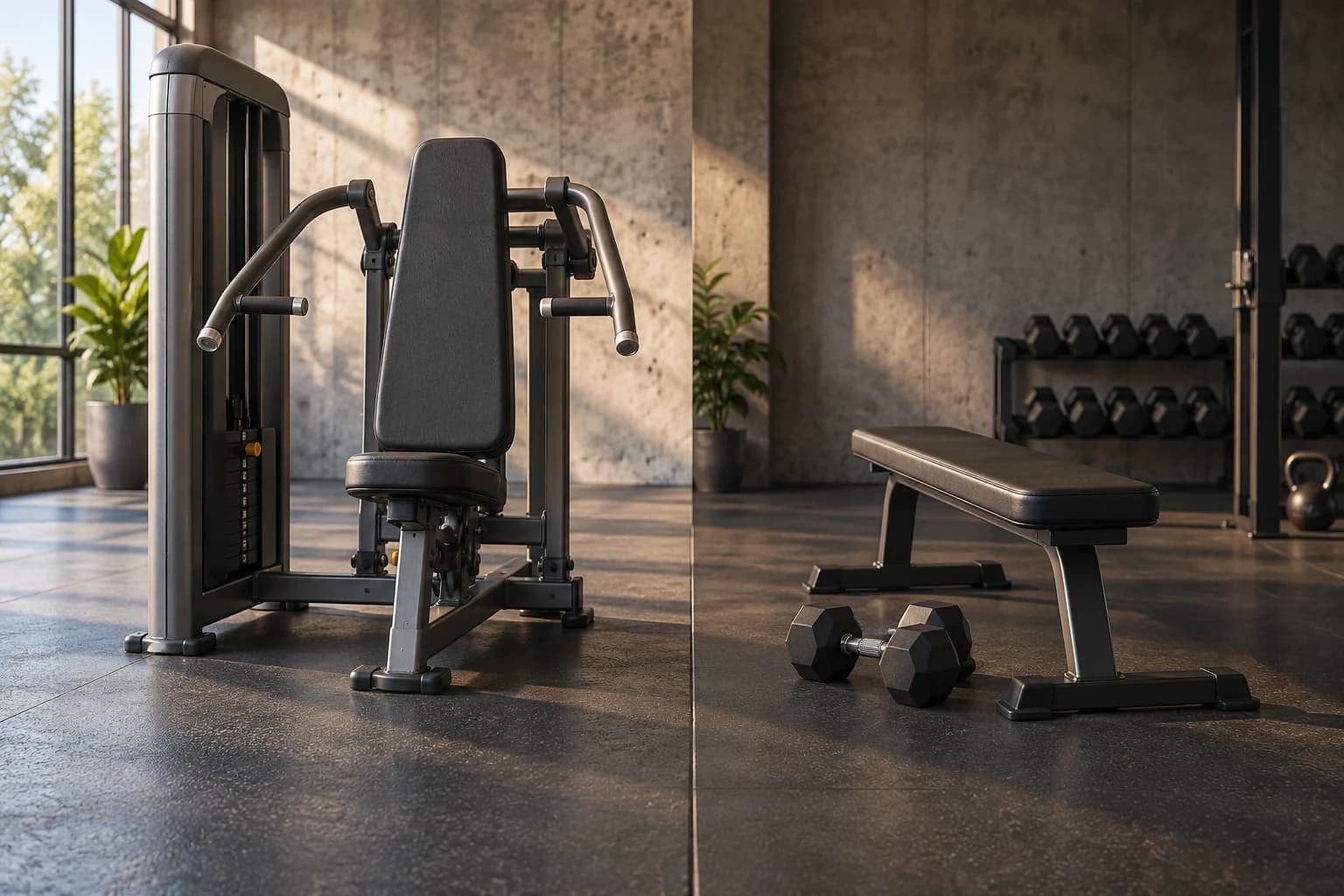
Many machines support the body and guide the load along a defined path. That can reduce some of the positioning demands in a specific exercise and make adjustments easier to repeat. Free weights require the lifter to control the implement's path as well as produce force. The extent of support varies: a seated machine, a cable movement, a dumbbell exercise and a barbell in a rack should not all be collapsed into two perfectly uniform categories.
For a beginner, compare the exact exercises available. Can the machine's seat and handles be adjusted to your body? Can you start with a manageable load? With free weights, can you get into and out of the position under control, and is the appropriate space or assistance available? These are concrete questions a gym induction can answer. A machine that fits poorly is not automatically the convenient option; a suitable free-weight movement may be straightforward.
Support also does not mean permission to ignore technique. A fixed path still needs a sensible setup and controlled repetition. Conversely, needing to learn a free-weight skill is not evidence that the exercise is unsuitable for every novice. Begin with instruction relevant to the movement and evaluate whether you can perform it consistently.
What the two trials actually measured
Aerenhouts and D'Hondt's 2020 trial involved 36 novice men aged 18–45 over ten weeks. Groups trained with machines, free weights, or switched from machines to free weights after five weeks. The researchers observed improvements over time without significant group-by-time differences in the reported outcomes. Muscle-size estimates used body circumferences, which should not be described as direct imaging of muscle tissue. The participants were male novices, not a sample of all ages and experience levels.
Schwanbeck and colleagues' study randomised 46 young adults, including 26 women, to eight weeks of free-weight or machine training. Biceps and quadriceps thickness increased without a detected group difference. The machine group improved more on the machine bench-press test, while other reported strength tests improved without detected between-group differences. That pattern is a useful reminder to read the tested movement before announcing a general equipment winner.
Neither study establishes that every programme produces identical results or that equipment never matters. A lack of a detected difference is not proof of complete equivalence across every outcome. Read the findings as evidence against dismissing one category outright, with a reminder that exercise practice, the comparison programme and the measurement all affect interpretation.
Match equipment to the task you need next
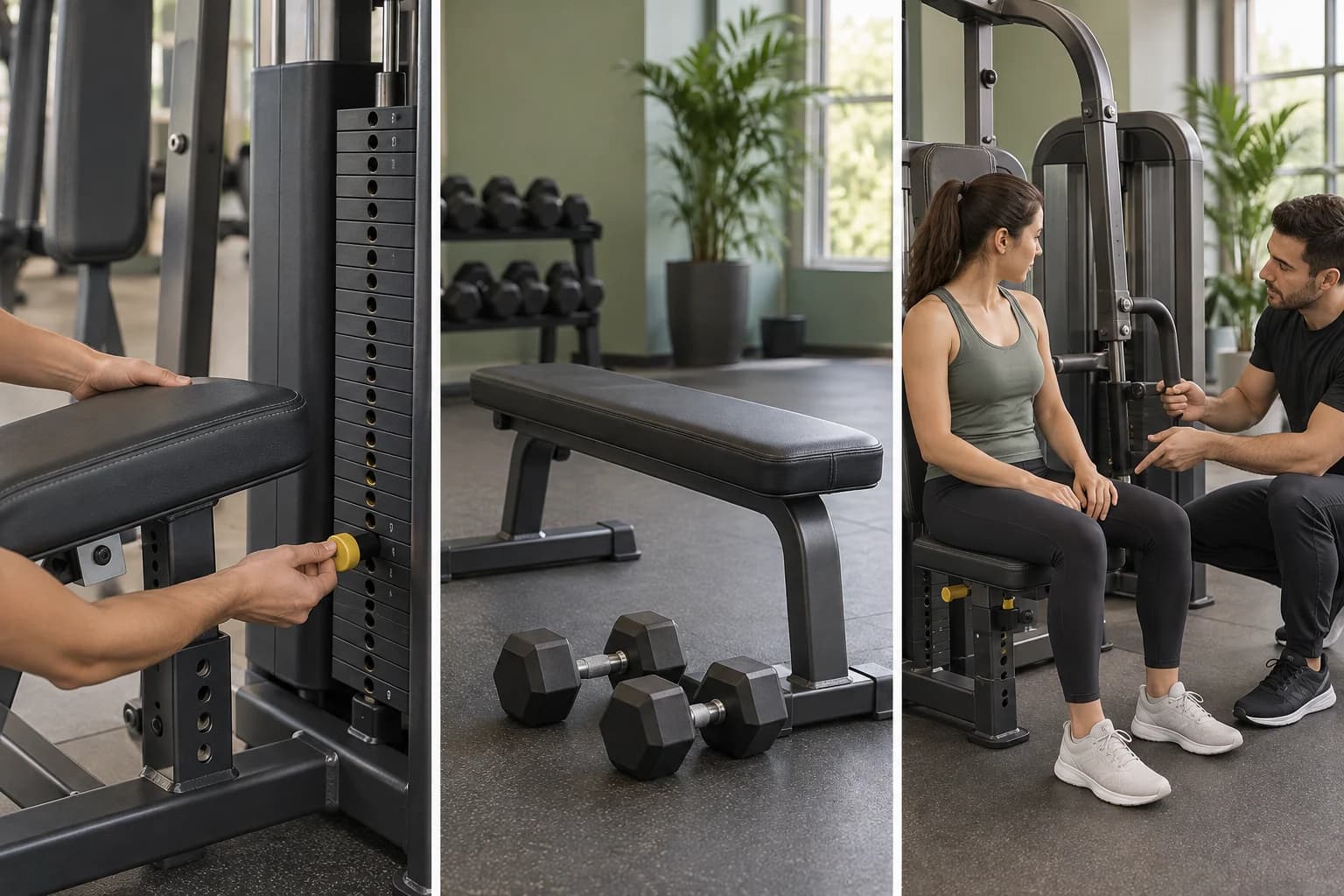
The table compares practical beginner decisions rather than guaranteed results. It deliberately refers to suitable equipment and exact exercises, because the categories are too broad for claims that every machine is stable or every free-weight exercise is difficult. Local gym layout and access can also change the choice. A theoretically ideal exercise that you cannot set up or reach during your training time is not a complete plan.
Consider a hypothetical beginner who wants to gain confidence pressing a load and finds an adjustable chest-press machine comfortable. That person can start there and later learn a dumbbell or barbell press if it serves a new goal. Another beginner specifically wants to join a barbell-focused class and has instruction available. Starting with coached barbell practice may fit that intention better. These are programme decisions, not evidence that one person will gain more muscle.
Mixed programmes are also legitimate. You might learn a free-weight movement while using a machine for another exercise whose setup is more convenient. The point is to make the combination purposeful and repeatable. Switching equipment every session merely to seek novelty can make progress harder to interpret, because loads and movement skills do not transfer as identical numbers.
| Question | Machines | Free weights |
|---|---|---|
| Learning the path | Guided movement may simplify a specific task | Control of the implement needs practice |
| Fit and setup | Check seat, handles and adjustment range | Check implement, position and suitable assistance |
| Muscle growth | Can provide resistance for targeted muscles | Can provide resistance for targeted muscles |
| Specific strength goal | Practise the machine task you will assess | Practise the free-weight task you will assess |
| Progress record | Record machine model and settings | Record implement, variation and range |
| Changing exercises | Stack numbers do not transfer directly | Loads must be relearned for a different task |
| Access | Depends on gym and busy-hour availability | Depends on space, equipment and instruction |
Muscle growth and a larger number on the stack are different
A rising load on a familiar machine is useful progress information when the seat, range of motion and execution remain comparable. It is not a direct measurement of muscle growth. Early performance can change as you learn the task, and the machine's mechanical arrangement affects how its labelled load feels. A weight-stack number is therefore a record for that exercise and machine, not a universal strength currency.
The same applies to free weights. A heavier barbell or dumbbell can demonstrate improvement in the movement if you maintain the intended form and range. If you shorten the movement or change the assistance, the comparison has changed. Record those details rather than treating the load alone as the outcome. For muscle growth, the cited studies used different measurement approaches; do not merge circumferences and ultrasound thickness into one imaginary before-and-after test.
This also explains why switching equipment can feel like a reset. A different movement may need new positioning and coordination, even when the muscles have been training. Begin the new exercise with a load appropriate to that task. Difficulty on the first attempt does not erase earlier progress, and copying a previous machine number into a barbell exercise is not a valid conversion.
Build a routine whose progress you can interpret
Use a gym induction to select a manageable set of movements and learn their setup. Record the machine settings or the free-weight variation, the load, repetitions and the range you intend to use. A clear record helps you recognise whether a later session is genuinely comparable. It also makes a discussion with a coach more useful than a recollection that one workout felt harder.
Progress should be appropriate to the movement and your situation. If you cannot keep the intended control, reconsider the load or obtain instruction rather than chasing the equipment label. No universal set count or progression schedule is prescribed here, because the trials do not produce an individual programme for every reader. The practical goal is a routine you can repeat and review, not an instant test of maximal lifting ability.
If your goal changes, adjust the programme deliberately. Someone who wants to improve a specific free-weight test should include practice relevant to it. Someone prioritising consistent sessions may place greater weight on setup convenience and access. Persistent pain, an existing condition or uncertainty about movement suitability is a reason for individual assessment, not a question settled by machine-versus-free-weight slogans.
How to choose equipment and track your own progress
At review time, return to the task you named at the start. If you wanted to learn a dumbbell press, assess that movement with consistent conditions. If you wanted a dependable beginner routine, consider attendance, controlled execution and progress in the selected exercises. If muscle-size change is the outcome of interest, use an appropriate measurement method and recognise its limitations. Do not quietly substitute an impressive number on an unrelated exercise.
The studies support a flexible starting choice, with limits. They do not prove that machines prevent injuries, that free weights create universally superior functional strength, or that a short trial predicts your future transformation. Those claims would require different evidence. Equipment can make a session more or less workable, but the category name cannot stand in for an individual programme and sensible instruction.
The cover is an AI conceptual illustration of an empty gym: a guided chest-press machine beside a bench and dumbbells, with the same lighting and floor. It demonstrates setup differences, not participant results or a measured experiment. Your own decision can be similarly concrete: choose an accessible movement you can learn, record the conditions, and evaluate the kind of strength you actually intended to train.
Questions and answers
Can beginners build strength using machines only?
Machines can provide effective resistance training when the exercise and programme suit your goal. The novice-male trial observed improvements across its equipment groups without detecting different time trends. That does not guarantee every outcome for everyone. If your goal is a particular free-weight skill, add relevant practice; a machine strength result is not an identical test of that skill.
Do free weights build more muscle than machines?
The two cited trials do not establish that universal claim. One used body circumferences to estimate muscularity; the other measured biceps and quadriceps thickness and did not detect an equipment-group difference. Their short durations and specific populations limit extrapolation. Exercise selection, progression and consistent training remain part of the question, rather than muscle growth being settled by equipment category alone.
Why can I press more on a machine than with dumbbells?
They are different tasks with different support, mechanics and coordination demands. Weight-stack labels also cannot be converted directly into dumbbell loads. Compare progress within the same exercise, using the same settings and range, instead of comparing the numbers as a common strength scale. When learning a new movement, select an appropriate starting load rather than copying the previous exercise.
Are machines always safer for beginners?
The cited studies do not establish a universal injury advantage. A supported path may simplify some tasks, but machine fit, setup, load and execution still matter. Free-weight exercises vary substantially too. Use appropriate instruction and choose a movement you can control. Existing conditions or persistent symptoms need individual assessment rather than a safety decision based solely on the equipment name.