
Answer in brief
The main beginner difference is how the court shapes play: padel uses walls after a legal bounce, while pickleball has a non-volley zone near the net. Serves, balls and scoring also differ. Neither sport is universally easier; compare the actual introductory sessions available.
How do walls and the kitchen change your first game?
The main beginner difference is how the court shapes play: padel uses walls after a legal bounce, while pickleball has a non-volley zone near the net. Serves, balls and scoring also differ. Neither sport is universally easier; compare the actual introductory sessions available. Both games use a net and rackets without strings, but those spatial rules change where you wait and which ball you let bounce. Before booking with friends, check the instructor, suitable loan equipment and the session format. A general comparison cannot establish the price, availability or quality of an introduction at a particular local venue.
For a group of friends, start with practical availability. Check whether a nearby venue offers a coached beginner session, loan equipment, a suitable playing surface and a booking that fits your group. A comparison of the sports cannot establish local availability or current prices. Those details may decide which you try first more strongly than an abstract claim that one game is easier. Neither sport has to become a permanent commitment after one visit.
This guide checks governing-body material available by 8 October 2026. The FIP padel rulebook states an application review of 1 January 2026. Pickleball guidance comes from USA Pickleball and the LTA. The focus is a social introduction, so agree any simplified practice format before playing and ask which scoring rules the host uses.
The wall and the kitchen create different decisions
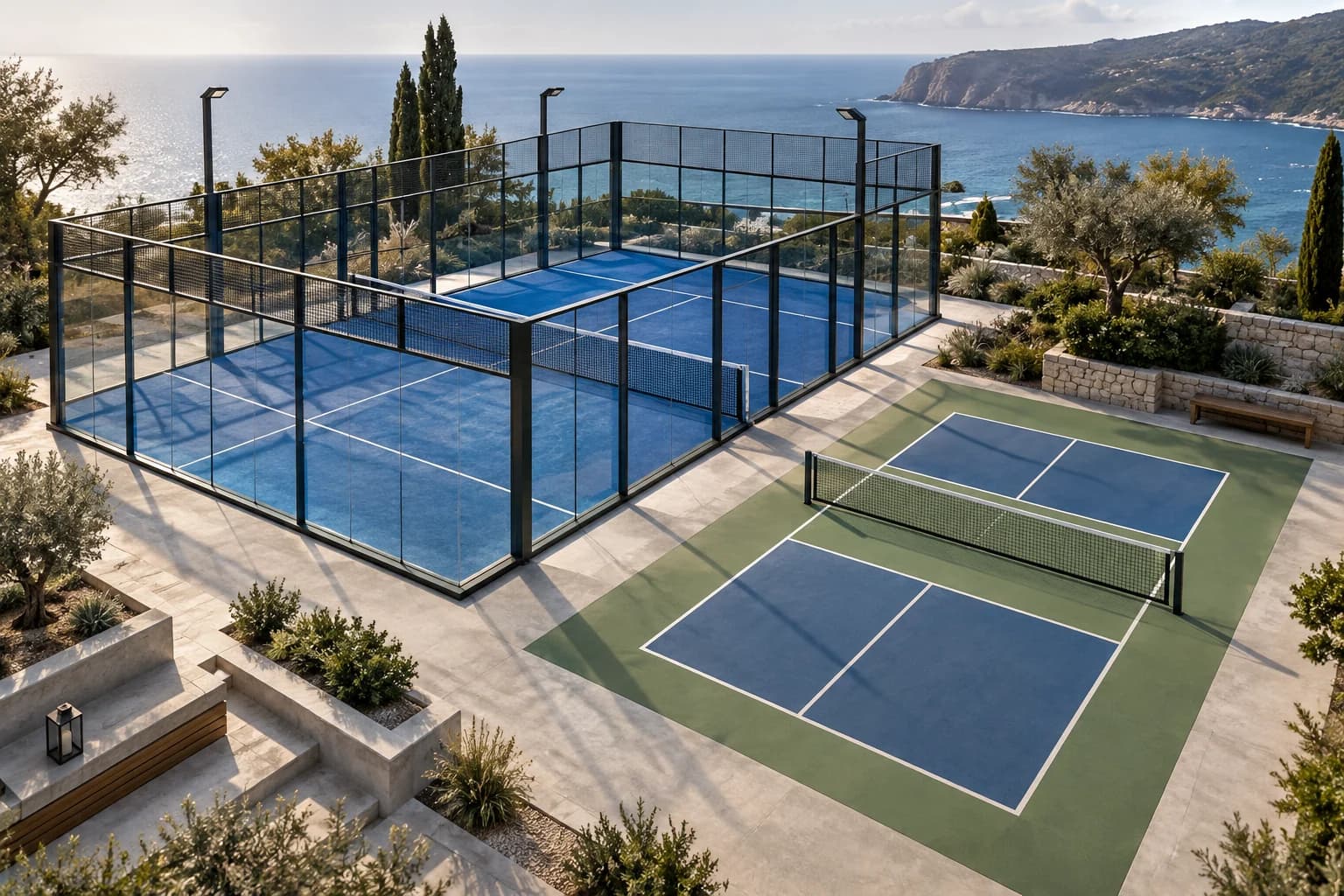
FIP specifies a padel court measuring 20 by 10 metres internally, enclosed by walls and fencing. The pickleball playing rectangle is 44 by 20 feet, approximately 13.41 by 6.10 metres, with a non-volley zone extending 7 feet, approximately 2.13 metres, from the net on each side. Those are playing dimensions, not the total footprint required for run-off space, access or a safe venue installation.
In padel, an opponent's ball must first make a legal floor bounce before the relevant wall rebound can be used. A beginner therefore has a decision unfamiliar from ordinary tennis: take the ball before it reaches the wall, or allow it to rebound and then return it before a second floor bounce. Do not assume every touch of any enclosure is interchangeable; walls, fencing and serves have distinct rules. Ask a coach to demonstrate the simplest legal wall return.
In pickleball, the kitchen is not a forbidden place to stand. You can enter it and play a ball that has bounced. The restriction concerns volleying, including contact caused by momentum from a volley. Learning that distinction prevents a common beginner mistake: retreating from every short ball, even when a bounced return from inside the zone would be allowed.
Serving and the first two bounces reset tennis habits
Padel starts with a bounced underhand serve struck at or below waist height and directed diagonally into the receiving service box. A fault on the first serve normally allows a second serve. This is different from an overhead tennis serve, and the enclosed space does not remove the service rules. During an introductory drill, have the host show where to stand, where to bounce the ball and the target box before adding pace.
Pickleball also serves diagonally across the net, clearing the non-volley zone. Its serving rules distinguish a volley serve from a drop serve; learn the version your instructor demonstrates rather than blending their conditions. The ball must bounce on the receiving side after the serve and then on the serving side after the return before either side can volley. This two-bounce rule changes the opening movement of a point even for experienced racket-sport players.
For your first session, practise the opening sequence slowly: serve, bounced return, bounced next shot, then continue. In padel, separately practise a legal floor bounce followed by a wall rebound. These drills are suggested learning steps rather than official shortened matches. They isolate the rules that most directly change a beginner's position, while leaving complicated disputes and advanced tactics for later instruction.
A court-first comparison for your booking decision
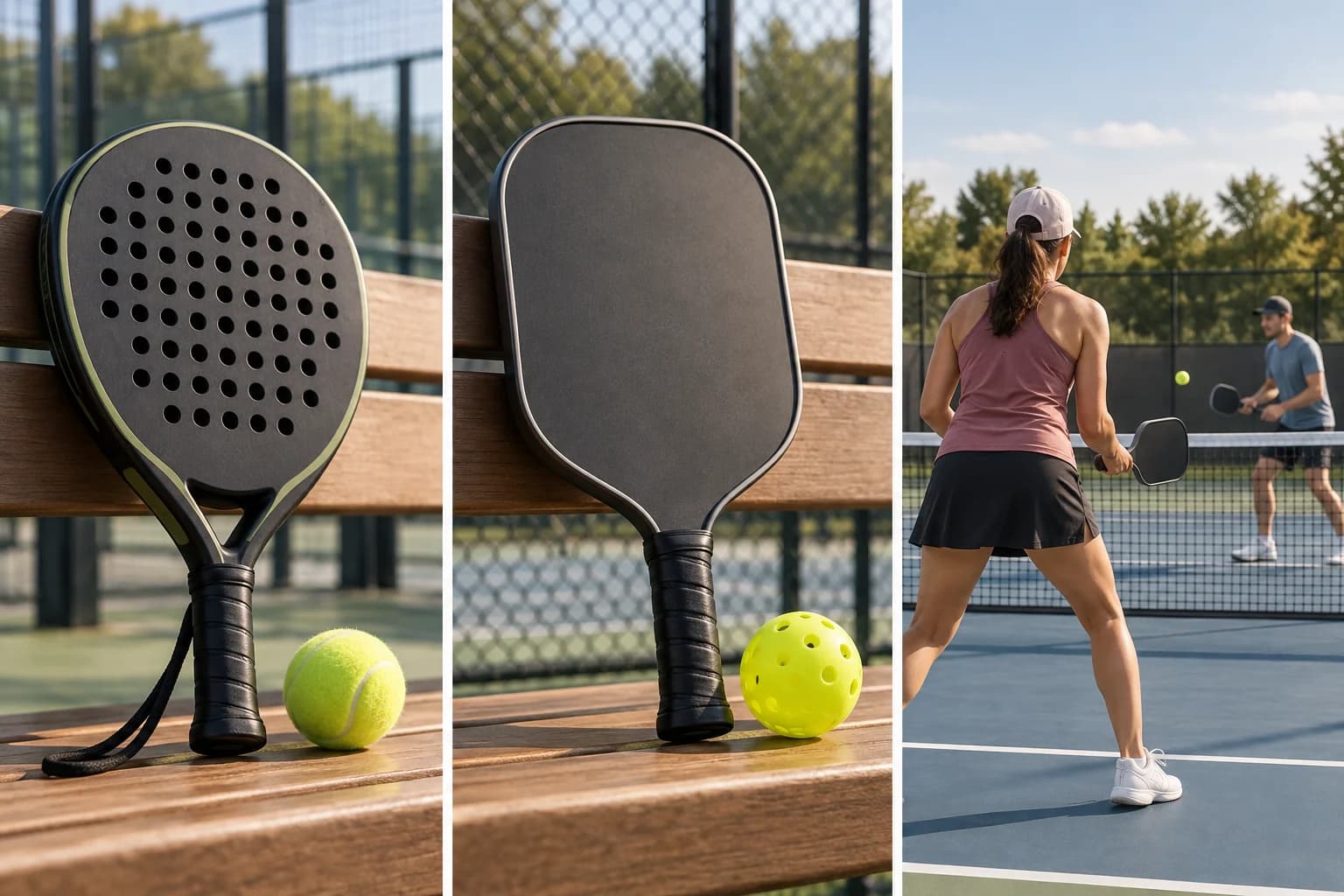
The table compares the main first-session features. It does not rank athletic value, injury risk or calories. A smaller playing rectangle is not proof of lower effort, and an enclosed court is not proof of a harder workout. Intensity depends on how you play, the rally, the session length and the people involved. Keep those questions separate from the court rules.
Imagine four friends who can book either a coached padel session with equipment included or an uncoached pickleball court. Coaching and loan equipment might make padel the more convenient first experience for that group. Reverse the local offer and pickleball may become the practical choice. The sport's name did not change; the conditions of the introduction did. This is why a venue comparison belongs alongside an equipment and rules comparison.
If two friends are available rather than four, pickleball has an established singles format as well as doubles. The standard FIP padel rules discussed here concern pairs. Check the actual booking format instead of assuming a venue will offer an equivalent two-person game. A lesson or practice session may have its own arrangements, and those should be confirmed directly.
| Feature | Padel | Pickleball |
|---|---|---|
| Playing rectangle | 20 × 10 m internally | 44 × 20 ft; about 13.41 × 6.10 m |
| Court edge | Walls and fencing affect play | Open rectangle; surrounding space still needed |
| Net-side rule | No pickleball-style kitchen | 7 ft non-volley zone on each side |
| Opening sequence | Bounced underhand diagonal serve | Diagonal serve, then two-bounce sequence |
| Equipment | Perforated racket and padel ball | Paddle and perforated plastic ball |
| Group format | Standard rules discussed here use pairs | Singles and doubles |
| Booking questions | Coach, rental racket, chosen scoring format | Coach, rental paddle, chosen scoring format |
Rent the right equipment before deciding what to buy
Padel uses a perforated racket without strings and a ball whose specifications are set by FIP. Its ball resembles a tennis ball in appearance, but appearance alone does not mean the two are interchangeable. Pickleball uses a paddle and a perforated plastic ball, with equipment appropriate to the venue and conditions. A paddle or racket from one sport is not a substitute for the other simply because both have solid hitting faces.
For an initial session, loan equipment can prevent a premature purchase based on a model you have never held. Ask whether the booking includes it and whether the instructor can help select a manageable option. In padel, the racket's wrist cord is required under the rules; use it as instructed. For either game, check the venue's footwear requirements and the surface rather than arriving in shoes selected only for appearance.
Comfort is individual. Do not treat a friend's preferred paddle weight or racket shape as a universal beginner specification. Begin with the host's suitable loan equipment, notice grip comfort and handling, and consider purchasing after you understand the session you want to repeat. This article does not nominate a best product, quote current prices or claim to have tested equipment.
Agree scoring before the first competitive rally
Padel uses tennis-style point calls and games within sets. The current FIP document includes different methods for resolving deuce, including advantage, Star Point and Golden Point formats. Do not tell beginners that every venue necessarily uses one decisive-point system. Ask the host which format applies and practise the calls. A simple agreed practice target can help a group learn, provided everyone knows that it is a drill rather than a complete official match.
For a common pickleball introduction, the LTA describes games to 11, winning by two, with points scored by the serving side. Doubles score calls also identify the server, so a third number can be unfamiliar to a newcomer. USA Pickleball's current rules are the appropriate reference for the full rule set and event formats. Confirm the scoring system for the session instead of carrying an assumption from an online clip into a local game.
Keeping score should not consume the whole introductory hour. Ask someone experienced to guide the first few points, announce the score before serving and pause when players lose track. If you simplify a drill, keep the legal bounce and volley conditions clear. A friendly practice format works best when it is explicit, rather than when each player silently applies a different sport's rules.
How to choose a first session with friends
After trying a game, discuss concrete experiences. Did you understand when the ball remained playable? Did the court lines or wall rebounds make sense? Was the equipment comfortable, and did the session allow everyone to participate at a manageable level? These answers are more useful than counting early mistakes as evidence that you chose the wrong sport. New rules can feel awkward even when the game becomes enjoyable with practice.
If you can, try the other sport under reasonably similar conditions: comparable instruction, group size and session length. An excellent coach in one sport and an overcrowded uncoached session in the other is a comparison of experiences as much as sports. You can still prefer one, but recognise what produced that preference. This is an editorial decision method, not a reported beginner trial or a universal learning-time estimate.
The cover is an AI conceptual illustration of miniature courts at a shared scale: an enclosed padel rectangle beside an open pickleball rectangle with kitchen zones. It is not a photograph of a real venue or match. Dimensions in the text come from governing-body guidance, while any generated image must be read as an illustration. Book the introduction you can access, learn its defining rules, and let your own session determine whether you want another.
Questions and answers
Is pickleball easier to learn than padel for every beginner?
There is no universal answer established here. Pickleball introduces the two-bounce sequence and non-volley-zone restrictions; padel introduces wall rebounds and its service conditions. Your racket-sport experience, instruction and venue can change the first-session experience. A coached introduction with suitable equipment is a more useful starting criterion than a blanket ease ranking based only on court size.
Can you enter the kitchen in pickleball?
Yes. The non-volley zone is not a general ban on entry. You may play a ball there after it bounces. You must not violate the volley rules, including touching the zone or its lines through momentum from a volley. Ask your instructor to demonstrate a legal bounced short-ball return and a volley momentum fault side by side.
Can you play either sport with a tennis racket and ball?
The regulation equipment is different. Padel uses a perforated racket and a ball with FIP specifications; pickleball uses a paddle and perforated plastic ball. A tennis racket is not their standard replacement, and a tennis-looking ball should not automatically be treated as a regulation padel ball. Loan equipment at a beginner session is a practical way to start.
Which first session should four friends book?
Compare coaching, equipment rental, format, travel and booking availability. Both sports allow doubles, but a supportive introduction may matter more than the theoretical comparison. Confirm the scoring before playing: the FIP rules applicable from January 2026 include different deuce formats, while pickleball also uses server identification. Try the other sport later under similar conditions if your group remains curious.