
Answer in brief
LVMH describes Jonathan Anderson's 2026 collection as his Dior haute-couture debut. We examine what the public presentation can show about creative direction and where a profile must stop.
The confirmed debut
LVMH describes Jonathan Anderson's spring–summer 2026 collection as his debut haute-couture presentation for Dior. Dior's official show material gives readers a place to examine the collection on the house's own terms. Those sources establish the event and provide a visual record; they do not open every private conversation between the creative director, atelier teams and clients. A profile should begin with that boundary. It can discuss what the work appears to do and how the house frames it, but it should not invent a personal motivation, a private quotation or a sales outcome. Anderson's public role makes the story newsworthy; the available evidence still determines which sentences can be written as fact.
What to look for in the garments
A useful review compares several looks rather than selecting the most dramatic image. Note the shape of the silhouette, the relationship between material and structure, and whether a motif changes as it reappears. Then compare those visible choices with established Dior references, without assuming that any single resemblance proves an intention. Dior's presentation may describe an artistic theme; a critic may see another tension. Both should be attributed correctly. The aim is not to score the debut with a single adjective such as modern or nostalgic, but to explain the decisions a reader can verify on the official page. Where construction cannot be seen clearly, say so instead of speculating about methods or materials.
Why a director's work is collaborative
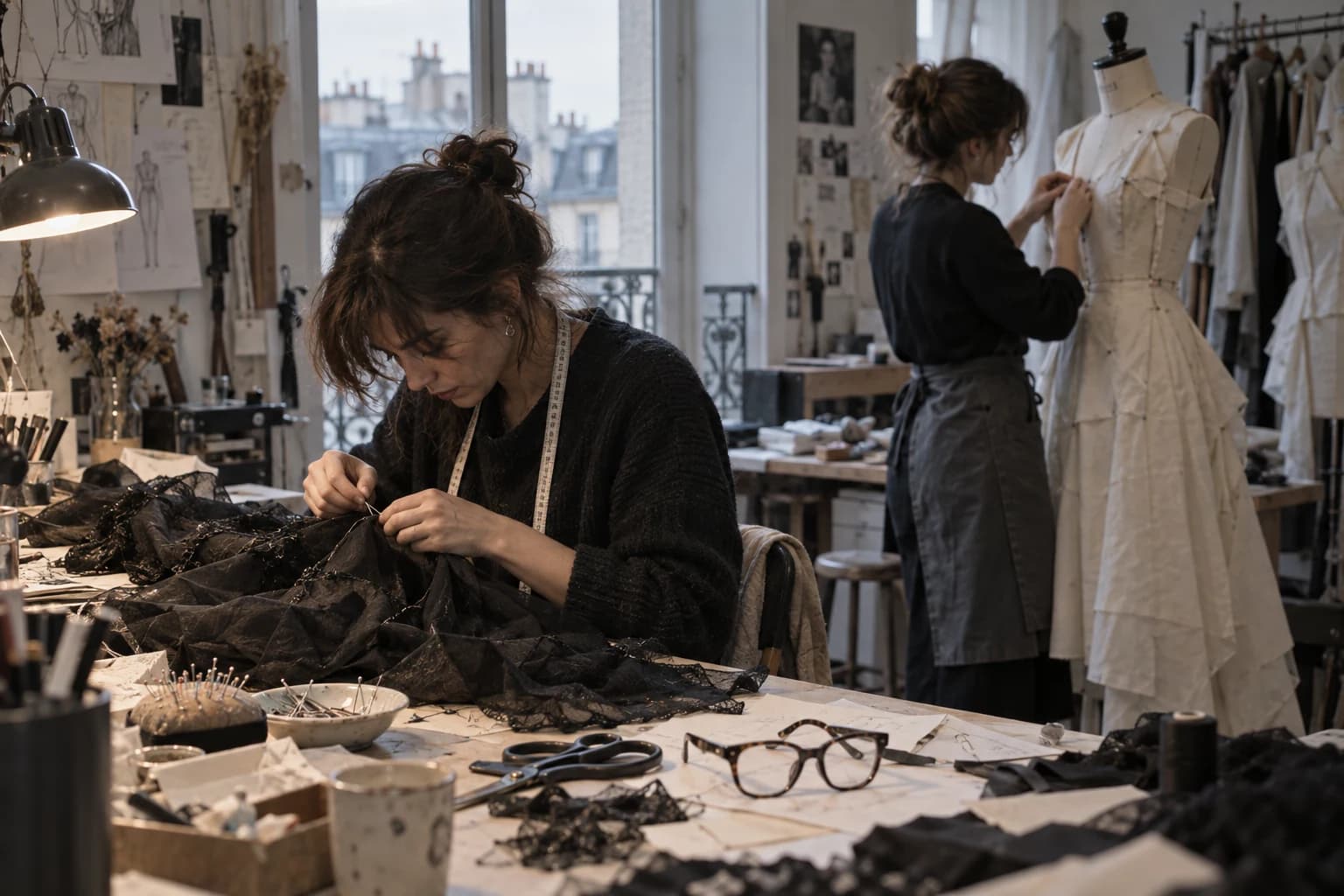
Couture requires a design idea to survive fitting, construction and finish. That makes the relationship between creative direction and specialist craft central to an assessment of the collection. It does not mean an outside writer knows which person made every choice in an atelier. A responsible profile can recognise the teams behind the work and analyse the finished result while respecting the limits of public documentation. Our cover is an anonymous editorial illustration of fabric and hands at a worktable, not a photograph of Anderson, Dior personnel or an actual garment. It represents the craft question without pretending to answer it visually. Any specific account of the production process needs a named source beyond the illustration.
The temptation to predict a house's future
A debut may make a strong statement, yet one collection cannot settle how a creative direction will evolve or how customers will respond. Editorial attention, client orders, future shows and archival influence are separate measures on different time scales. A thoughtful profile therefore records what can be assessed now: the official presentation, the visible design vocabulary and the questions the work opens. It leaves commercial impact and long-term influence for reporting that has evidence. This is particularly important with a well-known designer, whose reputation can cause every new piece to be read through expectations built elsewhere. The collection deserves to be examined as work, not treated as proof of a theory written before it appeared.
A transferable way to study creative leadership
Readers interested in design management can use three columns: inherited codes, new choices and capabilities needed to execute those choices. A house may preserve recognition while allowing a director to change proportion, materials or mood. The same method can be useful for a smaller brand deciding how far a redesign should move from its existing identity. It does not require imitating Dior's scale or aesthetic. The key is to distinguish continuity that serves an audience from repetition that avoids a decision, and experimentation that opens a direction from novelty that cannot be supported in production. Anderson's debut gives a concrete case for asking those questions, but the conclusions must remain tethered to the visible collection and official accounts.
How to read a creative director without inventing a biography: LVMH describes Jonathan Anderson's 2026 collection as…
A designer profile often becomes a collection of adjectives: visionary, disruptive, timeless. Those words reveal less than a close reading of decisions that are visible in the work. With Anderson's Dior couture debut, the defensible starting point is the official presentation and the house's description of the collection. Ask what materials, construction choices and proportions are shown, and how a recognisable house code is retained or revised. Where a judgement is interpretive, state it as an interpretation. Do not convert a silhouette into an undocumented private intention, or a press release into a measured sales result.
The atelier matters because couture is not simply an image on a runway. A line on a sketch has to become a garment that can be made, fitted and finished. A useful reading of a creative director's role considers the exchange between concept and specialised craft. Which visual idea depends on a particular construction technique? Which detail would be lost if the same idea were reduced to a digital moodboard? An anonymous image of hands at work can illustrate that process, but it cannot be passed off as a photograph of Dior's atelier or of Anderson himself.
Change inside an established house also has several audiences. Editorial readers may focus on novelty, long-standing clients on continuity, and design teams on how references have been translated into an executable collection. These audiences can read the same show differently without one of them being automatically mistaken. A responsible profile compares the house's own account with what can be seen in the finished work and avoids claiming that every consumer has responded in the same way. Public reaction, buying behaviour and long-term influence require their own evidence and time horizon.
For readers who work in branding, the practical lesson is a disciplined way to study leadership. Write down the inherited codes, the new choices that are observable, and the capabilities needed to make them real. Then distinguish an immediate aesthetic response from an institutional change that can be assessed only over several seasons. The same method can be applied to a smaller creative team without imitating a luxury house's budget or public profile. It keeps attention on decisions and constraints, which are more transferable than the mythology surrounding any celebrated individual.
A profile is a record of work, not mind-reading
Creative leadership stories are unusually vulnerable to retrospective certainty. Once a collection is shown, it can be tempting to write that every reference was inevitable or that the director intended exactly the reaction viewers had. Official collection materials can describe the house's stated framing; they cannot reveal every private discussion inside a studio. A responsible account places the visible choices alongside the stated context and leaves room for other interpretations. If a future interview supplies more detail, the profile can be updated with attribution. Until then, a close look at the work is more informative than an invented quotation or a dramatic but untestable account of personality.
That approach also protects the craft teams who make a collection possible. A public creative director is a legitimate subject of a profile, but construction, fitting, finishing and presentation involve work beyond one name. Readers interested in how design happens should ask which capabilities turned a concept into a garment and which constraints shaped that translation. The answer may be partly visible and partly unavailable. The illustration accompanying this piece evokes hands at a worktable without claiming to document a named atelier. It helps set the subject while keeping the factual burden with Dior's presentation and LVMH's account of the debut.
A useful next source
A later conversation with the designer, a documented atelier account or additional official collection detail could clarify how a choice was made. Until then, the visible garments and the house's public presentation are the record. Readers can compare the full sequence rather than a cropped social image and ask which claims the source actually supports. That habit protects both criticism and admiration from overstatement. It is possible to find a silhouette exciting without declaring a commercial revolution, or to question a styling choice without assigning a private motive to its maker. The profile remains open to evidence, which is a stronger form of attention to creative work than an invented certainty.