
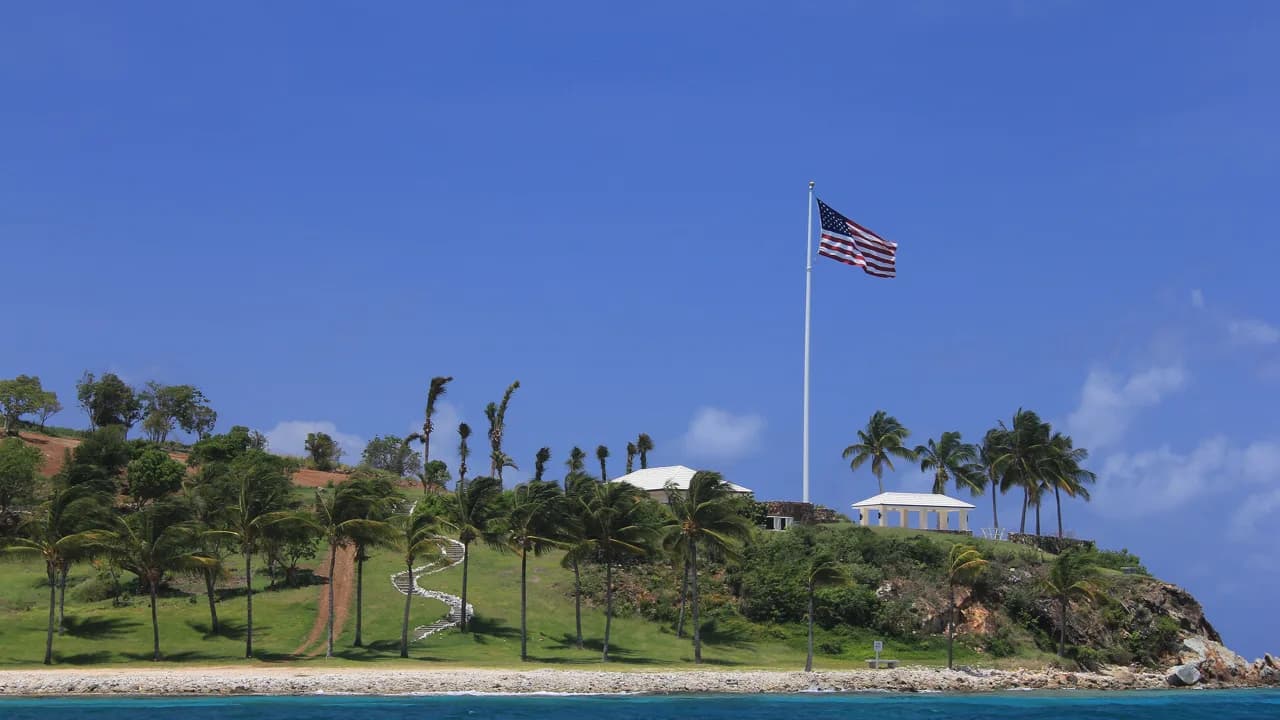
The island everyone knows from aerial photographs
From the air it looks like a postcard: 71.6 acres of land off St Thomas, a main compound, guest villas, a dock, a helipad and a striped building that the internet nicknamed the temple. This is Little Saint James, an island in the US Virgin Islands. It belonged to the American financier Jeffrey Epstein, and after his death in 2019 the name became a byword.
The phrase “Epstein island” sounds like the title of a conspiracy, but three separate stories sit behind it. The first is a criminal case about the sexual exploitation of underage girls, and it ended in a conviction. The second is Epstein's own death in a jail cell, which a medical examiner, the FBI and the Justice Department's inspector general all examined. The third is a legend about a secret list of powerful clients, and no court ruling has ever confirmed it.
What the courts established
Epstein himself was convicted once. In 2008 he pleaded guilty to two Florida state charges, one of them procuring a minor for prostitution. The sentence was 18 months, and he served less than thirteen. That became possible thanks to a sealed agreement with federal prosecutors, which the victims were never told about.
In July 2019 he was arrested again, this time on a federal charge of sex trafficking of minors. A month later he died in a New York cell, and the case was dismissed before it reached trial. So the main trial in this story is the trial of Ghislaine Maxwell. In December 2021 a jury found her guilty on five of six counts, and in June 2022 she was sentenced to 20 years.
The people at the centre of this story are the victims. The Justice Department itself spoke in 2025 of more than a thousand. For years the girls had no voice: at a hearing on 27 August 2019, after Epstein's death, a judge listened in open court to more than a dozen of them.
How the gaps turned into theories
Then the gaps begin, and legends grow in them. The 2007 agreement shielded not only Epstein but “any potential co-conspirators”, and then stayed sealed for years. A man with that history dies in a jail where the cameras near his cell were not recording and where staff falsified records of their checks. You could not design a better frame for suspicion.
Three great legends followed: the “client list”, “Epstein didn't kill himself” and the “missing minute” of jail video. Each has a hook in real documents, and each breaks off where the documents fall silent. A note for readers who came for something else: the search “Epstein” often leads to the Epstein–Barr virus too, which has nothing to do with this story. It is named after the scientists who described it in 1964.
It helps to separate three layers. A court judgment is an established fact. A government finding is a conclusion that can be checked and challenged. Everything else is a guess, however often it is repeated. In the dossier every fact is marked that way: where a court speaks, where an agency speaks, where rumour speaks.
The rule of this chapter
We name only people a court has convicted, and officials in their official roles: prosecutors, judges, Justice Department and FBI staff, the medical examiner. Other people who appear in documents, flight logs and photographs are not named here, and that is deliberate. Being mentioned in papers, having a seat on a passenger list or standing next to someone in a photograph is not proof of a crime. A conviction and facts found by a court are.
What is inside the dossier
The locked materials hold everything behind these three legends. The 2007 deal as the Justice Department's own report describes it, the night of 9 to 10 August 2019 as the inspector general's report sets it out, two versions of the jail video and the argument over editing, the text of the law under which about 3.5 million pages were published in 2025 and 2026, and the lawsuit over whether everything was released. For each myth the dossier shows what it rests on and the exact point where it stops holding.