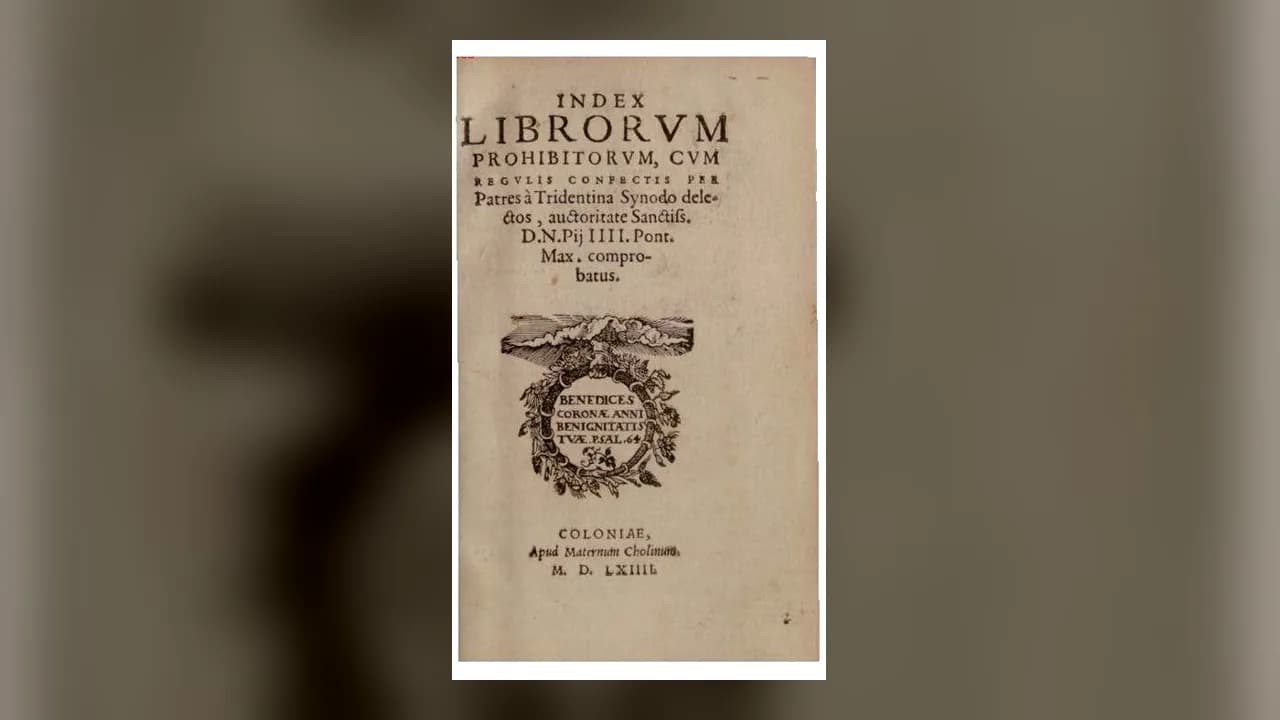
- The Index
- 1559–1966; the 1948 edition lists about 4,000 titles
- Copernicus on the Index
- from 5 March 1616; absent from the 1835 edition
- Book burnings
- 10 May 1933, Berlin: about 20,000 volumes
- Glavlit
- created on 6 June 1922
- Ministry of Justice list
- numbered up to No. 5519 on 16 October 2026
Two hundred and nineteen years on a list
On 5 March 1616 a decree of the Congregation of the Index appeared in Rome. Among other things it named a book by the canon Nicolaus Copernicus, On the Revolutions of the Heavenly Spheres: suspended, donec corrigantur, “until corrected”. Its author had been dead for seventy-three years. The book would stay on the list for 219 years and disappear from the Index only in 1835.
It is the most famous entry in the Index Librorum Prohibitorum, the catalogue the Catholic Church kept from 1559. The twentieth and last edition came out in 1948 and held about four thousand titles. Descartes, Kant, Flaubert and Sartre were among the authors. On 14 June 1966 the Congregation for the Doctrine of the Faith announced that the Index no longer had the force of ecclesiastical law.
Three machines under one word
The word “banned” hides three different mechanisms. The Index was a church list for believers, printed openly, with titles and edition numbers. Soviet censorship, Glavlit, created on 6 June 1922, worked before publication: a manuscript simply never reached the printing house, and books that did appear ended up in closed library departments called spetskhrans. Today’s Russian system is built differently. Nobody bans a book in advance; a court recognises a material as extremist.
That answers the most common search: the “list of banned books in Russia”. The country has no single list of banned books. It has the Federal List of Extremist Materials, kept by the Ministry of Justice on the basis of court decisions; on 16 October 2026 its numbering reaches No. 5519. It is not a library: the list holds leaflets, brochures, newspaper issues, audio recordings, videos and web pages, and books are only part of the entries. Article 20.29 of the Code of Administrative Offences punishes mass distribution of such materials, and their production or storage for mass distribution. The age marking from 0+ to 18+ under Law No. 436-FZ is a different matter: it is a classification, not a ban.
Why a ban smells like truth
Every prohibition is a gift to conspiracy culture. If a book is hidden, it must contain something; if it is burned, it must be dangerous; if it cannot be found, someone fears it. This logic works flawlessly and is wrong just as flawlessly. Books were banned for heresy, for indecency, for ideology, for incitement to violence, for forgery. The mere fact of a ban says nothing about whether a book is true.
Forgeries show it most clearly. The Protocols of the Elders of Zion is a proven fabrication: its text was lifted from a French political satire of 1864 that never mentions Jews, and the fraud was exposed by The Times of London in 1921. It is hate propaganda, and entries bearing its title appear on the Ministry of Justice list. The ban did not make it true, just as freedom of the press does not make every page true. The real victims of bans were other books: an astronomical treatise, a novel about one day in Dublin, philosophical works.
What the closed dossier holds
The dossier follows the documents: what exactly the 1966 notification says and what it leaves out; why the Index held Copernicus for two centuries while people read him anyway; what an American judge wrote when he let Ulysses in; how a material travels onto the Ministry of Justice list, from a courtroom to a numbered entry. At the end comes a short test for telling a real secret from a manufactured one. It fits every chapter of this book.
The open archive
The r/conspiracy archive holds only 4 posts on banned books, while four videos in the YouTube study set drew about 7.8 million views. The top post, 734 points, called shutting down websites the modern form of book burning.
- posts on r/conspiracy, 2008–2018
- 4
- comments under those posts
- 607
- the first post in the archive
- 22 February 2017
- YouTube recommendations of 4 videos
- 1,764
- views of those YouTube videos
- 7,751,001
Posts on the topic, year by year
- 20080
- 20090
- 20100
- 20110
- 20120
- 20130
- 20140
- 20150
- 20160
- 201720.2 per 1,000 posts of the forum
- 201820.3 per 1,000 posts of the forum
The busiest months
- March 2018 · 2 posts
- February 2017 · 2 posts
Counted from research archives: the popular text posts of one English-language forum, a study of YouTube recommendations and lists of conspiracy websites. What came of it is in the dossier.
The archives:r/conspiracy text-post archive, 2008–2018 (reddit-html-archiver)Faddoul, Chaslot, Farid. A longitudinal analysis of YouTube’s promotion of conspiracy videos, 2020Hanley, Kumar, Durumeric. A Golden Age: Conspiracy Theories’ Relationship with Misinformation Outlets, News Media, and the Wider Internet, 2023
Dossier for readers
The dossier
What is inside the locked materials of this chapter:
- The Index: 407 years of a list printed in the open
- 14 June 1966: what the document actually says
- 10 May 1933: bonfires in university towns
- Glavlit, the spetskhran and samizdat
- Ulysses against the United States
- Russia today: the law, the court, the list
- A real secret and a secret made to order
- A ban that was printed in the open
- Timeline: 14 dates
- Proven and invented: the verdict
- What to read next
Checking your reading permission…
Questions
Which books are banned in Russia?
There is no single list of banned books. There is the Ministry of Justice’s Federal List of Extremist Materials, filled by court decisions, and it is not limited to books. On 16 October 2026 its numbering reaches No. 5519.
What was the Index of Prohibited Books and when was it abolished?
A list of writings the Catholic Church advised the faithful not to read. The first Index appeared in 1559, the last edition in 1948 (about 4,000 titles). On 14 June 1966 the Vatican announced it no longer had the force of ecclesiastical law.
Who decides that a book goes on the list of banned materials in Russia?
A federal court, on a prosecutor’s application or in the course of a case. A copy of the decision goes to the Ministry of Justice, which enters the material in the federal list and publishes it on its website. The ruling can be appealed.
Sources
- Notification regarding the abolition of the Index of books, 14 June 1966Congregation for the Doctrine of the Faith, Vatican, 1966
- What does the Decree on Copernicanism Say?Inters.org, Rafael A. Martínez, 2016
- Book BurningUnited States Holocaust Memorial Museum, Holocaust Encyclopedia
- Protocols of the Elders of ZionUnited States Holocaust Memorial Museum, Holocaust Encyclopedia
- United States v. One Book Called “Ulysses”, 5 F. Supp. 182U.S. District Court, S.D.N.Y. (Caselaw Access Project, Harvard Law School), 1933
- USSR Law No. 1552-1 of 12 June 1990 “On the Press and Other Mass Media” (Russian text)Wikisource (text of the law), 1990
- Federal Law No. 114-FZ of 25 July 2002 “On Countering Extremist Activity” (Russian text)Wikisource (text of the law), 2002
- Extremist materials: the Federal ListMinistry of Justice of the Russian Federation
- Federal Law No. 436-FZ of 29 December 2010 “On Protecting Children from Information Harmful to Their Health and Development” (Russian text)Wikisource (text of the law), 2010
Contents of the book