
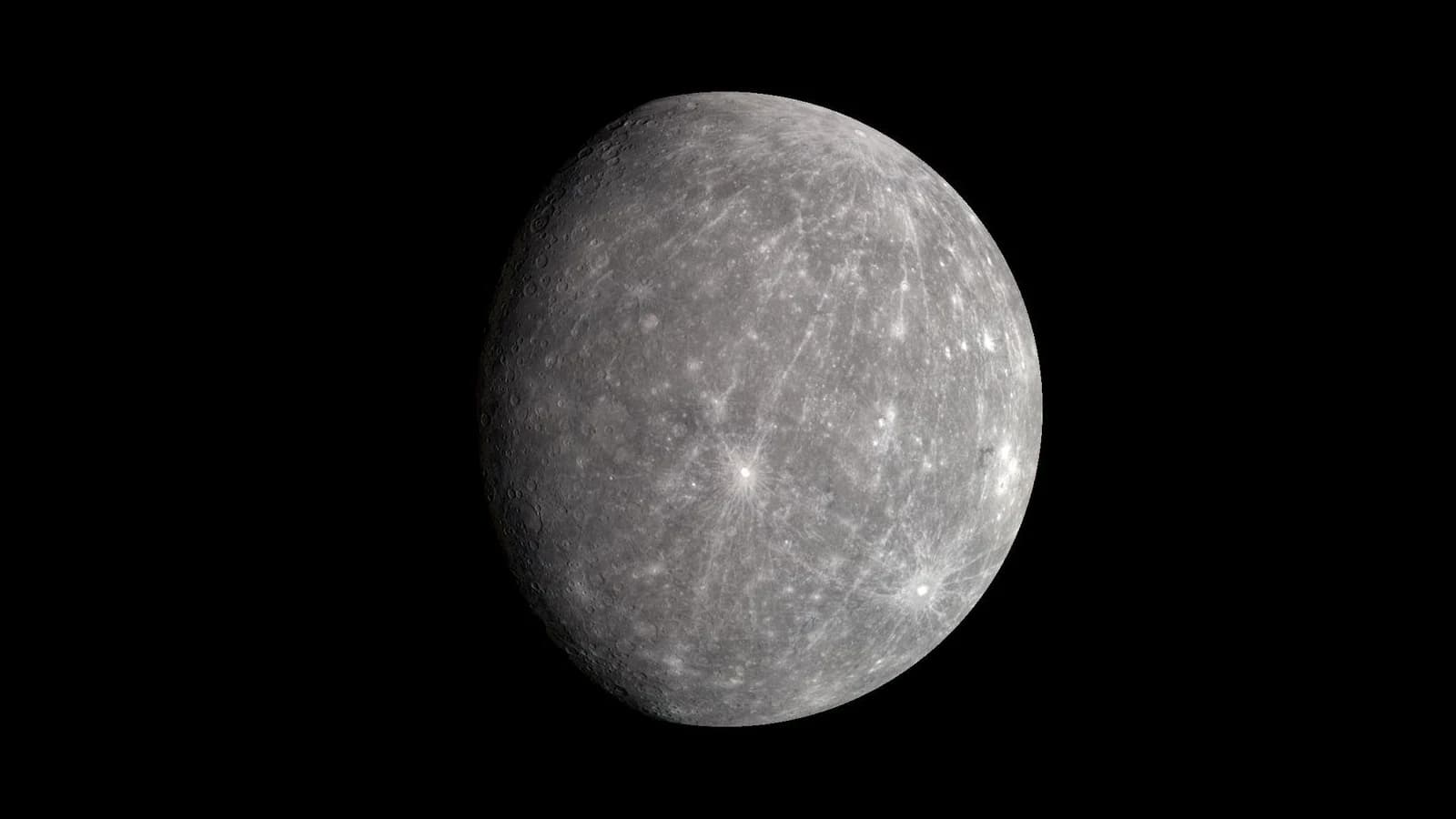
Answer in brief
Mercury retrograde 2026 has three periods: from late February to 19–20 March, from 29 June to 23 July, and from 24 October to 13 November. Each time Mercury only appears to drift backwards against the stars, because it overtakes the Earth on its inner orbit. The autumn period ends with the best morning view of the planet this year, around 21 November.
Mercury retrograde 2026: three periods, the last from 24 October
Mercury retrograde 2026 comes in three periods, and the last runs from 24 October to 13 November. The first lasted from late February to 19–20 March, the second from 29 June to 23 July. On these dates Mercury, seen from the Earth, appears to drift backwards against the stars, according to the “Astronomical Calendar for 2026” compiled by A. N. Kozlovsky and to NASA JPL’s Horizons ephemeris. As of 18 October 2026, the autumn period begins in six days.
The exact hour depends on the source. Kozlovsky’s calendar, which uses Universal Time, lists the stop on 24 October at 07:00 UT and the return to forward motion on 13 November at 11:00 UT. Horizons, computed along the ecliptic, the line astrologers measure along, gives about 07:00 and 16:00 UTC. In Moscow, three hours ahead of UTC all year, that means late morning on 24 October and the afternoon of 13 November. In time zones nine or more hours ahead of UTC, the ecliptic count already puts the end on 14 November local time.
The spring dates show why calendars online disagree by a day. Measured in right ascension, the coordinate telescopes are pointed by, Horizons gives 25 February and 19 March, as Kozlovsky’s calendar does; measured along the ecliptic, it gives 26 February and 20 March, the dates The Old Farmer’s Almanac lists in Eastern Time. The summer dates agree in both systems.
An apparent backward drift, not a planet changing direction
Retrograde motion is a trick of the viewpoint. NASA’s StarChild site, in an answer from June 2002, calls it an apparent change in a planet’s movement through the sky. Planets usually creep from west to east against the stars; for a few weeks some of them seem to slide the other way, then resume their course. StarChild names the cause: a faster planet catching up with and passing a slower one.
A NASA Goddard page by David P. Stern adds that Mercury and Venus shuttle back and forth across the position of the Sun and, being closer to it, overtake the Earth. Picture a runner on the inside lane of a track: on the far side she moves one way against the stands, and when she laps you on the near side she seems to move the other way. Mercury does the same each time it swings between us and the Sun.
Why Mercury turns back about three times a year
Mercury is the fastest planet. NASA’s Mercury fact page, updated on 25 April 2025, says it circles the Sun every 88 days at an average distance of 58 million kilometres, moving at nearly 47 kilometres per second. Wikipedia’s article on apparent retrograde motion gives the interval between these passes, the synodic period, as 116 days, and the backward drift as about 22 days on average, within a range of 19.85 to 24.19 days.
A year holds just over three such cycles, hence the three lines in the list of dates. The same article ties each retrograde to an inferior conjunction, when the planet stands between the Sun and us and is lost in the solar glare, so most of the backward drift happens out of sight.
Mercury in the October and November 2026 sky, evening to morning
The autumn retrograde sits inside a swing of the planet from the evening sky to the morning sky. Kozlovsky’s calendar puts Mercury’s greatest eastern elongation on 12 October, 25 degrees from the Sun, but warns that from Russia it shows for less than half an hour in the evening twilight above the south-western horizon.
On 4 November Mercury passes between the Sun and the Earth. Kozlovsky lists this inferior conjunction at 14:00 UT, and the 2026 calendar of the Institute of Astronomy of the Bulgarian Academy of Sciences, written for Sofia, at 16:24 local time, which is the same hour in Universal Time. The planet then moves into the morning sky. The backward stretch is built around this date: Mercury stops eleven days before the conjunction and resumes its forward motion nine days after it.
The best view comes later. Both calendars put the greatest western elongation on 21 November, about 20 degrees from the Sun. The Bulgarian one calls the end of November excellent for morning viewing: from Sofia, Mercury will have a negative magnitude and stand about 16 degrees above the horizon just before sunrise. Kozlovsky expects it in the morning twilight until mid-December.
What astrology claims about Mercury and what double-blind tests found
Astrology reads the same dates differently. The Old Farmer’s Almanac page on Mercury retrograde, written by an astrologer and dated 6 October 2026, says these periods are thought to influence communication, travel, technology and everyday decisions. It advises avoiding major contracts and big purchases, double-checking emails and travel plans, and backing up data and devices.
Science has tested astrology, though not the retrograde claim on its own. In December 1985 Nature published “A double-blind test of astrology” by Shawn Carlson, describing two double-blind tests of whether natal charts can accurately describe personality traits. Wikipedia’s article on astrology and science adds that 28 astrologers took part, over 100 charts were matched against psychological profiles, and the protocol was agreed with astrologers beforehand. The predictions did no better than chance.
The wider verdict rests on such work. The same article says the scientific community has rejected astrology for having no explanatory power, regards it as a pseudoscience, and knows of no proposed mechanism by which planets could affect people without contradicting basic physics and biology. This is not a judgement of people who read horoscopes. It means that a link between the planet’s apparent path and events on Earth has never been shown.
How Mercury retrograde became shorthand for a difficult week
Interest in the stars is wide but mostly light. Pew Research Center, reporting on 21 May 2025 on a survey of 9,593 US adults in October 2024, found that 28% consult astrology or a horoscope at least once or twice a year, and 20% of adults engage in such practices mostly for fun. In Russia, a VCIOM phone survey of 1,600 adults on 30 October 2022 found that 15% believe in horoscopes, 60% do not and 25% are unsure.
That explains the phrase’s second life. It is short, it arrives with exact dates three times a year, and it offers a ready excuse for a frozen laptop, a lost message or a late train. For many people it is a shared joke and a reminder to be careful rather than a belief. Whatever the reason behind a search for mercury retrograde 2026, the planet’s timetable does not depend on it.
Backups and clock changes worth checking in late October 2026
The advice to back up your phone holds with or without the planet. The UK’s National Cyber Security Centre, in guidance last reviewed in December 2021, defines a backup as a copy kept in a separate safe location and suggests holding irreplaceable data both in the cloud and on removable media. It recommends unplugging an external drive when it is not in use, because ransomware can spread to attached media.
Late October 2026 does have a real reason to recheck bookings: the clocks. In Bulgaria, and across the EU under Directive 2000/84/EC, summer time ends on 25 October 2026, says the Bulgarian Academy of Sciences’ calendar. In the United States, NIST says daylight saving time ends on 1 November 2026 at 2 a.m. local time. Russia has not changed its clocks since 26 October 2014, as Kozlovsky’s calendar recalls. A flight or an online meeting across these borders can shift by an hour, and Mercury plays no part in it.
Venus, Saturn, Jupiter and the next Mercury reversal in February 2027
Mercury is not the only planet backing up this autumn. Kozlovsky’s calendar has Venus turning retrograde on 2 October, passing between the Sun and the Earth on 24 October, a few hours before Mercury stops, and turning forward on 11 November; Horizons, along the ecliptic, gives about 3 October and 14 November. After the conjunction Venus becomes a morning star.
The outer planets trace their own loops. NASA’s skywatching column for October 2026, published on 1 October, marks Saturn’s opposition on 4 October, when it is visible for much of the night; Kozlovsky has Saturn turning forward on 11 December. Uranus reaches opposition on 25 November, and on 13 December Jupiter stops and starts backing up towards its 2027 opposition. Mars reaches one of its most distant oppositions on 20 February 2027.
For Mercury the next dates are computed too. Horizons puts the first retrograde of 2027 from 9 February to 2 or 3 March, depending on the coordinate; two more follow in June–July and October. What no table fixes is your own view: the hour of each stop shifts with the time zone, and the November sighting depends on latitude and weather.
Practical checklist
- Mark 24 October and 13 November 2026 in your calendar as the start and the end of the autumn retrograde.
- Recheck flights, trains and meetings that cross the 25 October EU and 1 November US clock changes.
- Back up your phone and laptop to the cloud and to an external drive that you unplug afterwards.
- Around 21 November, look low in the east before sunrise for Mercury’s best morning appearance of the autumn.
- Add 9 February 2027 to next year’s calendar: the first Mercury retrograde of 2027 begins that day.
Questions and answers
When does Mercury retrograde start and end in October 2026?
Mercury stops and begins its apparent backward drift on 24 October 2026, around 07:00 UTC, and resumes forward motion on 13 November, in the middle of the day UTC. The minute differs slightly between Kozlovsky’s calendar and NASA JPL’s Horizons; only where clocks run at least nine hours ahead of UTC can the end fall on 14 November.
How many Mercury retrograde periods are there in 2026?
Three. The planet backed up from late February to 19–20 March and from 29 June to 23 July, and does it again from 24 October to 13 November. Each lasts about three weeks, and there are three because Mercury’s 116-day synodic cycle fits into a year just over three times.
Does Mercury actually move backwards during retrograde?
No. Mercury keeps orbiting the Sun in the same direction at nearly 47 kilometres per second. It only looks as if it reverses: it overtakes the Earth on its inner orbit, and while it does so its position against the distant stars shifts the other way.
Why do some sites give 25 February for the spring retrograde and others 26 February?
Because the stop can be measured in two coordinates. In right ascension, which telescope users work in, the spring reversal ran from 25 February to 19 March; along the ecliptic, which astrologers use, from 26 February to 20 March. Time zones add a further shift of several hours.
When is the next Mercury retrograde after November 2026?
According to NASA JPL’s Horizons ephemeris, the next period begins on 9 February 2027 and ends on 2 or 3 March 2027, depending on the coordinate. Two more follow later in 2027, in June–July and in October, so the year again has three.