
Answer in brief
A joint initiative will study crops and resource exchange for future lunar habitats on Earth. Preparatory work is agreed; construction remains conditional, and the project is not a greenhouse already on the Moon.
The lunar agriculture demonstrator begins with work on Earth
NASA, the Canadian Space Agency and the German Aerospace Center are preparing a coordinated test programme for growing crops in future lunar habitats. NASA’s 30 September announcement describes work toward an Earth-based demonstrator, called LAM-GTD. The immediate step is preparatory cooperation. It does not establish that a greenhouse has been built, that a lunar site is ready or that astronauts can already depend on its harvests.
For readers following long-duration exploration, the interesting question is how food production fits into a habitat’s other demands. A crop compartment consumes electricity, water and attention while potentially supplying food and useful resource flows. Our interpretation is that the proposed demonstrator matters most as a way to examine those connections together, rather than simply show that a plant can grow inside a chamber.
The agreement and the building decision have different dates
DLR’s release on 29 September says the partners signed their memorandum in August 2026. The September publications therefore announce and explain an earlier agreement. DLR also describes a facility that could be built by 2032, after the parties decide whether and how to proceed. That is a conditional planning horizon, not a confirmed opening date or a deadline for deploying agriculture on the Moon.
Keeping these stages separate helps assess later progress. A completed design, an agreed construction programme and an operating experiment would each add different evidence. Preparatory cooperation can make those steps possible, but it does not supply their results in advance. The useful next question is which assumptions the partners will test and what evidence will support the eventual decision to build.
Three components connect plants with habitat resources
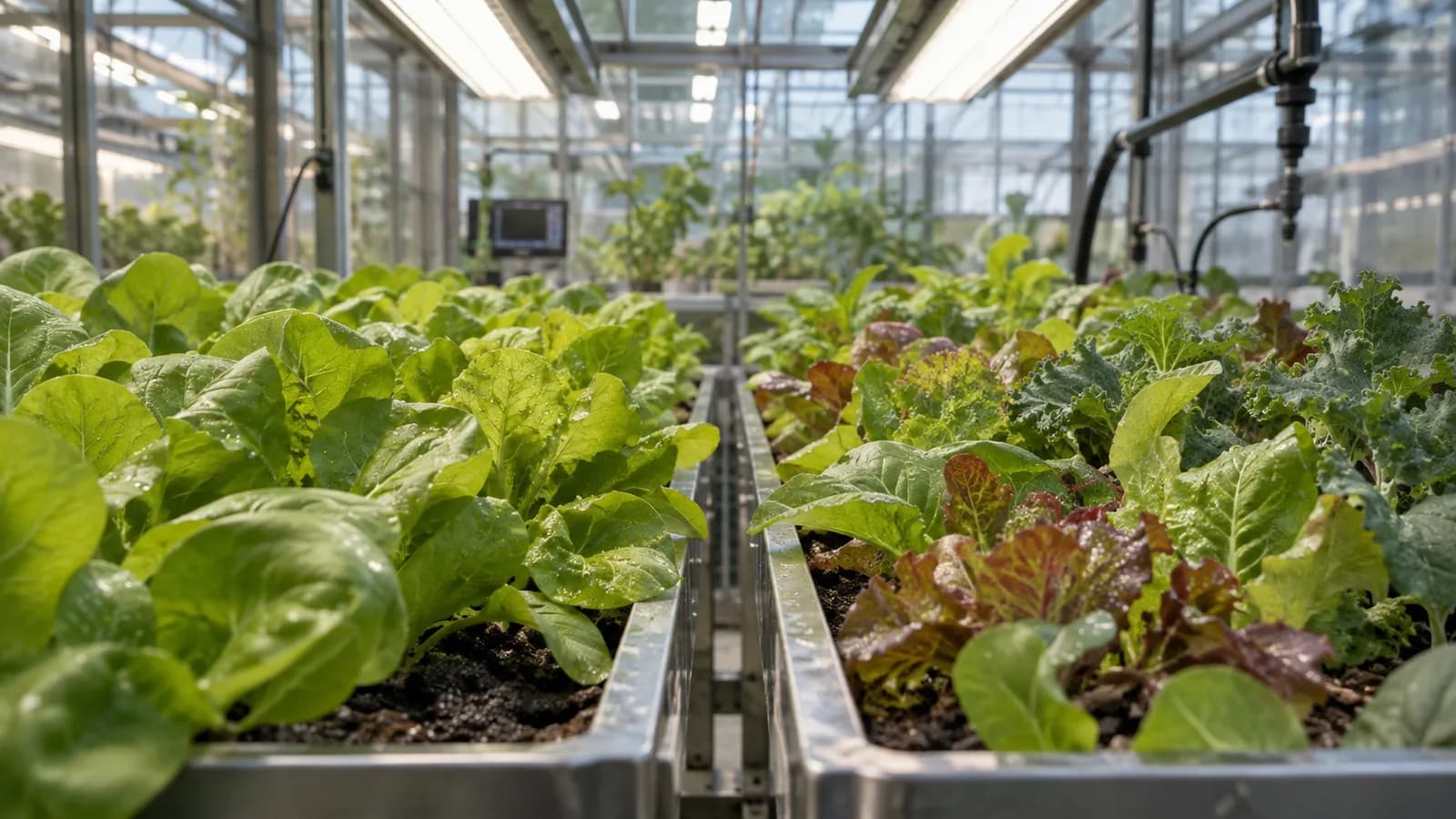
DLR describes a Ground Agriculture Module for dense crop production, an Airlock Module for pressure and gas control, and a habitat represented through the HabSim simulator. The habitat component would not be physically built as part of that simulator. The concept is intended to examine conditions including reduced pressure and exchanges of oxygen, carbon dioxide and water between the crop system and living environment.
The table identifies functions in the proposed architecture, not available hardware specifications. In our assessment, the simulated habitat is especially useful for making assumptions visible. If a model supplies a particular demand for water or oxygen, readers should be able to distinguish that assumed demand from a quantity measured in the crop module. Otherwise, an integrated result could conceal which parts were actually tested.
| Component | Intended role | Evidence boundary |
|---|---|---|
| Ground Agriculture Module | High-density crop cultivation | Proposed demonstrator |
| Airlock Module | Control pressure and gas composition | Planned interface |
| HabSim habitat | Represent habitat resource exchanges | Simulation; no physical habitat build in HabSim |
Antarctic experience supplies questions as well as precedent
DLR points to the historical EDEN ISS greenhouse programme in Antarctica, which began in 2018 and collected five years of data. Its research included plant production, system resilience, food safety, crew psychology, working hours, electricity and water. This is background experience behind the new proposal. It should not be presented as five years of results from LAM-GTD or as a trial under lunar gravity.
The breadth of those measurements suggests a sensible editorial test for the next programme: report the harvest together with the effort needed to obtain it. A higher yield could be less useful if it required frequent interventions at inconvenient times. That trade-off is our interpretation, not a reported outcome of the new demonstrator. It explains why crew workload belongs beside agricultural measurements.
A harvest must be assessed alongside its resource budget
NASA describes fresh crops as contributing nutrition and dietary variety, while plants can absorb carbon dioxide, produce oxygen and recycle water. Those functions connect agriculture to life support. They do not, on their own, demonstrate a closed system or a complete diet. The partners have announced a research direction, without publishing a measured balance showing how much resupply the proposed installation could eliminate.
A useful future report would place edible output, water inputs, electrical demand and crew time within the same stated test period. It would also explain what happened during cleaning, crop changeovers and faults. This is our suggested way to read eventual results, not an additional requirement already agreed by the agencies. It would make a successful harvest interpretable as part of an operating habitat.
The next milestone is a testable operating plan
For the public, the most informative next documents would identify experimental conditions, the crop programme and the division between physical measurements and simulation. A ground facility can answer important engineering questions while leaving others for later environments. The September releases do not establish that every lunar condition can be reproduced, nor do they publish an accepted performance threshold for a self-sufficient food system.
As of 1 October, the confirmed development is international preparation for a ground demonstrator with a defined resource-sharing concept. The project’s promise lies in learning how food production interacts with daily habitat operations. Construction decisions and experimental results still need to follow. Keeping those milestones explicit allows genuine progress to stand out when the partners publish the next stage.
Questions and answers
Is a greenhouse being installed on the Moon?
The announced work concerns an Earth-based demonstrator. It will investigate conditions relevant to future lunar habitats; the announcement does not report construction or operation of a lunar greenhouse.
When was the cooperation agreement signed?
DLR’s 29 September release says the partners signed in August 2026. NASA published its announcement on 30 September. The publication dates should not be substituted for the agreement date.
Will crops replace all astronaut food?
The partners describe fresh crops as a supplement offering nutrition and variety alongside stored food. They have not reported a system capable of supplying a complete crew diet without resupply.