
Answer in brief
Montage has moved its CK01P clock driver from samples to mass production. The component supports faster client memory, but a 9,200 MT/s label alone cannot establish PC compatibility or application gains.
A production milestone with a precise boundary
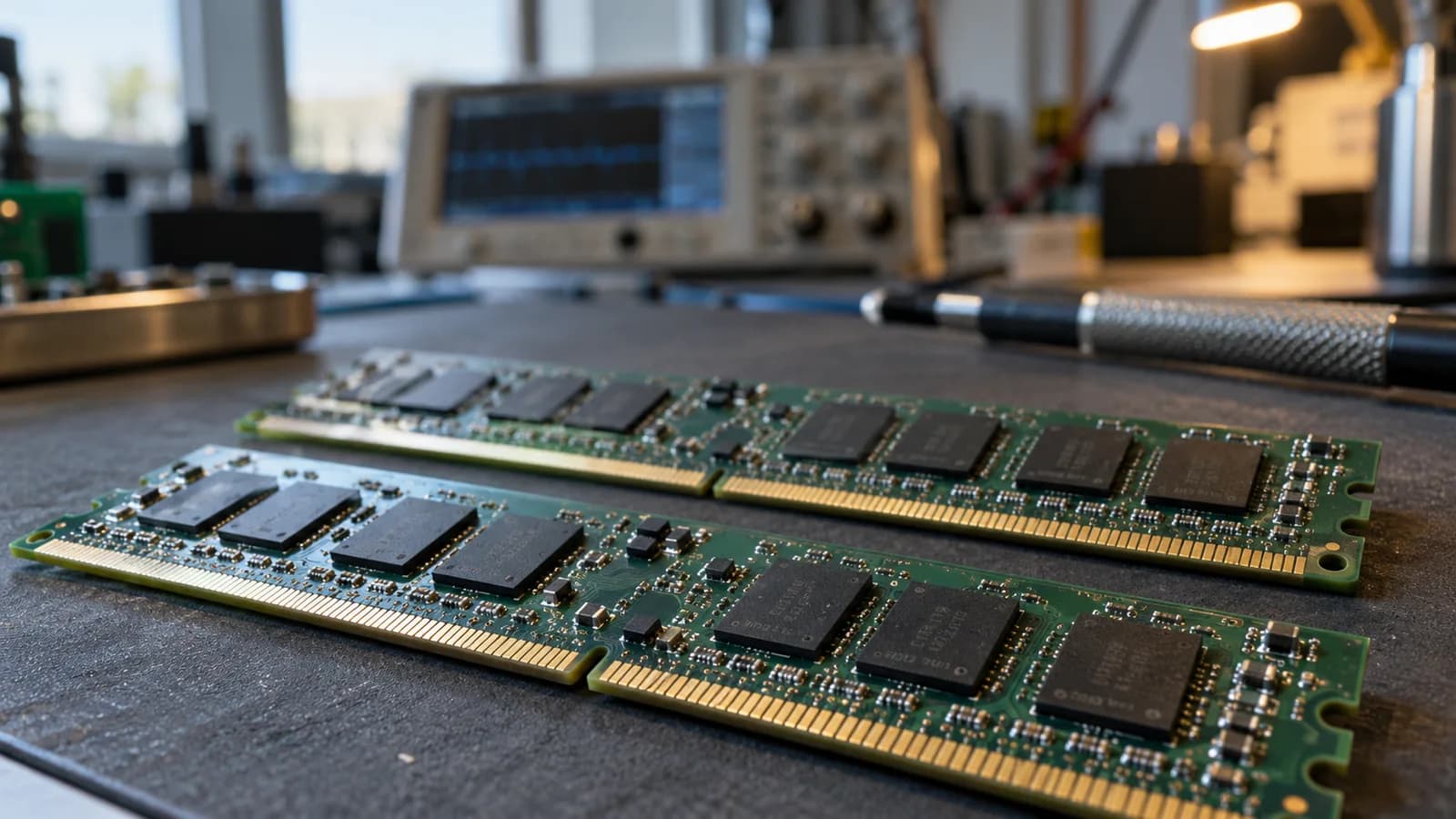
Montage Technology announced on September 29 that its CK01P DDR5 client clock driver had entered mass production. The chip supports transfer rates up to 9,200 MT/s and targets several next-generation memory-module formats. This is a supply-chain development with a practical consumer connection: memory makers gain a component for faster modules, while computer buyers still need a platform that can use them.
The timing matters because this is not the chip’s first introduction. Montage offered samples in November 2025. Moving to production changes its commercial stage, but the September release does not identify retail kits, prices, shipment volumes or a list of validated computers. Those missing details prevent a component announcement from becoming a recommendation to upgrade an existing machine immediately.
Why the clock needs its own component
Memory transfers depend on coordinated timing between the processor’s memory controller and the DRAM devices. Kingston’s October 2024 explanation describes how rising DDR5 speeds make clock noise and jitter harder to manage. A client clock driver re-drives that signal on the module. Kingston’s document is background engineering context, not independent confirmation of Montage’s new production volumes or performance.
This distinction also explains the extra letter in CUDIMM and CSODIMM: the C denotes a clocked module. A driver is neither the DRAM that stores working data nor a separate processor that makes applications run faster by itself. Its job is to support reliable signalling, giving module designers another way to operate at demanding transfer rates without treating every motherboard as identical.
What Montage has actually specified
The new release lists CUDIMM, CSODIMM, CQDIMM and CAMM among the intended formats, and states compliance with the JEDEC DDR5CKD01 specification. It also describes single-PLL, dual-PLL and bypass modes. These are options for the engineers integrating the chip; their presence does not mean a consumer can choose any memory format and insert it into the same computer.
Montage says the architecture supports programmable delay per channel and adjustable output characteristics, while unused clock outputs can be disabled. The useful interpretation is design flexibility across different module layouts. The release gives no quantified whole-system power saving, so switching off unused outputs cannot honestly be converted into a laptop battery-life claim or a percentage reduction in a household electricity bill.
| Feature | Published capability | Practical boundary |
|---|---|---|
| Transfer rate | Up to 9,200 MT/s | Platform validation still required |
| Clock modes | Single PLL, dual PLL, bypass | Selected by module/system design |
| Output control | Per-channel delay; unused outputs off | No system power saving quantified |
The headline rate is a ceiling
MT/s means millions of transfers per second. It describes the memory interface’s transfer rate, not application speed or the time a single request takes to return. For illustration, moving from 6,400 to 9,200 MT/s raises the nominal transfer rate by 43.75%, calculated from those two numbers. That arithmetic is not a benchmark and does not predict the same gain in games.
An application can be limited by computation, memory capacity, storage or other work. Even when bandwidth matters, timings and the actual operating configuration still count. VJOURNAL has not tested a CK01P module. A useful eventual review would name the processor, board firmware, module capacity, number of installed modules and workload, so that a reported result describes a reproducible system.
A matching socket is only one check
Kingston’s support guidance offers a concrete warning against reading compatibility from shape alone. It says some older Intel platforms can run compatible CUDIMMs in clock-driver bypass mode at lower rates, potentially requiring a BIOS update. That is context about particular existing platforms, not a promise that every future CK01P-based module will boot in every DDR5 socket.
For a planned build, start with the motherboard’s supported memory list and the processor’s specification, then check the exact kit identifier and firmware requirements. A laptop additionally needs an accessible, replaceable module of the right type. Buying a chip capability indirectly through a memory kit is useful only when the rest of the system can sustain the intended configuration.
What would make this matter at retail
The next meaningful evidence will be named module launches, platform validation and independently measured behaviour. Mass production makes those steps more plausible; it does not establish their dates. The important commercial question is whether faster validated kits become available at a sensible total system cost, including any board or processor change needed to take advantage of them.
For now, the announcement explains an enabling part of the memory supply chain that buyers rarely see. Montage has advanced a clocking component into production, while the buying decision remains about a complete computer. A reader who separates the chip’s supported ceiling from a kit’s rated profile and a PC’s tested operating speed can evaluate subsequent launches without mistaking one number for three different guarantees.
Questions and answers
Is CK01P a complete memory module?
No. It is a clock driver integrated into a module; it does not provide the DRAM capacity or certify a complete computer.
Does 9,200 MT/s guarantee faster games?
No. It is a supported component ceiling. Actual operating speed, timings and the workload determine any application benefit.
What should buyers verify first?
Check the exact memory kit against the motherboard support list, processor requirements and firmware, including any bypass limitations.