
Answer in brief
As of 3 November 2026, the next solar eclipse is the annular one of 6 February 2027, visible in parts of South America and Africa. The next total eclipse is on 2 August 2027 over southern Spain and North Africa, with up to 6 minutes 23 seconds of totality.
The next solar eclipse after August 2026 is annular, on 6 February 2027
As of 3 November 2026, the next solar eclipse is an annular one on 6 February 2027, and the next total solar eclipse follows on 2 August 2027. NASA’s list of future eclipses gives both dates. The total eclipse of 12 August 2026 has already passed.
NASA says the annular eclipse will be visible in parts of South America and Africa. In its decade table the central path runs over Chile, Argentina and the Atlantic, with a central duration of 7 minutes 51 seconds.
The total eclipse of 2 August 2027 crosses southern Spain and North Africa
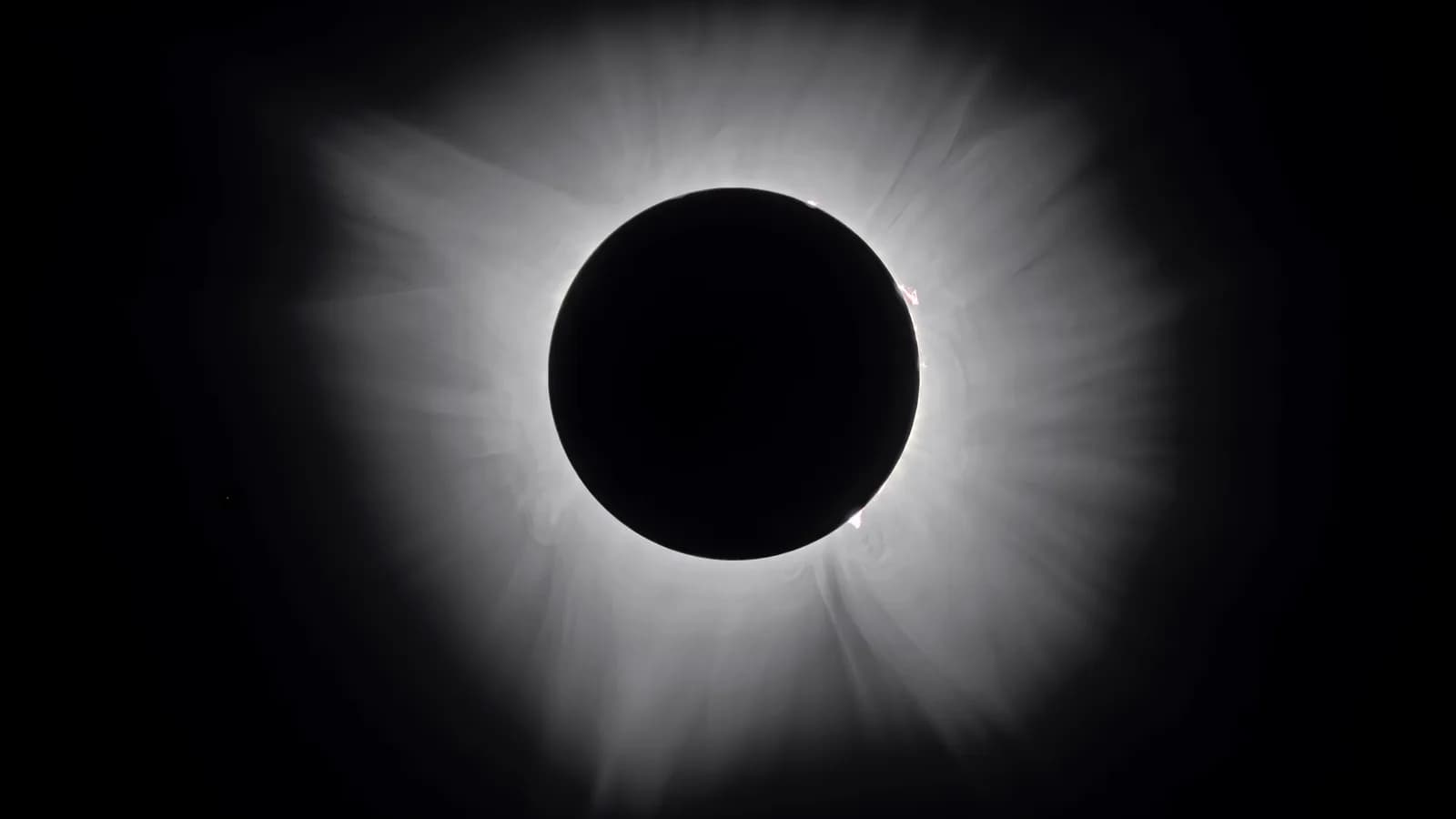
NASA says a total solar eclipse will be visible in southern Spain and North Africa on 2 August 2027. It lists totality over Morocco, Algeria, Tunisia, Libya, Egypt, Saudi Arabia and Yemen, and its decade table adds Somalia. The longest totality anywhere on the path is 6 minutes 23.2 seconds.
Outside the narrow band, NASA says a partial eclipse can be seen across most of Europe, much of Africa, the Middle East and Southeast Asia, and in eastern Canada and northern Maine. NASA notes that its predictions leave out the profile of the Moon’s edge, which may shift the point of longest totality by about 10 to 20 kilometres.
How long totality lasts in Spanish cities, according to Spain’s geographic institute
Spain’s Instituto Geográfico Nacional gives times in official peninsular time. In Cádiz totality begins at 10:45 and lasts 2 minutes 54 seconds, and in Málaga it begins at 10:48 and lasts 1 minute 48 seconds. Melilla gets 4 minutes 34 seconds. Ceuta, with 4 minutes 48 seconds between 10:45 and 10:50, has the longest totality on Spanish territory.
The institute says the rest of Spain sees a partial eclipse with at least 70 per cent of the Sun covered at the maximum. ESA describes the shadow crossing the Iberian Peninsula between 10:44 and 10:55 CEST, with about 3 minutes of totality at Cádiz.
NASA’s rules for watching an eclipse without harming your eyes
NASA says it is never safe to look directly at a partial or annular eclipse without proper eye protection. Eclipse glasses or a handheld solar viewer should meet the ISO 12312-2 standard, and ordinary sunglasses do not work, however dark they are.
During a total eclipse the glasses stay on until totality, when the Moon fully covers the bright face of the Sun and no part of it shows through the viewer. Only then may you look without protection. When bright sunlight returns, put the glasses back on at once. NASA also warns against looking through a camera, telescope or binoculars while wearing glasses, because concentrated light can burn through the filter.
What to check again before you plan around 2 August 2027
Dates and paths are astronomical predictions, but local details still matter. NASA’s tables use Terrestrial Dynamical Time rather than UTC, so take clock times from a national map such as the Spanish institute’s. The weather on the day cannot be known in advance. Check NASA’s page and the institute’s page again closer to the date.
Questions and answers
When is the next total solar eclipse after August 2026?
NASA lists it for 2 August 2027, total over southern Spain and North Africa. As of 3 November 2026, only the annular eclipse of 6 February 2027 comes before it.
Can I look at the eclipse without glasses at any moment?
Only during totality of a total eclipse, once no part of the bright Sun is visible. NASA says glasses stay on for partial and annular eclipses and for the partial phases of a total one.
How long will the 2 August 2027 totality last in Cádiz?
The Spanish institute gives 2 minutes 54 seconds of totality there, starting at 10:45 official peninsular time. ESA rounds the figure to about 3 minutes.