
Answer in brief
Ordinary absorptive panels treat reflections within a room; they should not be assumed to stop neighbour noise. Absorption may help echoey speech. Sound crossing walls, gaps or structural paths needs a separate assessment of transmission and sound insulation.
Is the problem room echo or sound from next door?
Ordinary absorptive panels treat reflections within a room; they should not be assumed to stop neighbour noise. Absorption may help echoey speech. Sound crossing walls, gaps or structural paths needs a separate assessment of transmission and sound insulation. The same office can have both problems, and treating one may leave the other unresolved. Describe the sound, its source and when it bothers you before choosing a product. An acoustic label does not tell you whether a material absorbs reflections or forms part of an assembly that limits transmission through the building.
Listen separately to your own speech, a household appliance and the neighbouring noise. Does your voice seem to linger after you stop? Does the unwanted sound arrive through a door or shared wall? Is it speech, music, footsteps or a vibration? These observations do not replace an acoustic survey, but they help you avoid choosing a product only because its packaging says acoustic or soundproof. The words need a mechanism behind them.
This comparison uses OSHA's technical explanation and the UK's BB93 school-acoustics material, checked by 8 October 2026. The sources distinguish absorption, airborne insulation, impact sound and reverberation. Their workplace or school performance targets are not adopted here as rules for your home. The purpose is to understand the mechanisms and make a better diagnostic decision.
Panels act on reflections rather than every route into the room
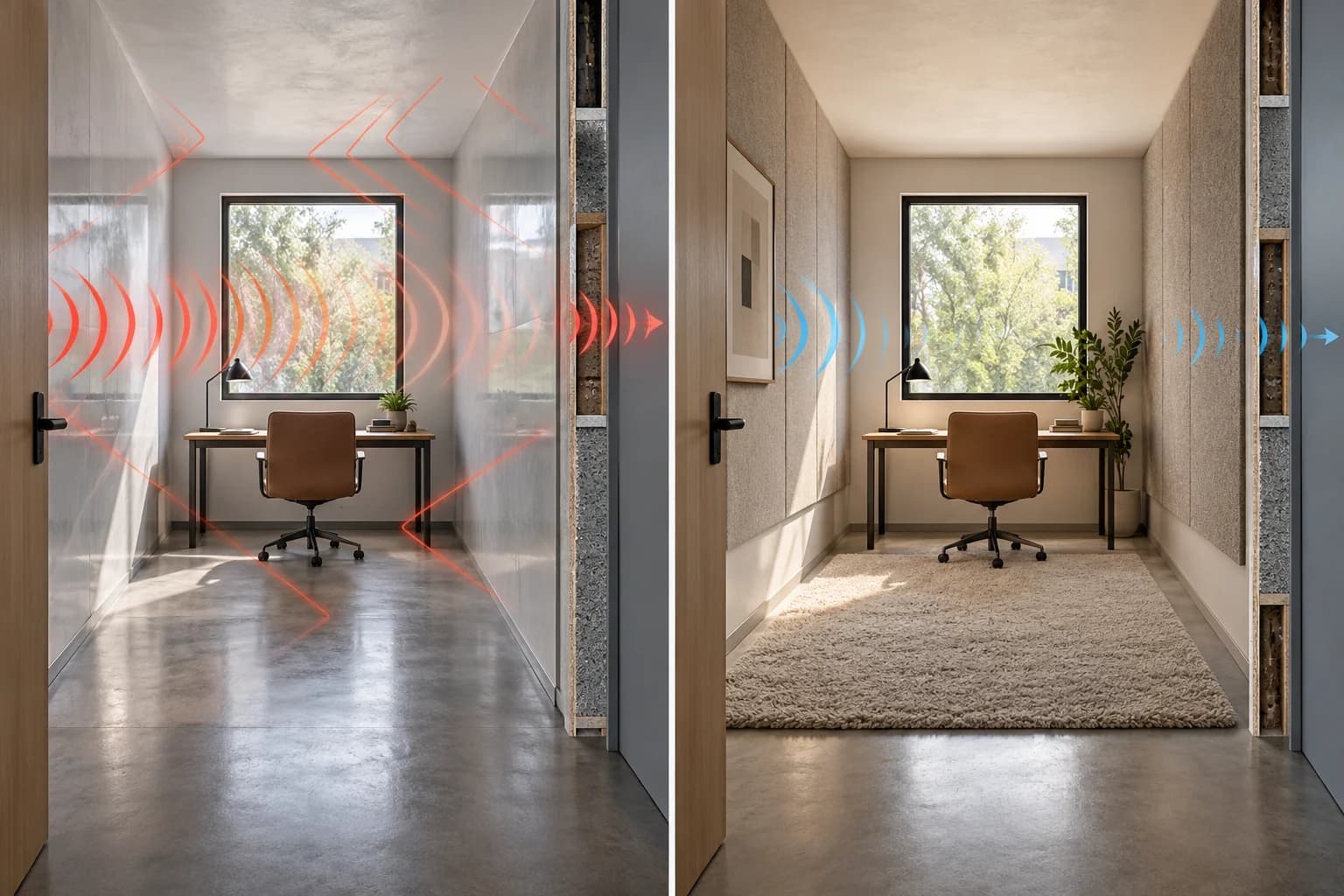
Sound from a voice reaches a microphone directly and also after reflecting from surfaces. In a room with many hard surfaces, these reflections can make speech sound more roomy. Absorptive material can reduce part of that reflected sound. OSHA explicitly distinguishes reducing the reverberant field from reducing sound that travels directly from the source. Placing a panel on a wall does not silence the person speaking or automatically block a neighbour's loudspeaker.
Material, thickness, exposed area, placement and sound frequency influence an absorber's behaviour. A decorative object with an acoustic name is therefore not enough information to predict the result. Ask for suitable absorption data and the conditions under which it was measured. A thin product that works for some frequencies should not be assumed to solve all low-frequency noise. Appearance and acoustic performance are separate purchasing questions.
For a home office, first define the desired result: clearer speech in the room, a less reverberant recording, or less noise arriving from elsewhere. Panels may be relevant to the first two. If the main complaint is transmission, the treatment must address that route. A modest improvement in call sound is not proof that the room now has meaningful sound insulation.
Sound insulation needs the transmission path to be understood
Airborne sound can pass through a separating assembly and through openings or weak elements. Structural vibration and flanking paths can involve floors, ceilings or adjoining parts of the building. The wall directly opposite your chair is not necessarily the only route. Adding visible panels there may change the room's reflections without addressing the connection that carries the unwanted sound.
A complete insulation intervention may consider airtightness, the mass and construction of separating elements, and how parts are connected or isolated. The appropriate assembly depends on the building and the noise. This is why a proposed solution should describe the existing structure, the relevant frequencies and the installation details. A product's material rating alone cannot guarantee the performance of an entire room with doors, gaps and other paths.
Do not close necessary ventilation openings or modify fire-rated construction merely to reduce an apparent gap. For structural work, involve the building owner and a qualified professional who can consider the assembly's other functions. That is a practical design constraint, not a claim that every noise complaint needs major construction. Establish the route before spending money on changes that may not address it.
Compare interventions by the problem they are designed to solve
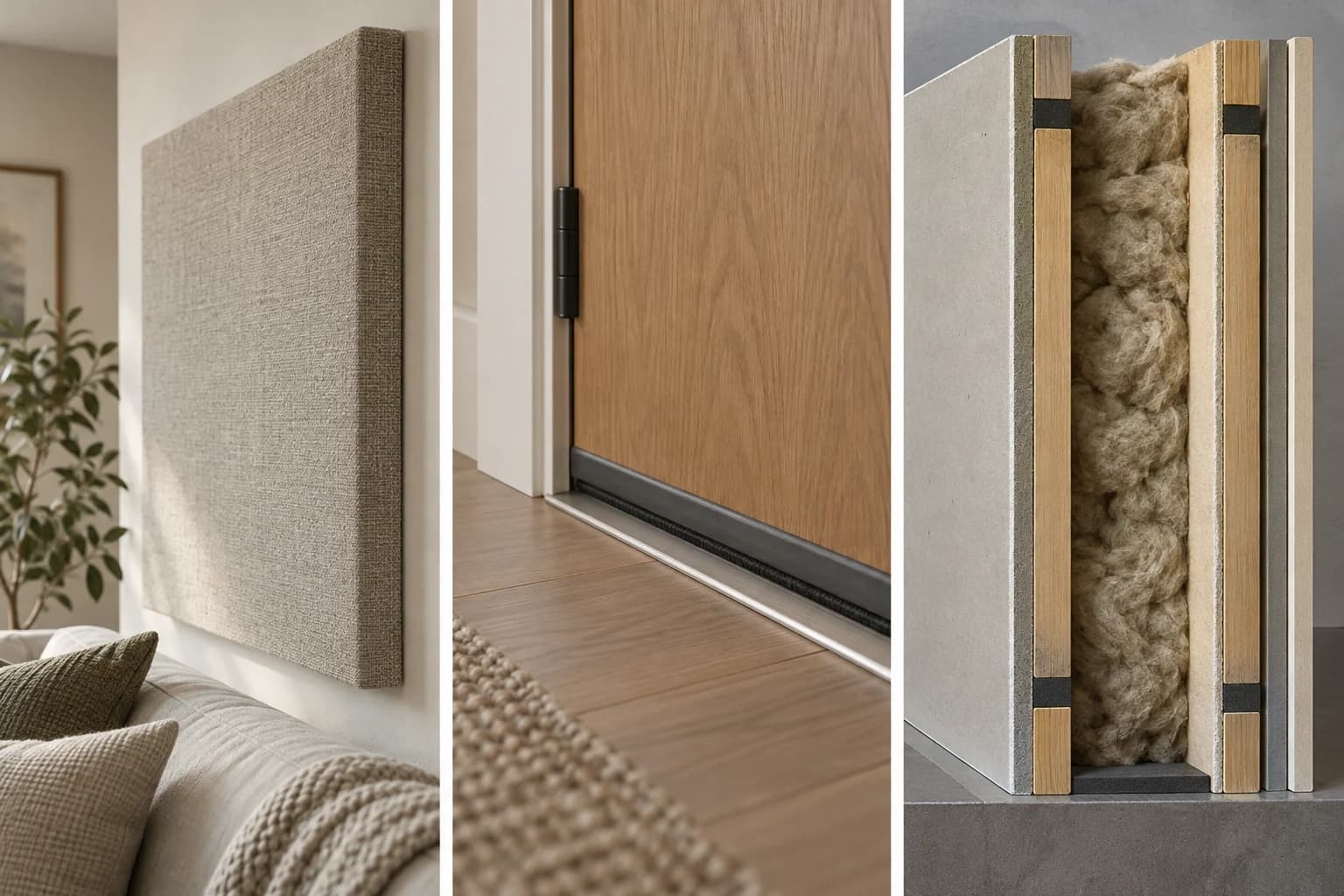
The table is a diagnostic starting point. More than one mechanism can be present: a room may sound echoing and receive external noise at the same time. In that situation, it can need both internal treatment and a separate transmission intervention. Treating one and then reporting that all noise is fixed would hide the difference between the two outcomes.
Consider a hypothetical study with bare walls, a hard floor and a distant microphone. Adding appropriately selected absorption and improving microphone position might make calls sound less reverberant. Now keep that study and add music transmitted through a weak separating assembly. The first changes do not establish that the incoming music will stop. A second investigation is needed to understand how the sound reaches the room.
Use these scenarios to frame questions for suppliers. Ask which path the proposed product addresses and what evidence supports that function. If the answer shifts from neighbour noise to a recording sounding nicer, the goal has changed. Insist on a description of your original problem before treating an attractive room photograph as proof of acoustic performance.
| Symptom or goal | Likely question | Relevant first step |
|---|---|---|
| Your voice sounds roomy | Reflections and microphone position | Check capture setup and suitable absorption |
| Neighbour speech enters | Airborne transmission and weak elements | Identify the separating assembly and gaps |
| Footsteps from above | Impact and structural transmission | Investigate floor and flanking paths |
| Low-frequency music remains | Frequency-dependent transmission | Seek diagnosis rather than thin-panel promises |
| Calls echo and outside noise enters | More than one mechanism | Separate absorption and insulation decisions |
| A product promises silence | Evidence may not describe your room | Request test category and installation conditions |
A microphone adjustment can be more useful than a wall purchase
For calls or recordings, inspect the capture setup before covering the room with material. A microphone far from the speaker can capture a different balance of direct voice and room sound than one used closer according to its instructions. Check microphone selection, placement and software settings, and listen to a short recording rather than assuming your ears hear the same balance as the remote participant.
For a practical comparison, keep the microphone, speaking position and recording settings constant while testing one change. Automatic gain control or noise processing can otherwise change the result without you noticing. Read the same short passage at a similar level, retain both recordings and ask a listener what changed. This is a listening check, not a calibrated reverberation-time or insulation measurement.
Soft furnishings may contribute to the room's absorption, but their effect depends on the room and frequency. Avoid attaching a universal decibel benefit to a rug, curtain or panel. If the problem is important enough to justify a measured target, an acoustic professional can select appropriate measurements. A smartphone recording can reveal an experience; it cannot certify that a building assembly meets a standard.
Read product ratings without merging unlike measurements
Absorption information describes how a material behaves when sound encounters it under stated test conditions. Sound-insulation information describes transmission through an assembly under other conditions. Reverberation time concerns how sound decays in a space. A favourable number for one of these is not automatically a favourable result for the others. Ask what was measured, with which specimen, installation and frequency range.
BB93 separates airborne sound insulation, impact sound and reverberation in its school-performance guidance. That separation is helpful conceptually, while its specific targets belong to its stated building use and regulatory context. A home office does not inherit a school-room criterion simply because both are used for speech. Likewise, OSHA's occupational guidance should not be presented as a residential compliance certificate.
When comparing suppliers, keep the units and evidence categories visible. If one product offers absorption coefficients and another describes transmission loss of a complete wall, the numbers cannot be placed on a single better-is-higher scale. A serious quote should connect the proposed intervention to your problem and explain the uncertainty. Reject precise promises that omit the room, assembly or installation needed to achieve them.
What to ask before buying panels or accepting a quote
Start with a written description of what you want improved and when it occurs. For speech capture, try reversible setup adjustments and a controlled listening comparison. For incoming noise, identify likely paths and obtain advice proportionate to the problem before buying decorative treatment. Keeping the goal explicit makes it easier to see whether a proposed change is relevant.
If you add panels for reverberation, assess the same recording or listening situation afterwards. If you commission insulation work, agree how performance will be evaluated and which transmission routes are included. One successful change does not settle every acoustic issue in the room. This staged approach is an editorial decision method, not a reported experiment or a promise that a particular sequence will achieve silence.
The cover is an AI conceptual illustration of the same study with bare reflective surfaces and then fabric-covered panels and a rug. A wall-section inset suggests a separate transmission route. It depicts hypothetical treatment conditions, without simulated readings or measured reductions. The useful purchase distinction remains simple: choose absorption for reflected sound, investigate insulation for transmission, and address both when the room has both problems.
Questions and answers
Do acoustic panels block music from neighbours?
Ordinary absorptive panels should not be assumed to solve transmission from a neighbouring room. They address reflections in the room where they are installed. Incoming music can involve walls, gaps and flanking or structural paths. Identify those routes and the relevant frequencies before choosing an intervention. A product labelled acoustic does not automatically provide useful sound insulation for your building.
Can acoustic panels make my voice clearer on video calls?
They may help when room reflections are an important part of the captured sound, but the result depends on the material, placement, room and microphone. Check microphone position and settings first, then compare recordings with those conditions held constant. Describe what listeners hear rather than inventing a decibel reduction. A call-quality improvement is not evidence that neighbour noise is blocked.
Does an absorption rating tell me how much sound a panel blocks?
No. Absorption data concerns reflected energy under particular material test conditions; insulation data concerns transmission through an assembly. Reverberation time is another room-level measure. Keep the measurement, units, specimen and installation conditions together when comparing products. A strong result in one category cannot be treated as proof of the same performance in another, especially in an unspecified home room.
Should school-acoustics requirements apply to my home office?
BB93 is useful for understanding the separation between airborne insulation, impact sound and reverberation, but its performance requirements concern its specified school context. They are not automatically residential targets. Define the home use and complaint first. If a measured result is necessary, a qualified professional can choose an appropriate assessment rather than transferring a school criterion without justification.