
Answer in brief
A ceiling light may be enough for general use, but reading and screen use can need different light in different places. Keep useful overhead light, add task lighting where needed and check glare from the seat. Layered lighting describes functions, not a required number of lamps or a guaranteed comfort benefit.
Is the ceiling light enough for what you do?
A ceiling light may be enough to move around a living room, but reading on the sofa and watching a screen ask different things of the light. Compare the places and activities that need support: a page where detail matters, a clear walking route and a seat where someone wants softer surroundings. Layered lighting is useful when it serves those needs; adding more fixtures is not itself the goal.
For a hypothetical small living room, draw three positions: the seat used for reading, the conversation area and the route to the door. Include the television or laptop if it is regularly used there. Sit in those places rather than assessing everything from the entrance. Your normal posture matters: a lamp that looks attractive from the doorway might put its bright opening directly in the reader's line of sight.
Write down a specific problem before shopping. “The page is in my own shadow” is more useful than “the room needs warmth.” Equally, “I cannot turn down the overhead light without leaving the doorway dark” points to control and distribution. These observations do not constitute a professional lighting survey, but they create a clear brief for an adjustable lamp or a conversation with a designer.
What do ambient, task and accent lighting do?
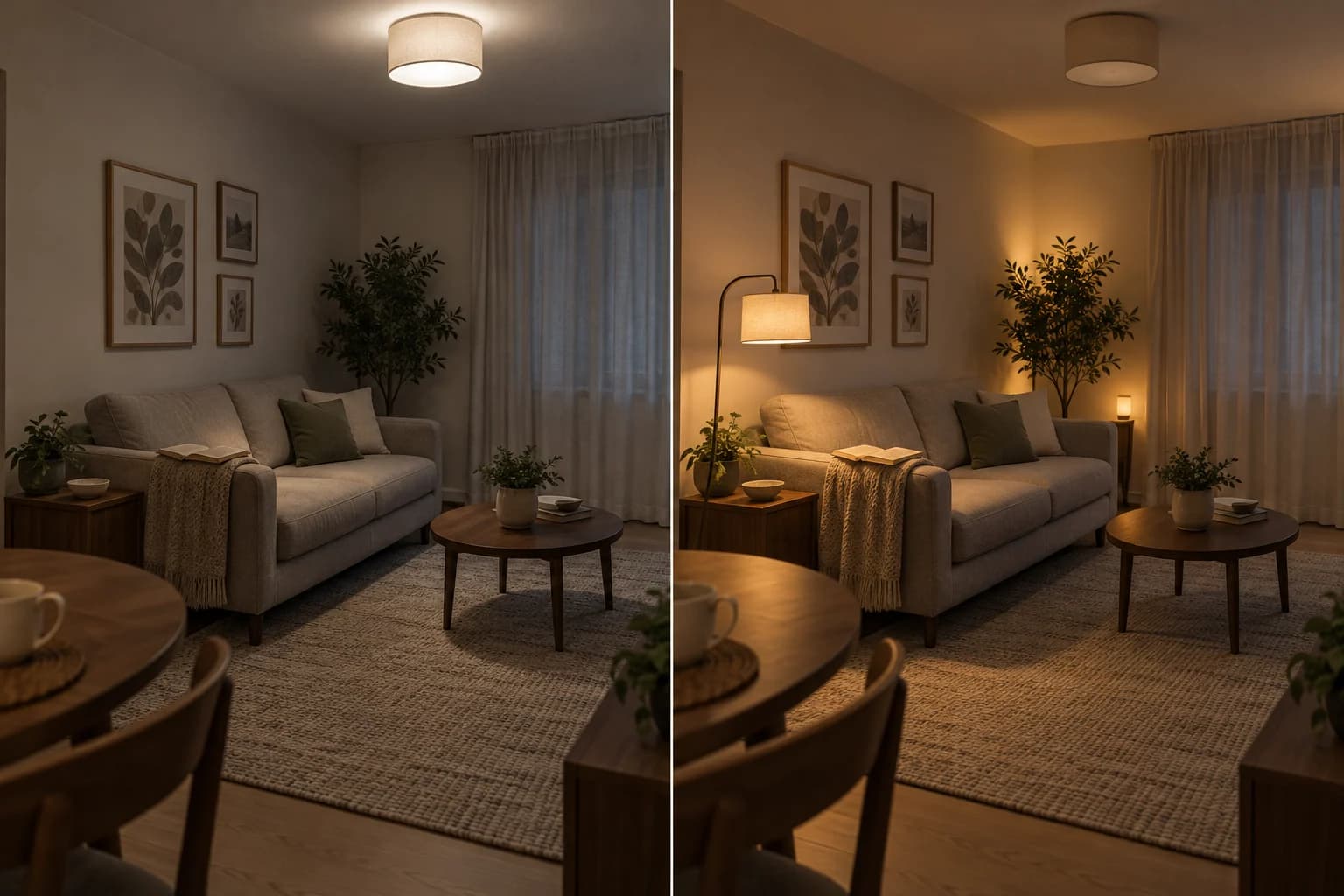
The DOE residential lighting guide separates ambient, task and accent functions. Ambient light supports general occupation, task light serves a particular activity, and accent light draws attention. These are useful descriptions of jobs, not a requirement to buy three categories of fitting for every room. One fitting may contribute to more than one job.
Apply that distinction to the sofa. General illumination helps someone cross the floor and recognise other people. A reading lamp can be directed towards the page. A small source near a wall or picture may shape the background. If the picture is unimportant to the occupants, accent lighting can simply be omitted. Layering becomes wasteful when every available surface receives a light without any corresponding use.
Start with the existing ceiling fitting and identify what it already does well. Keep that role in the plan. Then try one additional source in the weakest activity zone before building a complete collection. A borrowed table lamp can reveal whether a different location helps. It cannot establish the final lighting performance, but it can prevent buying several decorative objects to solve a single placement problem.
Where should a reading lamp go?
Consider a book held on the lap, a magazine resting on a table and craft work spread across a surface. Their light needs occur in different places. A lamp positioned for the first may illuminate the reader's shoulder instead of the second. Adjustable height and direction are useful because the activity can move. The relevant question is whether the light reaches the working surface in the posture you actually use.
Move the source while remaining seated. Look at the page, then look towards the room. If the bright lamp opening is distracting, try changing its angle or moving it outside the usual sightline. If your hand or head repeatedly blocks the light, try the other side or a different height. Do not assume the same side works for every person, seating arrangement or manual task.
CCOHS lighting guidance distinguishes general and local illumination and discusses glare. Here that supports a practical placement check, not a claim that the pictured lamp treats eye symptoms. Use your own page and normal glasses for the trial. If difficulty remains, the answer may involve print size or an individual visual need, not another fixture purchased on the strength of an appealing photograph.
How do you avoid glare on screens and faces?
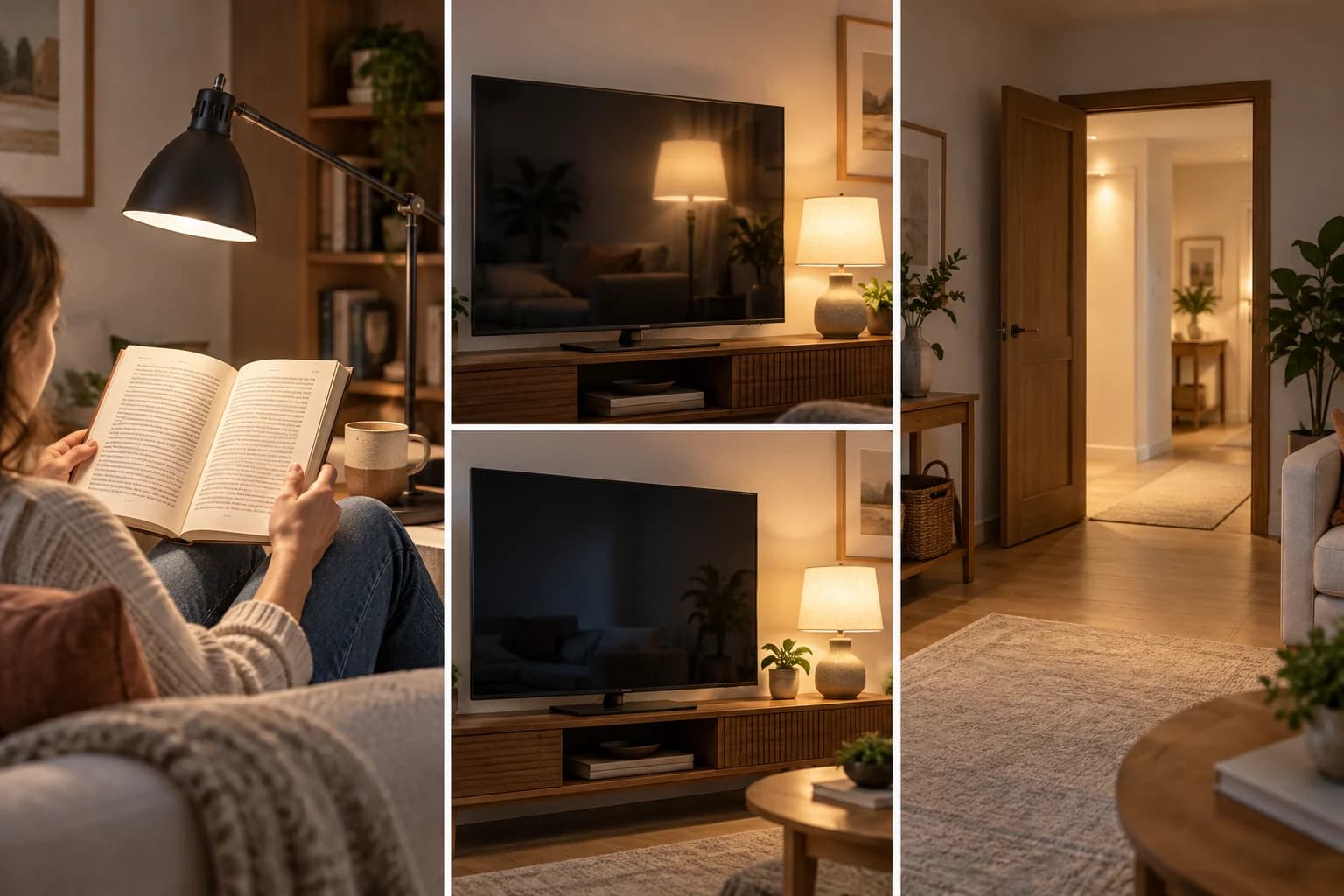
The best reading position might be a poor screen position. A source behind the viewer can appear in a reflective display; a lamp behind the screen may produce a different visual balance. Try the screen both on and off, since its dark surface can reveal reflections that disappear in a colourful programme. This is a household observation, not a brightness measurement or a claim about any display model.
Conversation introduces another position. Check how faces appear from the seats people use together. A dramatically lit corner may look convincing in a photograph yet leave one person's face hard to see. You do not have to make every part of the room equally bright. You do need to decide whether a decorative effect is taking priority over the activity for which that area exists.
Include the route around the coffee table and towards the door. An arrangement that works while seated may be inconvenient when someone stands up. A separate general-light setting can serve movement without forcing the reading lamp to illuminate the whole floor. In a household with different routines, consider who reaches each switch and whether changing one person's setting unexpectedly changes another person's usable space.
Which controls and light colour suit the room?
Layered lighting is easier to use when its sources can be controlled separately. A ceiling fitting and a reading lamp connected to one unavoidable switch offer less flexibility than their number suggests. Before choosing a control system, describe the settings you need: arriving home, reading, talking and using a screen. That simple list can be more useful than a large menu of automated scenes.
Check the actual compatibility of lamps, drivers and dimmers with their documentation. A product described as dimmable still needs an appropriate control arrangement. Try the useful range rather than assuming the lowest possible setting is the objective. For plug-in lamps, include socket location and a sensible cable route. New wiring or changes to installed equipment belong with an appropriately qualified installer under local requirements.
Colour appearance is a separate decision from the amount or direction of light. Compare finishes, the page and people's faces under the intended sources, rather than selecting everything from marketing photographs. Different households prefer different evening appearances. Neither a warm-looking image nor a specified colour temperature establishes better sleep, a medical benefit or a comfortable result for everyone. The useful outcome is a setting the occupants can choose and understand.
What does the before-and-after illustration show?
Our cover shows an AI-generated living-room concept. One panel uses the central ceiling light; the other adds a reading source and a softer background source while changing the overhead setting. The book and furniture make the intended use visible. This is an editorial illustration of arrangements, not photographs taken before and after a real installation. It does not prove that one panel meets an illumination target.
In particular, rendered exposure and apparent colour can make an illustration more persuasive than the underlying design information warrants. A brighter page on screen does not give its real-world illuminance. A pleasant room image cannot report glare at another seat, a resident's comfort, electricity consumption or the accessibility of a switch. Use the illustration to ask questions about positions and functions, rather than to borrow an invented result.
The decision table turns those questions into checks you can make in your own room. Treat each row as a possible reason for another source, not a shopping list. If your existing arrangement already serves the activity, the row may require no purchase. If several rows point to the same adjustable lamp or a more useful switch position, one intervention may address several inconveniences.
| Situation | Ceiling-only limitation to check | Possible layered response | Check before buying |
|---|---|---|---|
| Reading on the sofa | Your head or body shadows the page | Adjustable local lamp | Test the page from your seated posture |
| Conversation | Faces are difficult to see from one seat | Rebalance general or indirect light | Compare all regularly occupied seats |
| Television or laptop | A source reflects in the screen | Move or independently control that source | Inspect the screen both dark and in use |
| Moving through the room | Dimmed overhead light leaves a route unclear | Retain a separate general-light setting | Walk around furniture and check switch access |
| Artwork or wall texture | The intended feature has little emphasis | Optional accent source | Decide whether that emphasis serves the room |
| Mixed activities | One switch forces everyone into one setting | Separate controls for distinct jobs | Check compatibility and household routines |
Try one lamp before changing the whole room
Begin with one normal evening activity and one proposed change. Keep the seat, page, screen position and other light settings as consistent as practical. If taking comparison photographs, fix the camera position, exposure and white balance, and note daylight conditions. Otherwise automatic camera adjustments can create a dramatic difference that is partly photographic. Even careful photos remain a record of appearance rather than a complete measurement of usable light.
Ask every regular occupant to try their usual position. Record specific observations: a reflection remains on the laptop, the book is easier to place, a switch is awkward to reach, or the route beside the table is still difficult to see. These descriptions are more useful than assigning a made-up comfort score. Check the alternative arrangement for new inconveniences before treating the initial problem as solved.
Buy or install the next element only when its role is clear. The finished plan might be a ceiling light plus a reading lamp, or several separately controlled sources in a room with competing activities. It might also retain the ceiling-only arrangement for some occasions. The success criterion is an understandable choice of settings for actual use, with limitations visible, rather than a room that always looks like its most flattering picture.
Questions and answers
Is a ceiling light enough for a small living room?
It can be, depending on what you do and where you sit. Check reading, screen use and circulation separately. Ambient, task and accent are functions, not a minimum lamp count. Add a source only for an unmet need, then check whether its position or glare creates another problem.
Does layered lighting save electricity?
No savings were measured for this comparison. Consumption depends on the actual equipment, power settings and time in use. Independent controls can let you choose which sources operate, but adding lamps can also add consumption. Compare the real products and your routine before making an energy claim.
Can a room photo show whether there is enough light?
It can show appearance and suggest positions, but exposure, rendering and display settings alter the result. It cannot establish illuminance on a page or the comfort of every occupant. Our paired image is AI-generated. Use a real activity trial or a suitable professional assessment for decisions that need measurements.
Should a reading lamp replace the ceiling light?
Not necessarily. A local lamp may serve the page while general light continues to serve people and circulation. Try combinations from the reading seat and walking route. Separate controls are useful when the activities conflict, but the appropriate arrangement depends on the particular room and occupants.