
Answer in brief
LACMA plans Paul R. Williams: Architect for Living for 15 November 2026–31 May 2027 in the Resnick Pavilion. The announced display brings together drawings, photographs and related objects. As of 8 October, it is a forthcoming exhibition; admission availability still needs checking.
When does the Paul R. Williams exhibition open?
LACMA announced Paul R. Williams: Architect for Living on 7 October, with a scheduled run from 15 November 2026 to 31 May 2027 in the Resnick Pavilion. At the 8 October editorial cutoff, this is a forthcoming exhibition. Those dates give architecture readers a useful planning window, but they do not establish which tickets or guided visits will be available on a particular day. The museum’s exhibition page remains the appropriate place to reconfirm the schedule before arranging a visit.
What will LACMA show beyond celebrity homes?
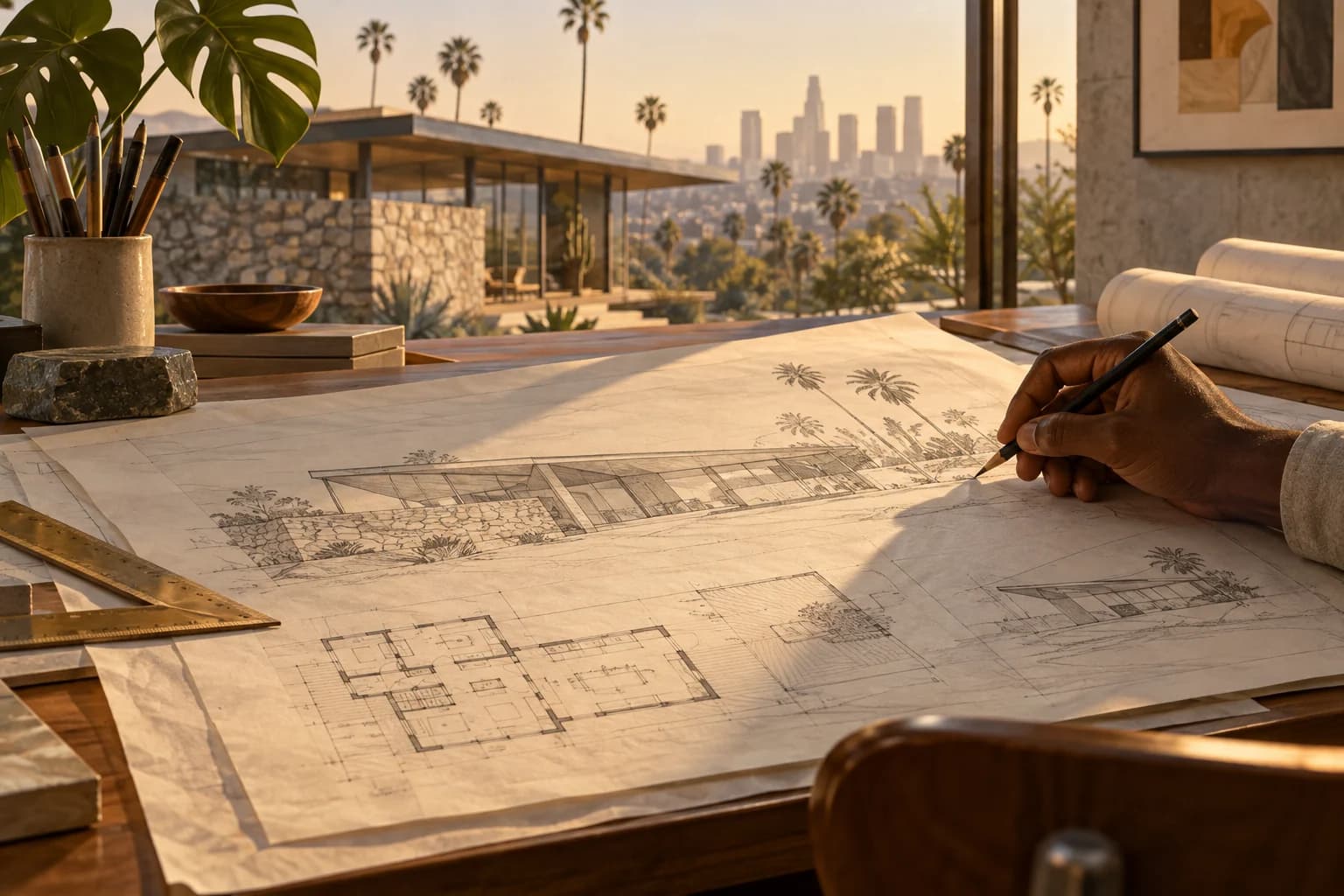
The museum’s advisory describes more than 120 drawings, photographs and archival ephemera, supplemented by additional publications, photographs and related objects. Exhibition design is assigned to Studio Barnes. That combination invites visitors to examine architectural decisions as well as finished appearances. A plan can explain how rooms connect; a photograph can show a building at a particular moment. Neither alone establishes the condition of the same property today, and a museum presentation does not automatically provide access to the buildings it discusses.
Where do the Williams archive materials come from?
Getty announced the joint acquisition of Williams’s archive with the USC School of Architecture in June 2020. Its account describes material from across his career, including commissions that were never built. That distinction is valuable when looking at an architectural rendering: an image may preserve an ambition rather than document a completed structure. The future LACMA display draws on an established archive, while the acquisition announcement supplies historical context rather than independent proof that the new galleries are already installed.
Which housing and civic projects are in scope?
LACMA’s outline includes residential, civic, religious, commercial and hospitality work. Reading Williams only through famous clients would therefore miss the scope of the planned presentation. Housing asks how limited space supports everyday routines; civic and religious buildings ask how communities gather and move. Comparing those purposes gives a visitor more to investigate than a single preferred style. The AIA’s historical record also documents Williams’s posthumous Gold Medal in 2017, offering a separate institutional reference for his professional recognition.
What should you check before visiting LACMA?
A useful starting question is how Williams adapted circulation, shared space or privacy to different commissions. Follow one feature across drawings and photographs, noting whether the object describes a proposal, a completed project or a later alteration. For practical arrangements, check LACMA’s current admission and accessibility information alongside the exhibition dates. We have not inspected the installation or tested its visitor route. That leaves the article as a sourced preview of the announced programme, with a method for looking closely when it opens.
Questions and answers
When can I see Paul R. Williams at LACMA in 2026?
LACMA’s announced exhibition dates are 15 November 2026 to 31 May 2027, at the Resnick Pavilion. As of 8 October, the show is still forthcoming. Recheck the museum’s exhibition and admission pages before travelling, because the published date range does not establish daily entry availability, guided tours or a particular ticket price.
What kinds of buildings will the exhibition cover?
LACMA’s planned selection covers several building types, rather than only celebrity homes. LACMA describes work across housing, civic buildings, religious spaces, commercial commissions and hospitality. The planned selection includes drawings, photographs and related objects. This is an opportunity to compare different building purposes, but the announcement should not be read as a promise of access to the properties themselves.
Were all the projects in Williams’s drawings built?
An architectural drawing can show an unbuilt proposal. Getty’s account of the archive explicitly includes projects that were never built. Look for the object’s date, project status and relationship to later photographs. A rendering can communicate a design intention, while a photograph records one view at one time; neither proves the present condition of a building.