
Answer in brief
On 21 November 2026, BepiColombo achieved about 77% of its planned velocity change before its braking burn stopped. ESA confirmed a stable 75-hour orbit against a planned 58-hour period and adapted the remaining manoeuvres within the existing number of burns.
The burn stopped early. The orbit held
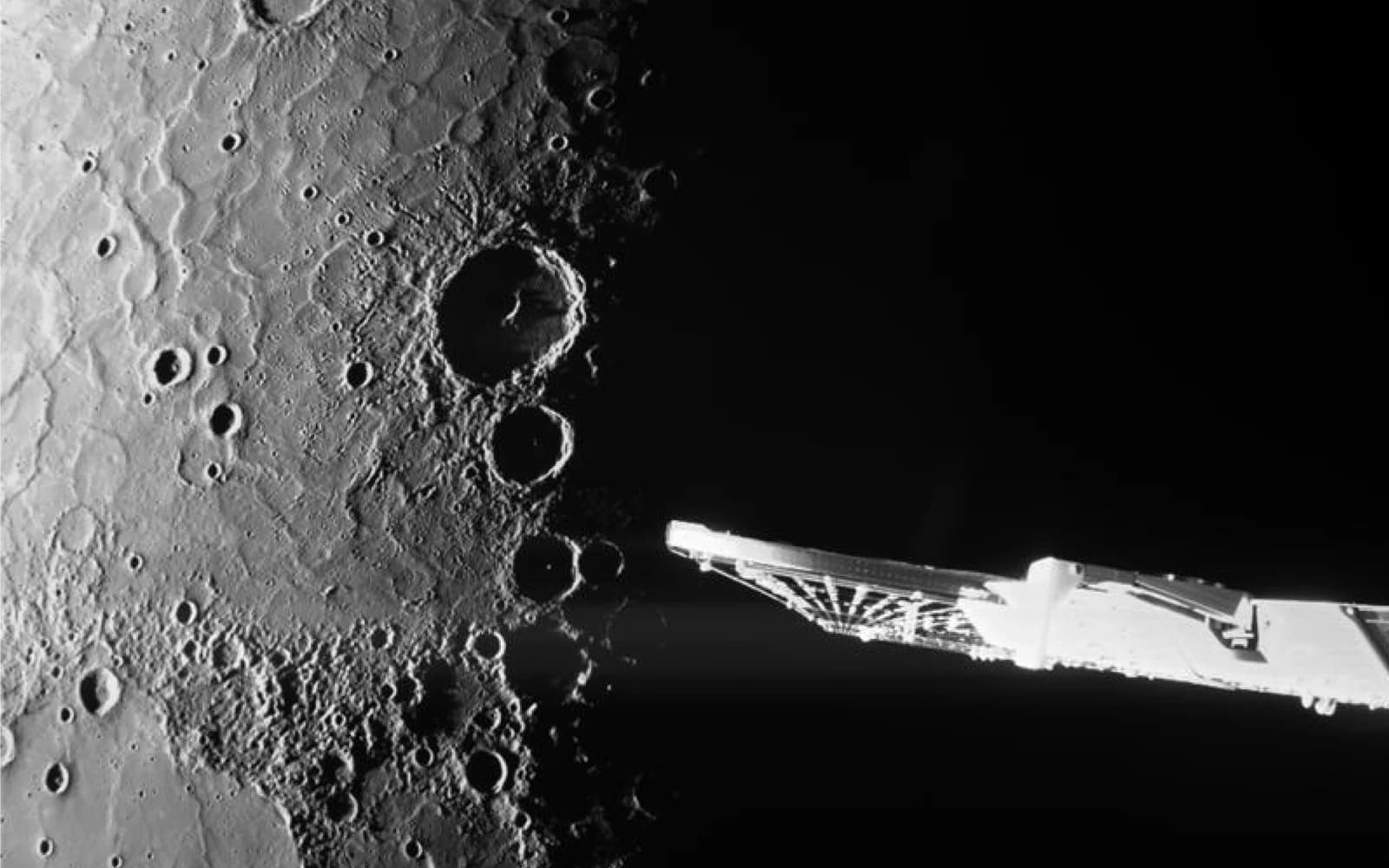
BepiColombo entered a stable orbit around Mercury on 21 November 2026 even though its first major braking burn cut out early. ESA’s 23 November operations report put the resulting orbital period at 75 hours, 17 hours longer than planned. More than eight years after launch, the European-Japanese mission had secured its first lasting orbit, with both science spacecraft still attached.
At 18:24 UTC, 635 km above the surface, the European Mercury Planetary Orbiter (MPO) started four thrusters aligned with the spacecraft’s axis. The burn was scheduled to run for 37 minutes. BepiColombo had turned into position earlier, interrupting contact with Earth as planned while it executed commands sent in advance. When ESA’s New Norcia antenna in Australia picked up the signal again, spacecraft telemetry showed that the burn had stopped and BepiColombo had entered safe mode.
A radio signal and an orbit answer different questions
Safe mode suspends nonessential activity to protect the spacecraft when it detects a problem. The restored radio link let controllers read that status. To establish whether Mercury had retained the spacecraft, ESA’s flight dynamics team had to reconstruct its trajectory. Engineers calculated that the burn had delivered about 77% of the planned change in velocity. The trajectory analysis then confirmed orbital capture.
ESA and spacecraft manufacturer Airbus traced the interruption to a software issue involving attitude guidance, which governs how the spacecraft is pointed, and thruster control. The teams were still investigating on 23 November. The unusually long first orbit was already known by then. An investigation into the cutoff and a calculation of where to fire next could proceed in parallel.
Eight years to arrive at a speed Mercury could hold
A spacecraft leaving Earth carries much of Earth’s orbital motion around the Sun. As it falls toward the inner Solar System, solar gravity speeds it up along its trajectory. To stay at Mercury, it has to meet a moving planet at a small enough relative speed. Doing all that braking with chemical engines would demand a much heavier propellant load, as ESA explains in its account of the journey.
BepiColombo’s transfer module used solar-powered ion engines to change the trajectory with gentle thrust over long periods. ESA’s timeline records nine gravity assists: one at Earth, two at Venus and six at Mercury. Each encounter bent the path, and together they brought the spacecraft in gently enough for weak stability capture. Mercury’s gravity could hold it temporarily for several circuits. The November chemical burn made that capture lasting, even with less braking than planned. ESA says the technique had been used at the Moon and makes its planetary debut at Mercury.
Seventeen extra hours changed the flight plan
A circuit that takes 75 hours instead of 58 pushes back the next return to the part of the orbit where braking is most efficient. ESA designed the descent as a series of short burns near the closest point to Mercury, where braking lowers the far end of the orbit. A single long firing would continue well past the best point and use propellant less efficiently. After each burn, the team determines the orbit actually achieved and designs the next manoeuvre around it.
That flexibility mattered as soon as the first burn stopped. ESA says it has adapted the remaining sequence without adding any burns. The 75-hour orbit gave the team a new starting point for the approach to separation and for MPO’s gradual descent to its science orbit, which ESA expects it to reach by March 2027.
Two spacecraft can test what caused a change
As of 24 November, ESA plans to split the pair on 9 December in Germany, already 10 December in Japan. The mission timeline puts the start of science operations on 6 April 2027, subject to operational changes. In its lower orbit, MPO will map terrain with a laser altimeter and use radio tracking to probe Mercury’s gravity and interior. Japan’s Mio will fly a more elongated orbit, measuring the magnetic field, charged particles and plasma waves.
JAXA explains why both spacecraft carry magnetometers. A reading from a single moving probe mixes differences from place to place with changes over time. During a disturbance, readings from two positions at the same time let scientists check how far a change extends and help distinguish the field generated within Mercury from effects driven by the solar wind. That comparison is the scientific payoff of getting two spacecraft into different orbits around the same planet.
Questions and answers
What does the 77% figure measure?
It is ESA’s estimate of the share of the planned velocity change the four thrusters delivered. The 37-minute figure was the scheduled burn length. ESA’s 23 November update gives the delivered velocity change as a percentage and describes the burn as ending early.
Why send two orbiters to Mercury?
ESA’s MPO will map the surface and probe the interior. JAXA’s Mio will measure the magnetic field, plasma and waves around Mercury. Both carry magnetometers, so readings taken at the same time in different places can help separate Mercury’s own field from disturbances driven by the solar wind.