
Answer in brief
After its transfer module departed, the joined orbiters used their own thrusters for a measured correction. The successful burn is a navigation step, not arrival.
An eight-minute test on the final approach
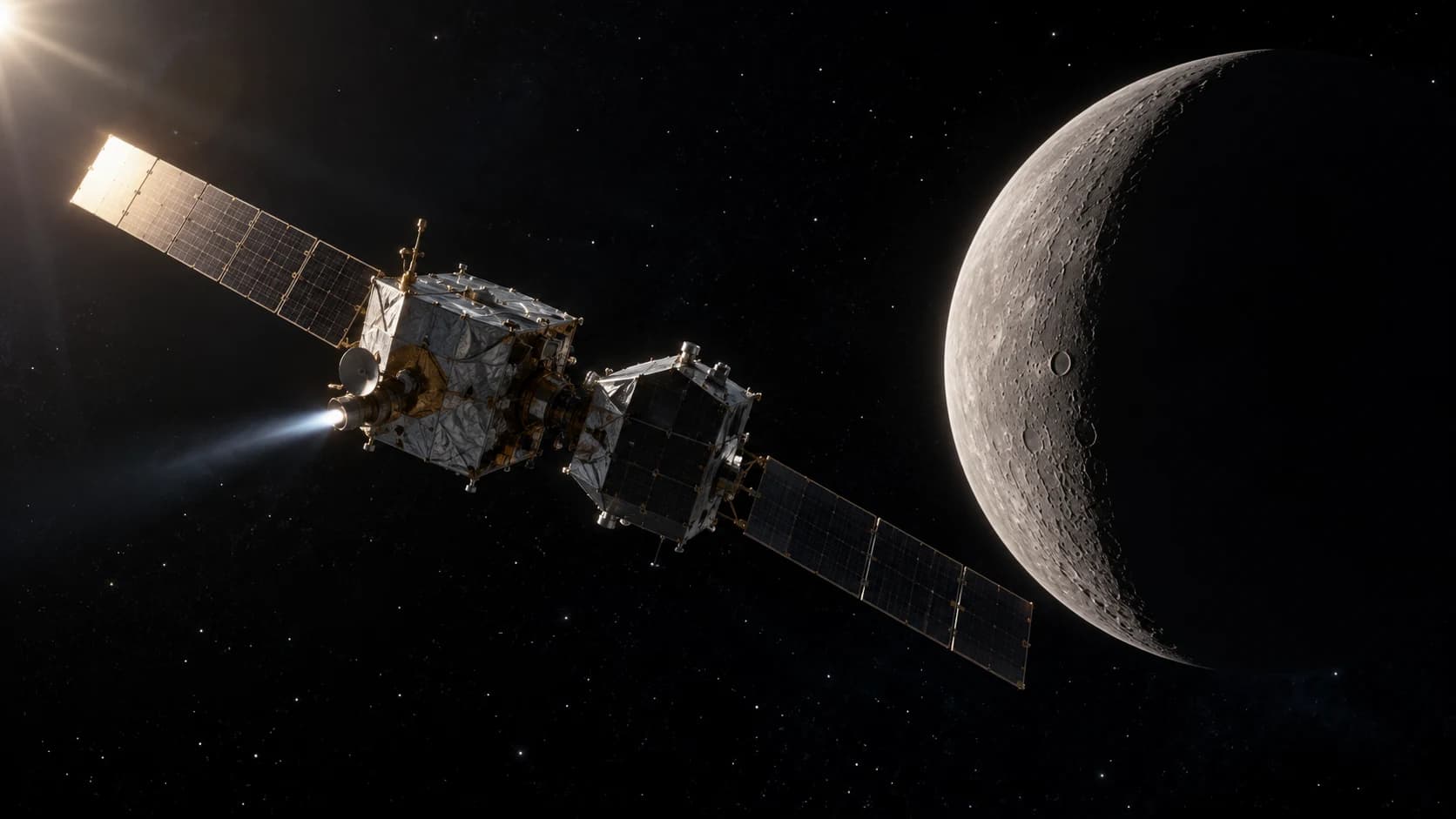
ESA's arrival log, updated on 28 September, says BepiColombo fired the axial thrusters of its Mercury Planetary Orbiter on 24 September for eight minutes and 42 seconds. Controllers measured an 11.4 metre-per-second velocity change while watching power, pressure, temperature, acceleration and radio Doppler data. This was the first planned course correction after the Mercury Transfer Module separated on 3 September. The result matters because the European orbiter now has to steer the joined stack carrying Japan's Mio as well as itself.
What changed when the transfer module left
The transfer module handled much of the long interplanetary cruise. With it gone, the science spacecraft has a different configuration and a new navigation responsibility. A measured thrust in that configuration confirms that engines, guidance and ground monitoring can work together on the remaining approach. It does not mean the critical Mercury capture has happened. ESA says further small corrections are scheduled to refine targeting before the principal orbit-insertion sequence in November; each will be assessed against the required trajectory.
Two missions within one arrival
BepiColombo is a joint ESA-JAXA mission. The European Mercury Planetary Orbiter and Japanese Mio orbiter are intended to study different aspects of the planet, including its surface and magnetic environment. JAXA describes Mio's instruments as probes of plasma, fields and Mercury's thin atmosphere. ESA currently schedules orbit insertion for 21 November, separation of the orbiters for 9-10 December and the formal science phase for April 2027. Those dates are plans, not observations of steps already completed.
The remaining engineering test
Mercury is difficult to orbit because a craft approaching the inner Solar System must lose enough relative speed for the planet to capture it. The September correction is evidence of controllable navigation after module separation, not proof that every later burn will perform identically. At the 30 September cutoff, the next decisive evidence will be telemetry from additional corrections and then confirmation of insertion and separation. Scientific results will require instrument commissioning after arrival. Describing the current phase as a successful landing or completed Mercury study would run ahead of both agencies' records.
Questions and answers
Has BepiColombo entered Mercury orbit?
No. At the 30 September cutoff, ESA planned orbit insertion for 21 November 2026. The September burn was a trajectory correction during approach.
Why are there two orbiters?
ESA's Mercury Planetary Orbiter will study the planet and its environment; JAXA's Mio is designed to investigate magnetic and plasma conditions. They are still travelling together.