
Answer in brief
A typical HEPA purifier does not remove the CO2 produced by people: it recirculates air and captures particles. Ventilation exchanges indoor and outdoor air. Depending on outdoor conditions and the building, a room may need both suitable filtration and fresh-air supply.
Why can CO2 rise while a HEPA purifier is running?
A typical HEPA purifier does not remove the CO2 produced by people: it recirculates air and captures particles. Ventilation exchanges indoor and outdoor air. Depending on outdoor conditions and the building, a room may need both suitable filtration and fresh-air supply. That does not by itself mean the filter is broken. Occupants keep adding CO2 by breathing while the device filters the same indoor air. To understand a stuffy room, separate occupancy, pollutant sources and the actual outdoor-air exchange. Feeling a breeze from the purifier does not establish that fresh air has entered the room.
Imagine a closed study occupied for several hours. A correctly selected purifier moves indoor air through its filter and returns it to the room. People continue exhaling carbon dioxide, and recirculation does not introduce a comparable supply of outdoor air. Opening a suitable window or providing controlled outdoor-air ventilation changes the air-exchange process. These are hypothetical conditions illustrating a mechanism, not measurements of a particular home.
The evidence reviewed by 8 October 2026 comes from EPA home-air-cleaner guidance, HSE ventilation-monitoring advice and a University of Melbourne air-cleaner resource. Their useful distinction is between pollutants, removal mechanisms and ventilation evidence. None turns a purifier light or a single monitor number into a universal guarantee that a room is healthy.
Follow particles and gases along different routes
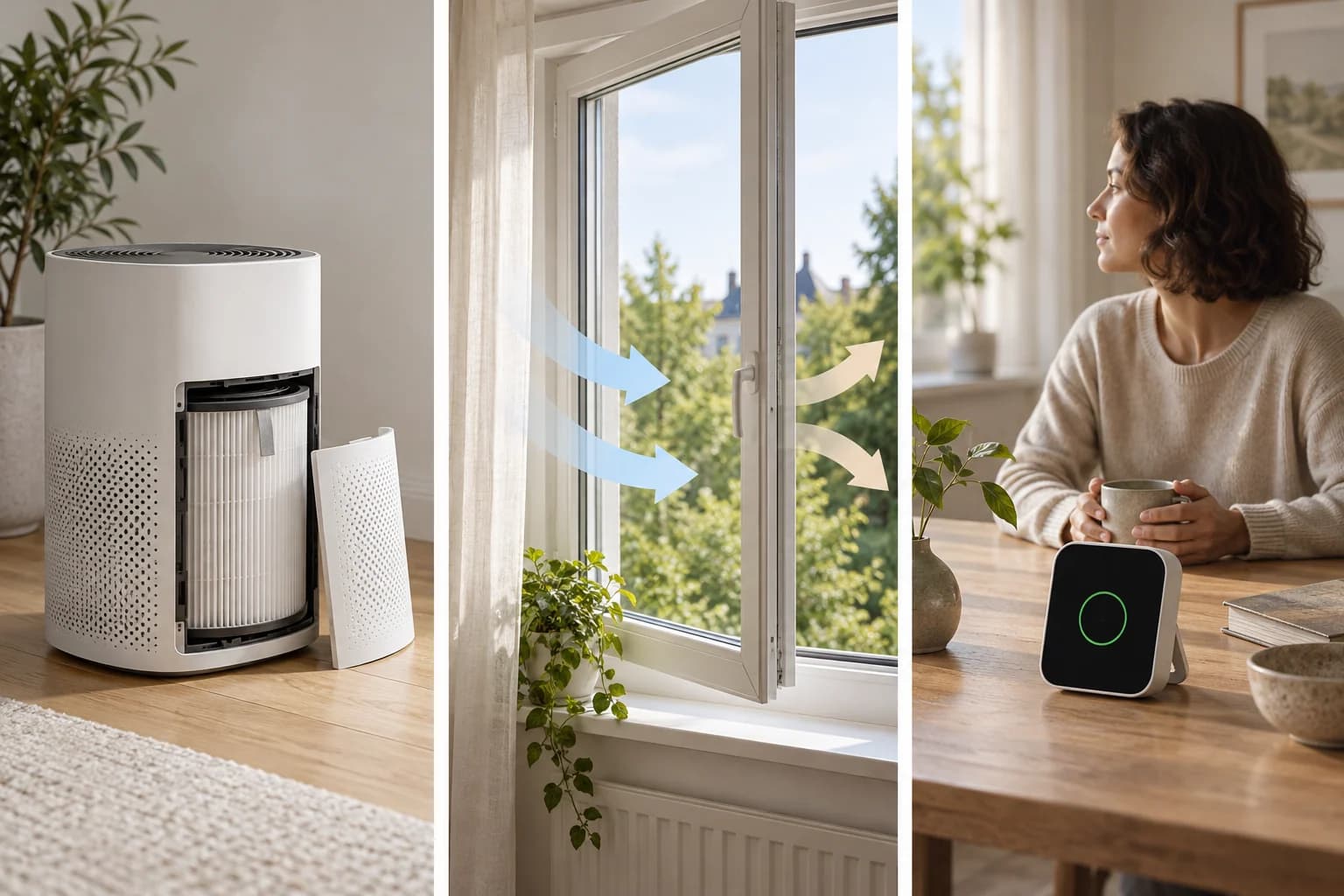
Particles include suspended material that can be captured by a suitable filter as air passes through it. Carbon dioxide is a gas and does not behave like those particles at a HEPA medium. Putting both under one label such as air quality conceals the reason the same device can affect one without meaningfully removing the other. A fan that feels like fresh air may simply be moving the air already inside.
Some air cleaners include sorbent media intended for certain gases, but the presence of a carbon layer should not be interpreted as household CO2 scrubbing. EPA distinguishes particle filtration from gas-phase removal and notes the importance of the amount of gas-removal material. Check the specified pollutant and performance claim rather than extending the word filter to every substance. Odour removal and carbon-dioxide removal are not the same claim.
Source control is another separate route. Reducing or removing a pollutant source can be more direct than trying to clean up everything afterwards. EPA presents filtration as a supplement to source control and ventilation with clean outdoor air. A practical room decision therefore starts with sources, continues with available air exchange, and asks where particle filtration can add useful removal.
Ventilation exchanges air, but the outdoor conditions still matter
Ventilation brings outdoor air into a space and removes or replaces indoor air through an appropriate flow path. In an occupied room, that exchange can dilute carbon dioxide generated by people. How much it does depends on the airflow, occupancy and conditions. A briefly open window is not a documented ventilation rate, and the same window position may perform differently with changing weather.
Outdoor air also has its own conditions. Smoke, traffic pollution, noise, temperature and humidity can affect whether opening a window is the sensible immediate intervention. Do not turn the need for ventilation into a universal instruction to open every window at every moment. Consult local information and the building's available ventilation arrangement. Mechanical outdoor-air supply and appropriate filtration can require professional consideration rather than a simple consumer-device swap.
A purifier can still have a useful particle-removal role when outdoor conditions limit window opening. That does not mean it solves carbon dioxide accumulation in a crowded room. If adequate fresh-air exchange cannot be achieved for the occupancy, revisit how the space is used and obtain suitable advice. Separate the constraints instead of choosing one device and declaring every air problem resolved.
Use the comparison table to choose a combination
The table groups problems by mechanism. It is not a health scoring system or a ranking of product brands. A room may need source control, particle filtration and ventilation at the same time. The relevant combination depends on what is present, how the room is occupied and which outdoor-air options are workable.
For a hypothetical room with indoor particles and rising occupancy-related CO2, using a suitable air cleaner while improving outdoor-air exchange addresses two different routes. For a room exposed to outdoor smoke, indiscriminate window opening might introduce additional particles even while changing CO2. The decision then needs local conditions and the building's ventilation capabilities. These examples explain tradeoffs without promising a specified reduction or declaring one room safe.
Keep the intended outcome visible when comparing purchases. If the complaint is a CO2 trend, a particle-only purifier specification does not answer it. If the concern is particles, an open window does not automatically establish that their indoor concentration will fall. If a moisture source is causing mould, a cleaner does not fix that source. Each problem needs evidence about the mechanism you intend to change.
| Problem or goal | Particle purifier | Outdoor-air ventilation or source action |
|---|---|---|
| Suspended particles | Can remove particles passing through suitable filters | Effect depends on outdoor particles and airflow |
| Occupancy-related CO2 | Ordinary HEPA does not remove the gas | Air exchange can dilute occupant-generated CO2 |
| Specific gases or odours | HEPA alone is not a gas-removal system | Control source; check suitable ventilation and gas treatment |
| Outdoor smoke | Can supplement particle control indoors | Consider local outdoor conditions before opening windows |
| Mould from moisture | Does not fix the moisture cause | Find and resolve moisture source |
| Monitor interpretation | CO2 does not measure particle-cleaning benefit | Record occupancy and ventilation with CO2 trends |
| Usable capacity | Check CADR at the relevant operating setting | Check actual fresh-air provision separately |
Match particle-cleaning capacity to the room and usable setting
For particle removal, EPA recommends considering clean air delivery rate, or CADR, in relation to the area served. The rating describes particle-cleaning capacity under stated conditions; it is not an outdoor-air supply rate and does not establish CO2 removal. A filter-efficiency claim without airflow information is therefore an incomplete room-selection guide. The device must move sufficient air through the filter to serve its intended space.
Consider the room's size and ceiling height, an open-plan connection to other areas and the speed at which you will actually run the device. EPA notes that higher fan speeds and longer operating times generally increase filtration. A maximum-setting specification may not describe the setting you tolerate during a call or overnight. Check operating information, noise and maintenance needs without inventing a performance figure for your room.
Keep inlet and outlet paths usable according to the device instructions, and maintain filters as directed. These practical details can affect whether the selected unit is doing the intended job. They do not allow this article to certify removal rates. Product selection should use current specifications; this comparison has not tested a model or measured particle concentrations in a home.
Read a CO2 monitor as evidence about ventilation conditions
HSE explains that CO2 monitoring can help identify poorly ventilated occupied spaces. It also warns that a snapshot can be misleading and recommends recording readings alongside occupancy and ventilation conditions. That approach is more informative than declaring a room good or bad from one number. CO2 varies across a space and over time, so the way a monitor is used belongs in the interpretation.
Follow the manufacturer's instructions for placement and calibration. Avoid positioning a sensor where a person's exhaled breath or an immediate airflow opening dominates the reading. Compare trends under documented conditions and note when people arrive, windows change or ventilation operates. A monitor intended to measure actual CO2 should be distinguished from an estimated indicator derived from other sensors; read its specification rather than relying on a label alone.
Particle cleaners do not reduce CO2 as ventilation does. HSE accordingly explains that CO2 readings do not show the effect of air-cleaning devices in reducing other contaminants. A low reading does not establish the absence of all pollutants, and an unchanged reading does not demonstrate that a particle filter has removed nothing. Use each measurement for the question it can answer.
How to assess air quality beyond a single CO2 reading
For a practical review, write down the room's occupancy, likely pollutant sources, ventilation options and cleaner setting. If you have monitoring, keep particle and CO2 observations separate. Compare like conditions where possible and avoid assigning causation to a device change when occupancy or outdoor conditions changed at the same time. These records can support a useful discussion with a ventilation professional.
Be cautious about health promises detached from this evidence. The comparison does not show that a specific purifier prevents infection, improves sleep or enhances concentration, and it gives no universal household CO2 safety threshold. It explains mechanisms and monitoring limits. If there is a suspected hazardous source or a continuing building problem, address that issue directly rather than relying on an appliance display.
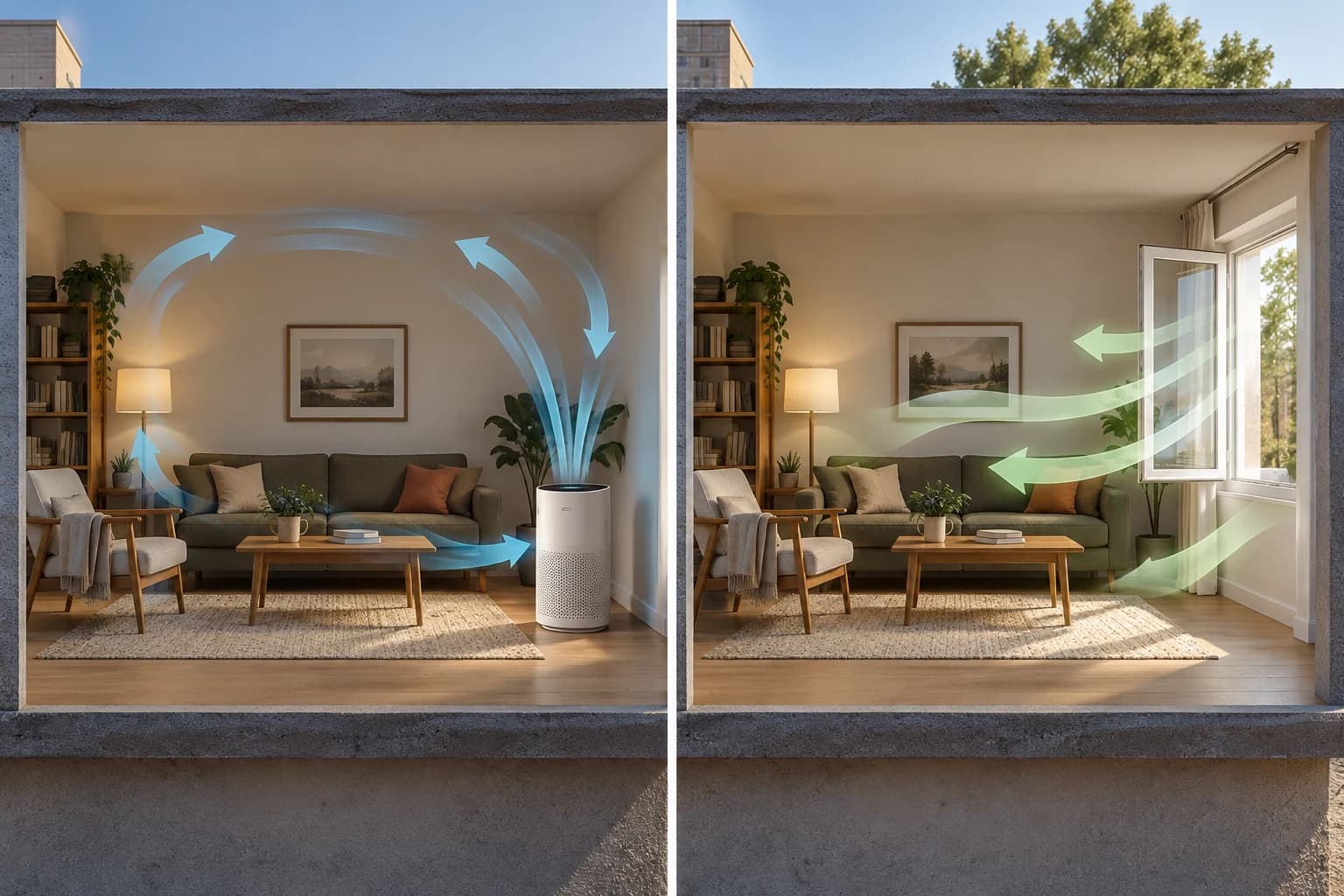
The cover is an AI conceptual illustration of the same furnished room in two cutaway views: one shows recirculating filtration, the other outdoor-air exchange through an open window. The translucent arrows are explanatory, not a measured simulation, and there are no concentration readings. Cleaner particles and renewed air can be complementary goals. Choose the combination by the pollutant and the available conditions, rather than treating either process as a complete replacement for the other.
Questions and answers
Why does CO2 stay high with the air purifier running?
A typical HEPA purifier recirculates indoor air and captures particles rather than removing carbon dioxide. Occupants can keep adding CO2 through breathing while the filter is operating normally. Investigate the fresh-air provision and occupancy separately from particle-cleaning capacity. An unchanged CO2 reading alone does not prove the purifier has failed to remove particles or that its filter is defective.
Does activated carbon remove CO2 from a room?
Do not infer that from its name. Gas-removal media are designed for specified substances and conditions, and an ordinary consumer carbon layer is not a practical CO2 ventilation replacement. Check which gases the manufacturer actually claims to address and with what evidence. Particle filtration, odour treatment and carbon-dioxide removal are distinct functions that should not be merged into one purchase promise.
Is opening a window always better than using an air purifier?
No universal choice follows from this comparison. Outdoor-air exchange can dilute occupant-generated CO2, while a suitable cleaner can remove particles. Outdoor smoke, pollution, weather and building conditions affect window use. The room may need both appropriate fresh-air provision and filtration. Check local conditions and the available ventilation arrangement instead of assuming either device operation or window opening solves every pollutant.
Does a low CO2 reading guarantee healthy air?
No. CO2 can help interpret ventilation in occupied spaces, but it is not a complete measure of particles, gases, moisture problems or health risk. Follow monitor instructions and record trends with occupancy and ventilation conditions. HSE also explains that CO2 does not show the contaminant-removal benefit of air cleaners. Keep measurements attached to the question they can actually answer.