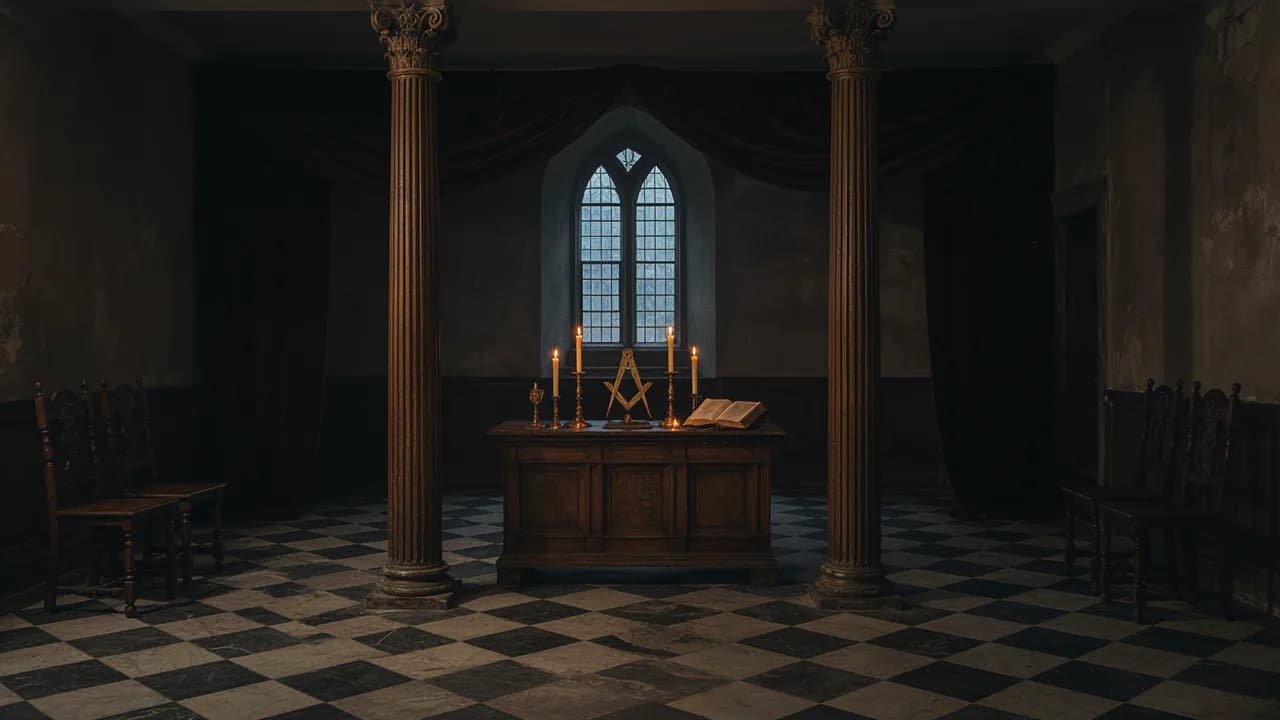
Freemasons: Who They Really Are, What Their Sign Means and Where the Plot Ends
In 1717 four London lodges sat down to dinner in a tavern. Three centuries later they are credited with ruling the world. What in that story is a document and what is invention, from a papal bull of 1738 to a list of 962 names.
The picture is AI-generated.
Founded
1717, London: the first Grand Lodge
Today
about 6 million members, by Masons' own estimate
Sign
the square and compasses, often with a letter G
First ban
Pope Clement XII's bull, 28 April 1738
Biggest hoax
Léo Taxil, 1885–1897, confessed 19 April 1897
Freemasons in plain words
On 24 June 1717, in a London tavern called the Goose and Gridiron, a few steps from St Paul’s Cathedral, representatives of four lodges sat down to dinner. They declared themselves a Grand Lodge and elected a first Grand Master, Anthony Sayer. By the standards of the age it was a modest event: a dinner and the election of a chairman. Yet Masons count this date as the start of their organised history, and a bar in London’s Freemasons’ Hall now carries the name of that tavern.
Freemasons are a fraternity that admits men through a ritual of initiation and meets in groups called lodges. Most Masonic historians trace it to the guilds of medieval stonemasons who built castles and cathedrals, which is where the aprons, the square, the compasses and the language of “building” come from. It is not a church and not a party. A candidate is expected to believe in a Supreme Being, but he chooses his own faith.
How many are there today? The United Grand Lodge of England puts its own membership at roughly 170,000 to 180,000, and Masons estimate about six million worldwide (figures from the UGLE website on 16 October 2026). There is no single headquarters: there are hundreds of independent grand lodges that recognise one another, or do not.
The Masonic sign: square, compasses and the “all-seeing eye”
The main Masonic sign is the square and compasses, a builder’s tools, often with a letter G between them. It is linked to “geometry” and to “God”. The leather apron is also a trade inheritance: it protected a stonemason from sharp chips, and for a Mason it became a mark of membership.
The “all-seeing eye”, an eye in a triangle, stands in Masonic tradition for the Great Architect of the Universe, meaning God. But the same picture can be read another way. In 1782 the US Congress described such an eye on the reverse of the Great Seal as a sign of Providence, and it later landed on the one-dollar bill. Who read it as Masonic, and when, is in the dossier.
So the honest answer to “how do you recognise a Mason by his sign” is duller than the legend. A square and compasses on a building or a ring says only that its owner was connected to a lodge. An eye in a triangle on a banknote or a logo is not a pass into a secret union.
Two stories that built the legend
Masons have been suspected of everything: of revolutions, of Satanism, of secret power over money and governments. The first to condemn them was Pope Clement XII. His bull In eminenti apostolatus of 28 April 1738 threatened excommunication for any Catholic who joined a lodge. The argument was simple: if a society hides from the light, its deeds must be evil. The bull offers no proof; it leans on rumour.
A century and a half later a French journalist, Léo Taxil, invented a Satanic order inside Freemasonry and a fictional priestess, Diana Vaughan, fooled the press and church dignitaries, and on 19 April 1897 publicly confessed to the fraud. Then in 1981 Italian financial police found a list of 962 names in a safe: a plot inside a lodge, it turned out, can be real. Between those two stories runs the whole border between invention and document.
What the dossier holds
The dossier covers what the 1738 bull and the bans that followed actually say, how Taxil led Rome by the nose and how his evening in a Paris hall ended, what Italy’s parliament established about the P2 lodge, why the “eye” on the dollar says nothing about Masons, and how the ban on lodges looked in Russia, from the arrested publisher Novikov to the rescript of 1822 and the pledges of 1826. And where exactly the document stops and the invention begins.
The open archive
The r/conspiracy archive holds 324 posts about Freemasons, 107 of them from 2017 alone, against two in 2010. The topic's share stayed near 9 posts per thousand: the forum grew, and the topic grew with it.
posts on r/conspiracy, 2008–2018
324
comments under those posts
21,294
the first post in the archive
30 April 2010
YouTube recommendations of 56 videos
6,083
views of those YouTube videos
57,957,086
Posts on the topic, year by year
20080
20090
201028.1 per 1,000 posts of the forum
20111018.7 per 1,000 posts of the forum
20121714.6 per 1,000 posts of the forum
2013145.8 per 1,000 posts of the forum
2014208.5 per 1,000 posts of the forum
2015349.2 per 1,000 posts of the forum
2016539.8 per 1,000 posts of the forum
20171079.5 per 1,000 posts of the forum
2018679.1 per 1,000 posts of the forum
The busiest months
January 2018 · 13 posts
June 2017 · 13 posts
August 2017 · 11 posts
Counted from research archives: the popular text posts of one English-language forum, a study of YouTube recommendations and lists of conspiracy websites. What came of it is in the dossier.
What is inside the locked materials of this chapter:
From guilds to drawing rooms: how stonemasons became Freemasons
Three degrees, an apron and an oath of silence
Washington and Mozart: famous brothers in public roles
Russia: an arrested publisher and the ban of 1822
The bull of 1738: a blow struck at rumour, not at proof
Léo Taxil: the most successful lie about Freemasons
The P2 lodge: when the plot was real
The dollar, world rule and a forgery we will not quote
The secret centre nobody found, and a list of 962 names
Timeline: 13 dates
Proven and invented: the verdict
What to read next
Checking your reading permission…
Questions
Who are the Freemasons, in plain words?
A men’s fraternal society with an initiation ritual and meetings called lodges. Most Masonic historians trace it to medieval stonemasons’ guilds; the first Grand Lodge was founded in London in 1717. It is neither a religion nor a party, but members are expected to believe in a Supreme Being.
What does the Masonic sign mean?
The square and compasses are a builder’s tools, a picture of building one’s own character; the G between them is read as “geometry” and “God”. An eye in a triangle is the Great Architect of the Universe, yet in 1782 the US Congress described the same eye as a sign of Providence.
Is it true that Freemasons rule the world?
The documents do not support it. There is no single centre, only hundreds of independent grand lodges. Lodges were banned by a pope (1738), Russian emperors (1822, 1826) and the Nazis. The one real plot, Italy’s P2 lodge (1981), was secret, and that is why the law dissolved it.