
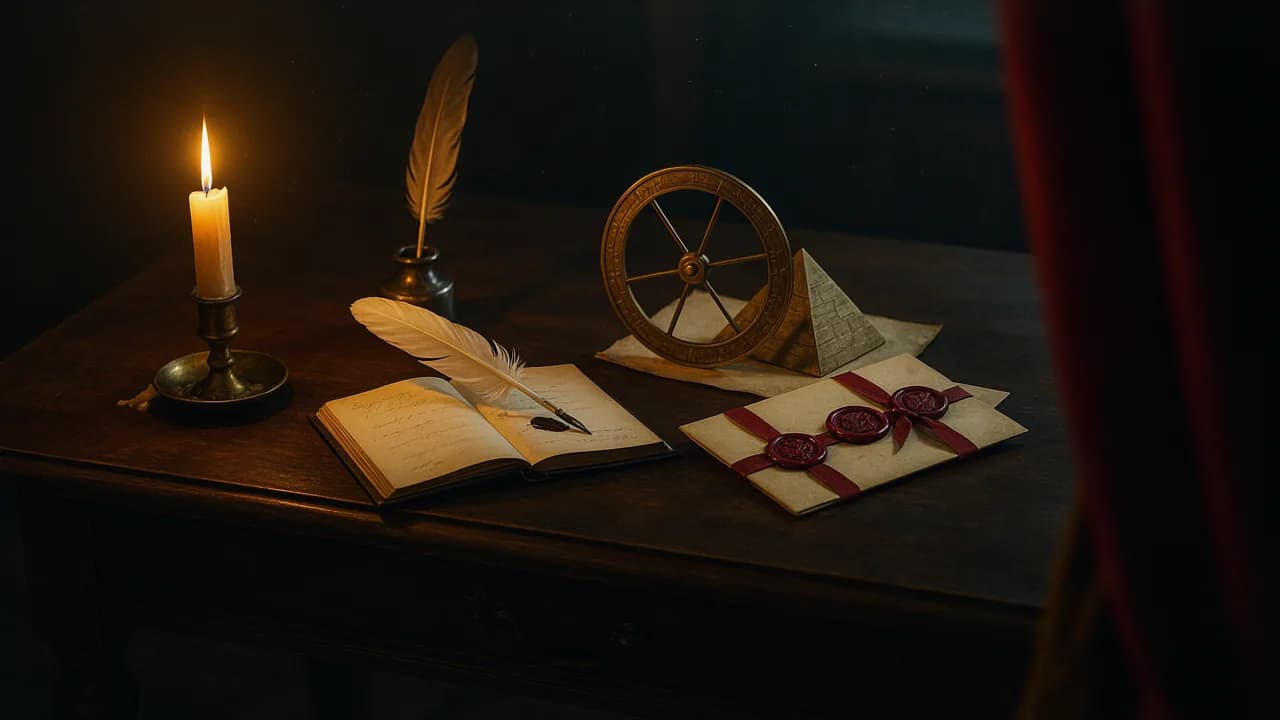
Landshut, 11 October 1786
For two days, 11 and 12 October 1786, officials went through the papers in the house of Franz Xaver von Zwack, a former government councillor, in the Bavarian town of Landshut. It was the find the authorities had waited years for: more than two hundred letters between the head of a secret order and his closest aides, tables of secret signs, a calendar and invented names for cities, statutes, instructions for recruiters and the text of an initiation rite.
A year later the government printed those papers as a book. That made a society that had hidden from all of Europe one of the few secret unions whose inner workings can be read almost in full. It was called the Order of the Illuminati, the “enlightened”. And here is the paradox: the better the documents showed what the order really was, the more luxuriantly the legend grew of what it supposedly became afterwards.
A professor and four students
The order was founded on 1 May 1776 by Adam Weishaupt, a twenty-eight-year-old professor of canon law at the University of Ingolstadt. The Jesuits had raised him, and their school left him with a lasting dislike of clerical control over education. Weishaupt dreamed of a secret union of reasonable men that would quietly “enlighten” students, officials and rulers. There were five members at the start: himself and four students.
At first the union was called the Order of Perfectibilists, “those who perfect themselves”, but the name sounded odd and was changed to Illuminati. Members took pseudonyms from antiquity; Weishaupt himself was Spartacus. A novice climbed through degrees, and every senior member was required to watch his juniors and report on them upward. The emblem was the owl of Minerva.
The real rise began in 1780, when Baron Adolph Knigge, an experienced Freemason and a gifted organiser, joined. He completed the system of degrees and brought in members of Masonic lodges. By the end of 1784 the leaders boasted of two or three thousand men; historians recounting the rosters arrive at noticeably smaller figures. The papers carry the names of the Duke of Saxe-Gotha, Duke Karl August of Saxe-Weimar and the poet Goethe.
Freemasons and Illuminati: what is the difference
People mix them up constantly, and Weishaupt is partly to blame. Freemasonry is a far older brotherhood with its own lodges and rituals. Weishaupt first wanted to join a lodge, but he could not find the money and decided its “mysteries” were childish. He became a Mason only in 1777, a year after founding his order, when he joined the Munich lodge “Theodor of Good Counsel”.
Through Knigge the Illuminati began to recruit inside the lodges and took over Masonic degrees: apprentice, companion, master. But membership of a lodge was not required to join. They were two separate unions, and the Bavarian edict of 2 March 1785 named both and banned both.
The Illuminati sign: what is not on it
When people say “the Illuminati sign”, they usually mean the eye in a triangle above a pyramid on the back of the dollar bill. The real order had no such emblem; its sign was the owl of Minerva. The Eye of Providence and the unfinished pyramid were approved by the US Congress for the Great Seal on 20 June 1782, when the order was still only gathering strength in Germany. And the seal reached the dollar bill only in 1935.
The order died; the myth outlived it
By the end of the 1780s the order had ceased to exist: bans in 1784, 1785 and 1787, house searches, officers and professors dismissed, Weishaupt driven out of Bavaria. But in 1797 a Scottish professor, John Robison, and a French abbé, Augustin Barruel, declared that the order had not died, only gone underground, and had staged the French Revolution. A year later American preachers were already warning their flocks about the order’s “emissaries”, and in 1969 two editors of Playboy began turning crazed reader letters into a satirical novel about a world conspiracy. Its jokes are still mistaken for facts.
The locked materials hold the dossier without cuts: how a system of mutual surveillance worked inside the order, what exactly was found in Landshut, how a sermon in Charlestown on 9 May 1798 carried the fear across the ocean, and what Jefferson wrote about Weishaupt. They also hold the prank that swallowed the world, the real story of the pyramid on the dollar, and a closing table: what is proven here and what is invented.