
Answer in brief
Offside is judged from a player’s position at the relevant teammate touch and becomes an offence only through involvement. The three cases differ in technology and reference moment, not in the underlying IFAB rule.
Reading a disputed offside without falling for the freeze-frame trap
This guide compares three documented disallowed goals that used different verification mechanisms: a calibrated line without an on-field monitor review, a dispute over which broadcast frame viewers were shown, and a decisive touch detected by a sensor inside the ball rather than by television cameras. Each case follows the same sequence: what the viewer sees, what the officials actually check, and what evidence supports the ruling.
Mbappé’s Clásico goal was ruled out without an on-field review
On October 26, 2025 at the Santiago Bernabéu, Real Madrid beat Barcelona 2–1 and a Kylian Mbappé goal was disallowed for offside. El Debate reported that the semi-automated system produced the decision and that the referee did not go to the monitor. Al Jazeera says the shot came from outside the penalty area. Open reports do not identify the player who made the final pass, so this article does not invent one. The sources also differ on detail: Sports Illustrated places the action in the 12th minute, COPE in the 14th and says only a small part of the foot was beyond the line, while ESPN places it within the opening 15 minutes.
The same phase of the match also contained a different VAR intervention: a penalty initially awarded for a challenge on Vinícius was later reversed. The contrast is not simply automation versus a human referee. Under the IFAB VAR protocol, a factual positional decision such as offside will often be completed by the video officials without an on-field review, although the referee remains the final decision-maker and a review is permitted. FIFA’s explanation of semi-automated offside says video officials verify the proposed kick point and offside line before communicating the result. A monitor-free offside decision is therefore normal for this type of factual check; the penalty incident involved a different, more interpretive question.
IFAB defines offside position by body location, not by reputation or role
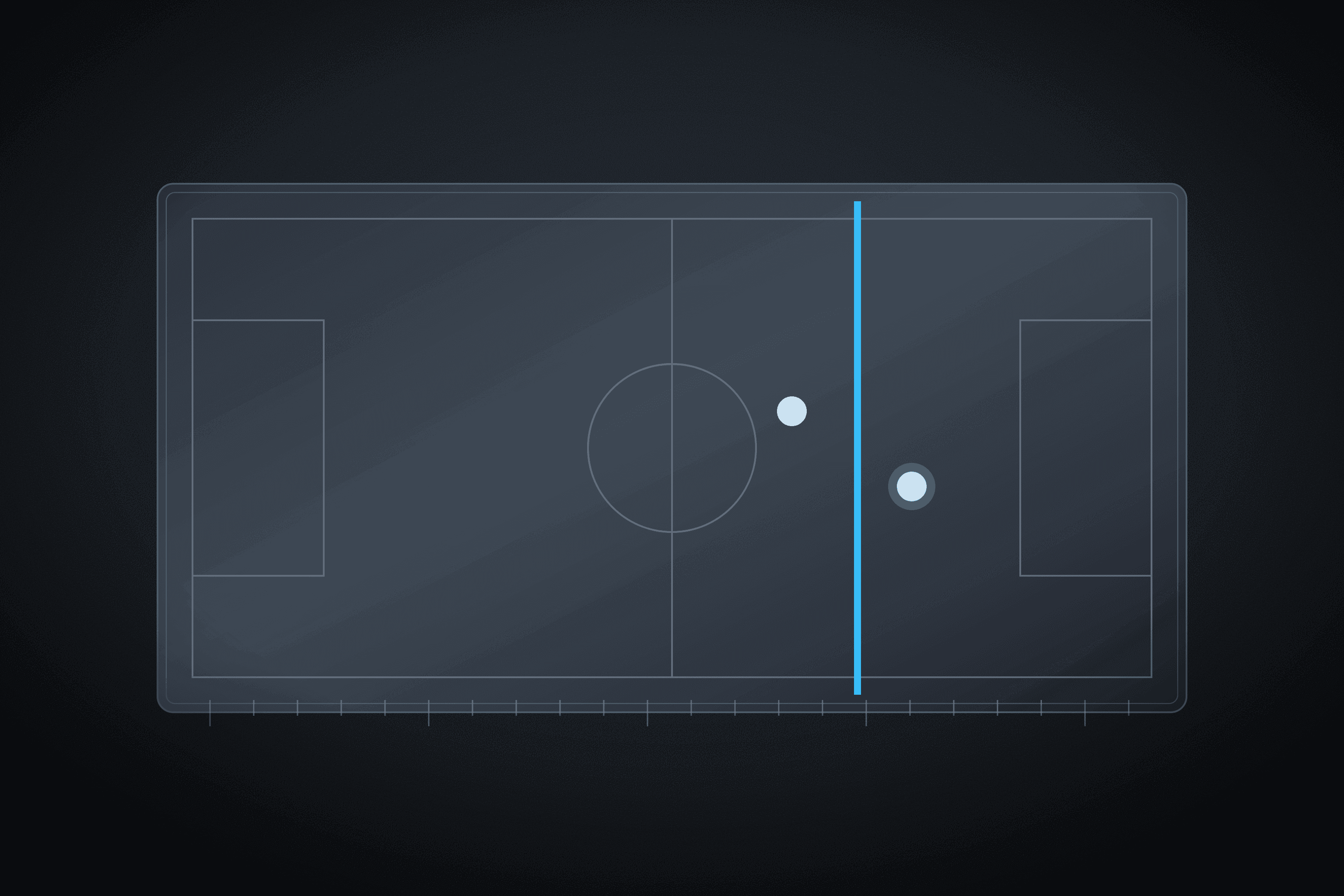
Law 11 for 2026/27 says a player is in an offside position when any part of the head, body or feet is in the opponents’ half and nearer the opponents’ goal line than both the ball and the second-last opponent. The second-last opponent does not have to be an outfield defender: it can be the goalkeeper or any other opponent depending on positioning. Hands and arms are excluded, with the lower boundary of the armpit marking where the arm starts for this purpose.
That is the first point viewers often miss: being in an offside position is not itself an offence. The law separates where the player is standing from what the player then does in the phase.
An offside position becomes an offence only through involvement
Law 11 identifies the relevant forms of involvement: playing or touching a ball passed by a teammate, interfering with an opponent, or gaining an advantage from a rebound, deflection or deliberate save. It also states that receiving the ball directly from a goal kick, throw-in or corner kick cannot create an offside offence.
In the Clásico incident, the relevant condition was straightforward once the position was established: Mbappé received the ball from a teammate and then shot. The debate therefore concerned the accuracy of the positional line, not whether an attacker who actively plays the ball from an offside position can be penalized.
Officials measure the kick point, not any convenient television frame
An offside line is not supposed to be drawn from a random frame selected from the broadcast. The Premier League’s explanation of its pre-SAOT process says Hawk-Eye operators identified the kick point among synchronized 50-frames-per-second broadcast feeds and then manually positioned the line on the relevant body point. That page describes the Premier League’s earlier workflow, not the exact system used in the La Liga and 2026 World Cup incidents here, but the general logic is shared: establish the touch or kick moment first, then assess position at that moment.
Because a 50-fps feed consists of discrete frames, editorially it follows that a contact occurring between frames must be represented by one of the available frames; the Premier League page itself does not spell out that inference. What it does explain directly is why a correctly placed line can still look wrong to a viewer: camera angle and camera roll can distort apparent spacing and verticality on the screen.
A related controversy appeared after Mbappé’s first disallowed goal against Mallorca. El Debate argued that the television presentation showed the passing moment and the forward’s position in separate images, leading some viewers to suspect that the wrong frame had been chosen. That criticism concerns the broadcast presentation, not a finding that the official decision was overturned or proven incorrect.
Human vision can misread extremely tight timing
Puya Soltani of the University of Bath’s Centre for Analysis of Motion used motion-capture technology in a laboratory task with ten students. Participants were asked to identify the ball-contact moment and judge player position; on average, their timing error was about 132 milliseconds. At a running speed of roughly 8 metres per second, that timing difference can correspond to around one metre of movement. The study also notes that certain camera angles can sometimes create a positional illusion.
This research does not evaluate the specific technology used in the 2025–2026 matches discussed here. It explains a more general perception problem: a frame that feels decisive to a viewer can differ materially from a calibrated assessment built around the actual contact moment.
Two Mbappé offsides against Mallorca show how “obvious” is not a rule category
Real Madrid beat Mallorca 2–1 on August 30, 2025, and Mbappé had two goals disallowed in the first half. The first came in the sixth minute after a long Trent Alexander-Arnold pass and was flagged by the semi-automated system. The second followed an Arda Güler pass in first-half stoppage time. Reports described the two moments differently: El Debate called the second more obvious, while El Español emphasized the similar attacking pattern of receiving behind the line and going through on goal. Güler also had a goal disallowed later in the match, but for handball after VAR review rather than for offside.
Those descriptions illustrate an important distinction. “Tight” and “obvious” are viewer or media descriptions of margin, not separate versions of Law 11. The legal test does not become stricter or looser because the gap is visually larger in one incident.
The 2026 World Cup Gvardiol incident moved the reference moment forward
On July 2, 2026, Portugal beat Croatia 2–1 in the World Cup round of 32, and a late Joško Gvardiol goal was disallowed in stoppage time. ESPN, citing FIFA, describes the sequence as an Ivan Perišić cross deflecting from Renato Veiga toward Igor Matanović. Broadcast replays made it appear that Matanović might not have touched the ball before it reached Mario Pašalić, whose subsequent touch led to Gvardiol’s finish. Connected Ball technology in the Adidas Trionda detected a slight Matanović header that cameras had not clearly shown. FIFA’s position, as reported by ESPN, was that Pašalić was offside at that new touch moment.
The difference from the Mbappé cases is therefore not a different offside law but a different reference point. In the Clásico and Mallorca examples, the key moment was the original pass from a teammate. In the Croatia incident, Matanović’s slight contact created a fresh teammate touch and moved the moment of assessment forward. Pašalić’s position had to be judged at that later instant.
A defender’s deliberate play and a teammate’s touch trigger different logic
Two mechanisms are often confused. If a defender deliberately plays the ball, even unsuccessfully, an attacker’s previous offside position can cease to matter; the exception is a deliberate save. IFAB’s 2022 clarification and current Law 11 point to factors such as distance, ball speed and whether the defender had time to coordinate the action when distinguishing deliberate play from a reflex deflection.
The Gvardiol incident is different because the crucial touch came from an attacking teammate, Matanović, not a defender. That is not a reset created by defensive play; it is the ordinary rule that the attacker’s position is assessed each time a teammate plays or touches the ball. Both stories may be summarized as “the touch changed everything,” but the law is doing different work in each case.
Practical checklist
- Remember that an offside position alone is not an offence; the player must become involved in the phase.
- Check whether the attacker played the ball, interfered with an opponent or gained an advantage from a rebound, deflection or save.
- Remember that a player cannot be penalized for offside directly from a goal kick, throw-in or corner kick.
- Ask whether a defender deliberately played the ball after the attacker had been offside; that can reset the phase unless it was a save.
- Do not confuse a goal disallowed for offside with one disallowed for another reason, as happened in the same Mallorca match.
Questions and answers
Can a referee disallow a goal for offside without using the monitor?
Yes. A factual positional question can normally be completed by the video officials without an on-field review, although the referee remains the final decision-maker. The Clásico sources describe Mbappé’s goal being ruled out in that way.
Can the goalkeeper be the second-last opponent for offside?
Yes. Law 11 refers to the second-last opponent, not specifically a defender. If the goalkeeper has moved upfield, two other opponents may become the relevant reference points.
What if the decisive touch came from the attacker’s own teammate?
Position is reassessed whenever a teammate plays or touches the ball. In the 2026 Gvardiol incident, a slight Matanović touch detected by the ball sensor created a new reference moment for Pašalić’s position.
How is a defender’s deliberate play different from a deflection?
IFAB considers factors such as distance, speed and whether the defender had time to coordinate the action. Deliberate play can reset a previous offside position except for a save, while a reflex deflection does not have the same effect.