
Answer in brief
There is no universal bin for a compostable coffee cup. Check whether the collection service accepts the exact cup and lid and sends them to suitable treatment. A reusable cup needs repeated use and a practical washing or return route.
Where will the cup go after your coffee?
The right bin for a compostable coffee cup depends on a confirmed local collection route, not the label alone. The service must accept that product and send it to suitable treatment. A reusable cup has a different requirement: it must be used again, with practical washing or return arrangements. Before choosing between them, ask what will happen to the cup after this drink. A leaf symbol or a reassuring description does not establish either route.
The US Environmental Protection Agency's food-service guidance prefers an effective reuse system and makes local acceptance essential when considering commercially compostable service ware. That is guidance about the conditions that make a system work, not proof that an unspecified cup has a particular environmental score. For a reader buying coffee at a station or office, the immediate task is concrete: find the accepted bin or return point before choosing a product that depends on it. If there is no confirmed route, do not assume a compostable label fills the gap.
Ask about the route at the place where you normally finish the drink, not just where you buy it. An office, transport interchange or park may have different collection arrangements from the café. If the answer is unclear, keep the cup until you can follow confirmed directions rather than interpreting the bin colour as a promise. The supplier's material description is useful information to show the waste service when asking about acceptance of the exact cup and lid.
What do reusable, recyclable and compostable mean?
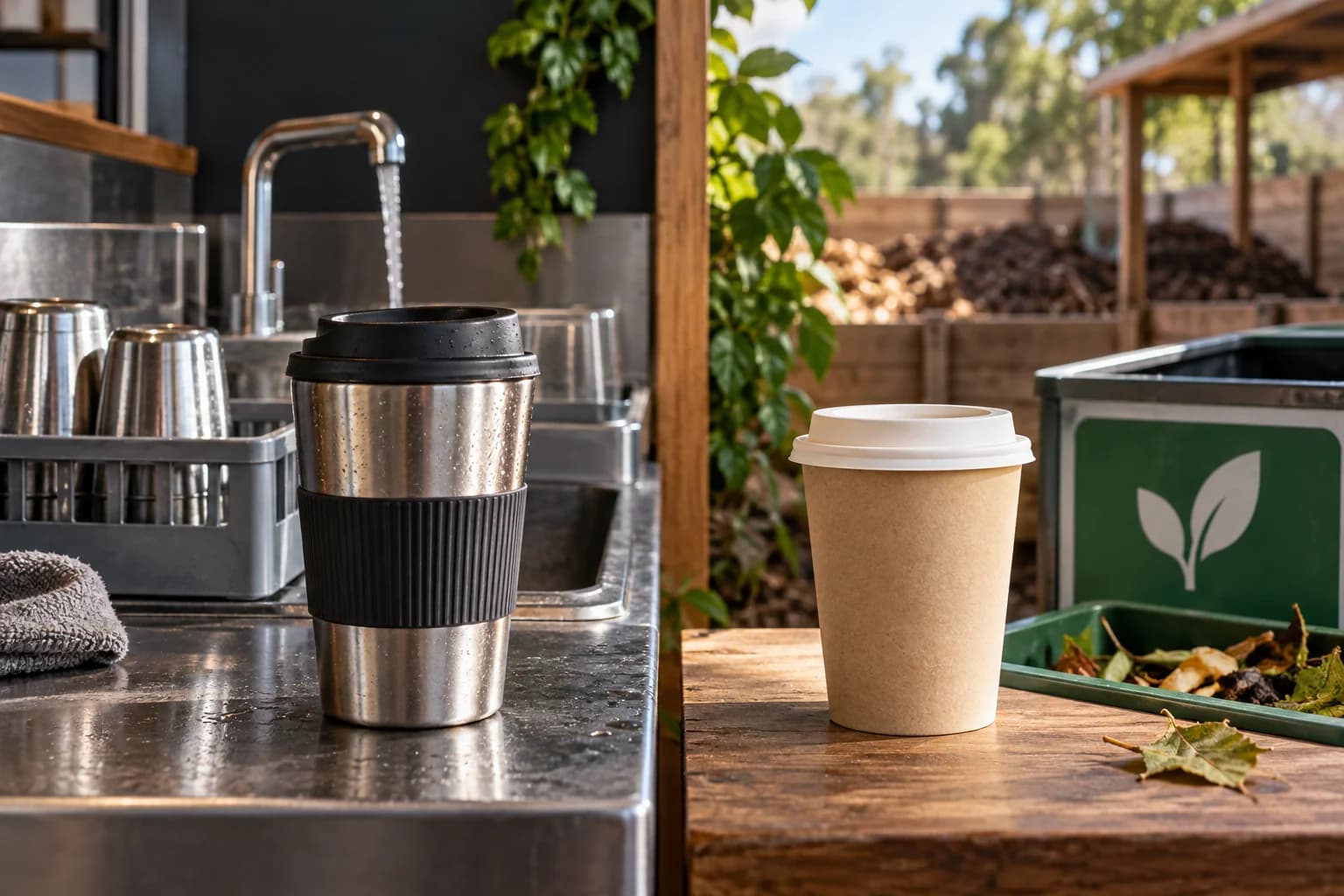
Reusable, recyclable and compostable describe different intended routes. A reusable cup is designed for repeated service. Recycling depends on collecting and processing the relevant material. Composting depends on biological treatment under the conditions specified for the product. None of these words alone tells you which local bin to use. The cup, lining and lid may also have different requirements, so inspect the whole purchase rather than just the largest visible component.
Commercial compostability and home compostability are not interchangeable. A product intended for commercial composting should not be assumed to break down in an ordinary garden heap. Similarly, a fibre-looking cup is not automatically acceptable in mixed paper recycling. Ask the supplier what the exact product is certified for, then ask the collection service whether that product type is accepted. These are two questions for two organisations. A supplier can describe a design or certification; the waste service determines whether the item belongs in its actual collection stream.
How can washing or returning a cup fit your routine?
For a personal reusable cup, choose a size and lid arrangement that fit your normal drink and bag. Check the manufacturer's washing instructions, whether the parts can be separated, and how you will transport the cup after use. A technically durable cup left at home cannot replace the takeaway cup bought on the journey. The most useful design feature may be the one that makes cleaning and remembering it straightforward in your own routine.
An organised return scheme solves a different problem: you borrow or obtain a cup, return it to an accepted point, and the operator handles the next cycle. Check where returns are accepted, whether a deposit applies and whether you must use an app or account. Do not assume another café takes the same scheme simply because its cup looks similar. If the return point is inconvenient, factor that into your choice before buying. These are practical questions about achieving repeated use; they do not establish how many uses offset manufacturing impacts in every environmental category.
Which cup route can you actually use?
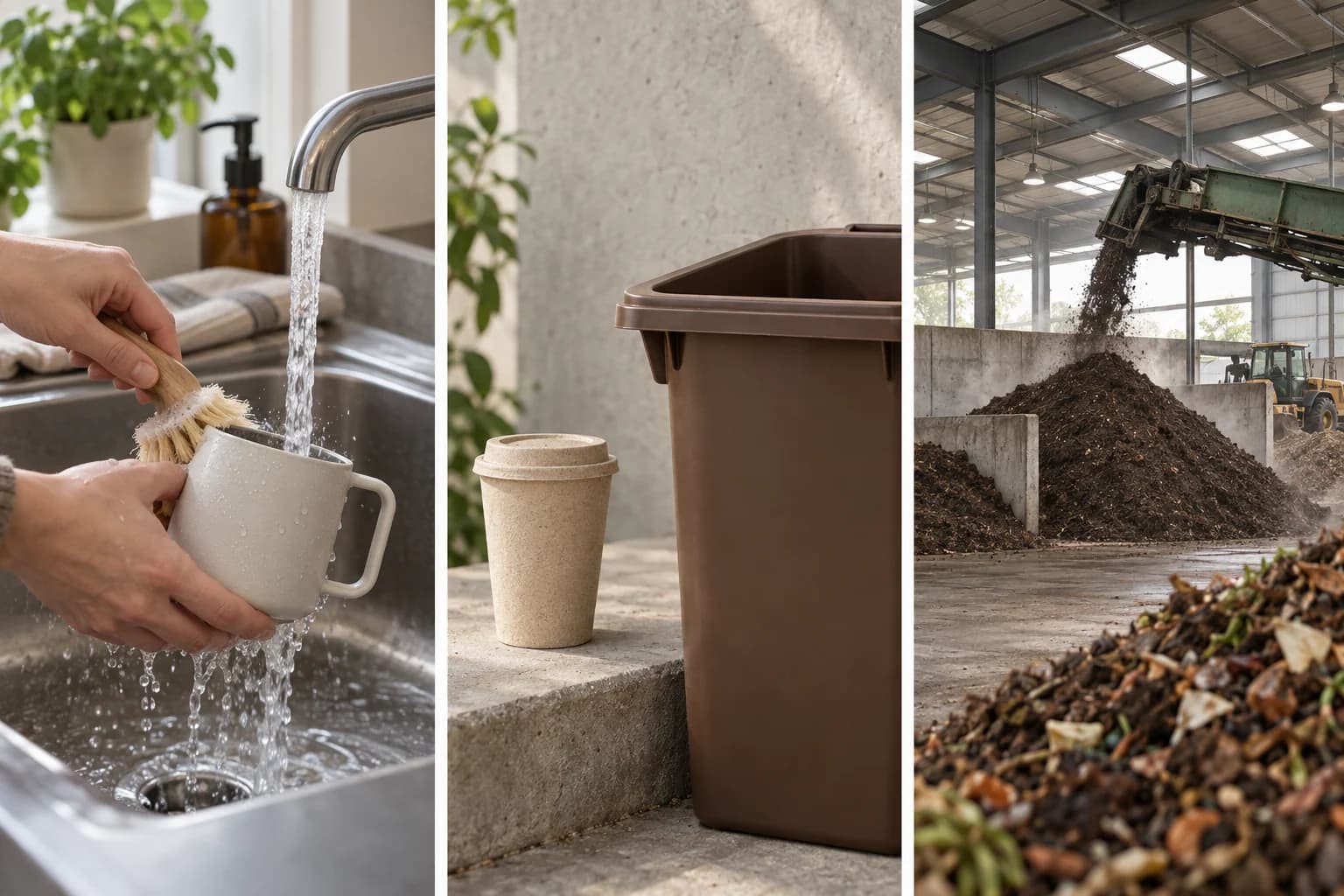
Use the table as a checklist for the cup in front of you. The reusable column assumes a product intended for repeated use and a real washing or return arrangement. The compostable column assumes a verified product and a collection service that accepts it. Remove those assumptions and the comparison changes. The object can stay visually identical while its actual route becomes entirely different.
Consider a hypothetical office café with a return tray and contracted washing, versus a street purchase carried several kilometres away. The office arrangement may make returning a reusable cup simple. The street purchase may require carrying your own cup or finding a participating return point. For a compostable cup, the same distinction appears in collection: an accepted on-site stream does not mean the bin at your eventual destination accepts that cup. Treat the end of your journey as part of the purchase decision, rather than relying on the bin that happened to be beside the café.
| Question | Reusable cup | Commercially compostable cup |
|---|---|---|
| Next stop | Home washing or confirmed return point | Accepted separate collection |
| Repeated service | Designed and handled for repeated use | Normally single-use service ware |
| Cleaning | Follow product or scheme instructions | Follow collection preparation instructions |
| Treatment | Wash and return to service | Facility must accept this product type |
| Lid | Clean reusable parts as directed | Check acceptance separately |
| No local route | Carry home or find a valid return point | Follow local waste-service instructions |
| Impact claim | Needs assumptions about use and washing | Needs assumptions about collection and treatment |
Do the lid and leftover coffee need separate instructions?
A coffee purchase includes more than a cup body. A lid, sleeve, stirrer or sachet can introduce another material and another sorting instruction. Check whether the whole set is accepted together or whether parts must be separated. Do not put an unfamiliar lid into a compost stream merely because its cup belongs there. Follow the collection service's directions for remaining liquid and other contamination instead of improvising from the packaging's appearance.
For venues, make this information visible where people actually discard or return the items. An instruction at the till is less useful if a person later faces three ambiguous bins. Use the exact accepted product types in the guidance and keep procurement aligned with that list. If a supplier changes a liner or lid, ask whether acceptance changes too. The operational goal is a coherent purchase-to-collection route, not a mixture of products that look environmentally similar but require customers to guess which treatment each one needs.
How many reuses does an environmental comparison assume?
The Life Cycle Initiative's February 2021 beverage-cup report brings together life-cycle studies of single-use cups and alternatives. The existence of a life-cycle comparison is a reminder to examine the whole service, rather than judging a cup by one material feature. Manufacturing, repeated use, washing and final treatment belong to the question. This article does not extract a universal carbon figure or reuse threshold from that collection of studies.
If you encounter a claim that a cup becomes better after a stated number of uses, ask what is being compared and which impact is measured. Look for the material, washing method, transport, loss rate and disposal assumptions behind the number. A result for one arrangement should not become a rule for another without checking those conditions. Likewise, a successfully collected compostable cup does not prove that every environmental impact is lower than a reusable alternative. This practical guide helps identify workable routes; it does not calculate a comparative life-cycle assessment for your local café.
What if your local service does not accept the cup?
If the local service does not accept your compostable cup, follow its instructions for that item rather than placing it in organics or recycling by guesswork. A cup designed for one treatment can contaminate a stream intended for other materials. Ask the café whether it has a separate accepted collection route, but do not assume it will take back cups from every location. For the next drink, consider whether a personal reusable cup, a genuine return scheme or drinking on site fits the circumstances.
For a café or event buyer, verify the chain before ordering: exact product, accepted collection, actual hauling arrangement and intended facility. For a customer, verify the part of that chain you can use at the end of the drink. Then choose a habit you can repeat. Keeping an existing suitable cup in circulation is a different action from accumulating several new reusable cups. The comparison becomes useful when it leads to an actual return, wash or accepted collection, instead of leaving the next step implied by a label.
For an organised reuse scheme, inspect the return process from a customer's point of view. Can a person return the cup when the café is closed, and can someone without the relevant app participate? What happens if a lid is lost or the cup is damaged? These questions identify barriers before a scheme relies on people behaving in a way the site makes inconvenient. For a personal cup, make a place for it beside the bag you take out. A reliable routine gives the object an actual second use, rather than another place in the cupboard.
Questions and answers
Can compostable coffee cups go in food waste or the green bin?
Only if that collection service accepts the exact product. A green bin or a nearby composting facility does not establish acceptance of every compostable cup or lid. Check the service’s preparation instructions as well. Industrial compostability also does not establish suitability for your home compost heap; verify the product’s certification and instructions separately.
Can a paper-looking coffee cup go in paper recycling?
No universal rule follows from its appearance. A cup can include a lining and a lid with different handling requirements. Consult the collection service about the actual product type and follow its preparation instructions. A paper recycling bin is not proof that every fibre-based cup belongs in that stream.
How many times should I use a reusable coffee cup?
This guide gives no universal break-even count. Such a comparison depends on the cup, washing method, transport, loss and final treatment, as well as which environmental impact is being measured. Choose a workable habit that achieves repeated use, and examine the assumptions before applying a published threshold to your own arrangement.
What if my cafe sells compostable cups but there is no accepted collection?
Ask whether the café offers a verified separate collection route you can actually use. If it does not, follow the local waste service's directions for the cup rather than guessing a bin. For future drinks, consider your own suitable reusable cup, a functioning return scheme or an on-site cup when convenient.