
Answer in brief
Usually yes. GINETEX defines 40°C on the washing symbol as a maximum, not a temperature every wash must reach. Keep the required gentle process, hand-wash restrictions and other care instructions, and choose a suitable detergent and load.
Does a 40°C label allow a 30°C wash?
A garment labelled 40°C can usually be washed at 30°C if its other care instructions are respected. GINETEX treats the number in the washing symbol as the maximum permitted temperature. It is not an instruction to reach 40°C every time. Before choosing a cooler setting, check the required mechanical treatment, the condition of the clothes and the instructions for your detergent and washing machine. Temperature alone cannot make an unsuitable programme appropriate.
Look underneath the tub as well. One bar calls for a milder process; two bars call for a very mild process. Treat these as a separate instruction about mechanical handling. A normal cotton programme set to 30°C is not automatically a replacement for a very mild programme marked 40°C. Similarly, a hand-wash or do-not-wash instruction cannot be overridden by choosing a cooler machine cycle. Check any written care directions too, especially on garments with several fabrics, linings or decorative details. This comparison concerns ordinary washable clothing, rather than a prescribed hygiene procedure.
Keep a simple list for garments whose care instructions are easy to forget. A photo of the original label can help when the printing fades, but it should belong to that exact item rather than a similar garment bought later. Include any separate instruction for a removable belt, lining or trim. When someone else washes the item, the list should identify the required process clearly. This avoids making the whole decision again from memory each time the garment reaches the basket.
How should I sort lightly worn and dirty clothes?

Imagine two hypothetical loads: lightly worn office shirts and muddy trousers after a walk. Both could have a 40°C maximum, yet they ask different things of the wash. For the first, 30°C may be a sensible starting point when the detergent and programme support it. For the second, identify the dirt and any permitted pretreatment before deciding that a higher setting is the answer. These are decision examples, not results from a stain-removal experiment.
Keep colour, care process and fabric requirements in the sorting decision. A tough pair of trousers should not determine the programme for a delicate blouse beside it. When instructions conflict, separate the load rather than trying to average the settings. Inspect cuffs, collars and pockets while sorting, and note stains needing treatment according to the garment and product instructions. This makes the temperature decision smaller and more useful: choose a suitable process for a compatible group of garments, rather than forcing everything in the basket into one default cycle.
Which detergent and programme suit the load?
Read the detergent packaging for recommended temperatures, dosing and fabric restrictions. A product intended for a particular kind of laundry may not be suitable for another simply because both are being washed at 30°C. Dose using the guidance for load size, soil level and local water hardness. More detergent is not a reliable substitute for the wrong programme. Nor can a temperature change correct a detergent that the garment instructions prohibit.
The programme name matters because time, agitation, rinsing and spinning accompany the temperature setting. Consult the machine manual to see which settings remain available within the required cycle. A short programme may have different loading conditions from a normal programme; a wool programme may handle clothes differently from cotton. Do not assume the longest or fastest option is the best response to a stain. If you change temperature, keep a note of the programme you used. That record helps you make a repeatable choice without pretending to conduct a controlled laboratory test.
What should I compare before selecting 30°C or 40°C?
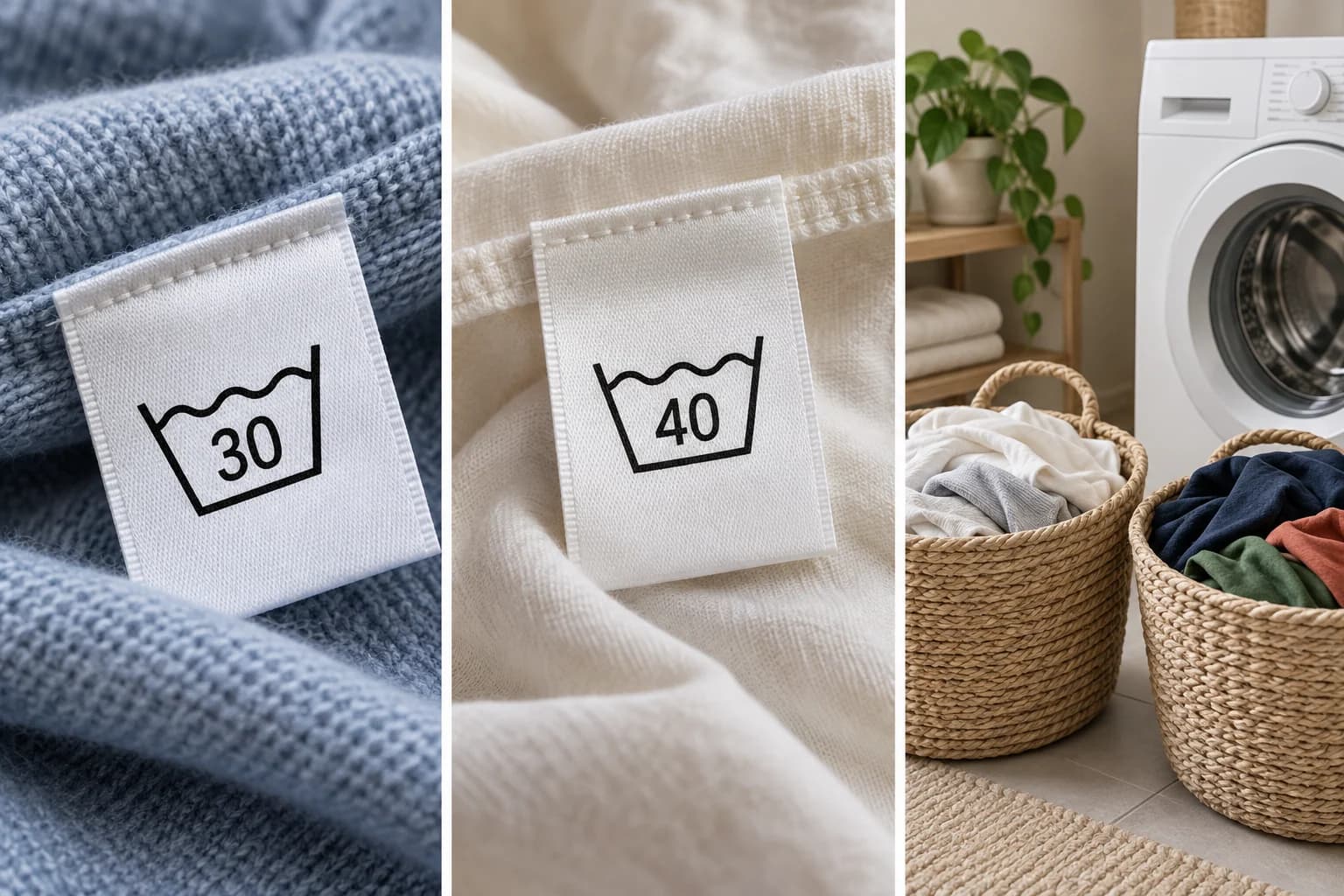
The table below compares choices you can check before washing. Neither column promises a cleaning result, a percentage energy saving or a hygiene outcome. A label permitting 40°C establishes a ceiling; it does not establish that the load needs that setting. Conversely, selecting 30°C does not establish that every stain will be removed. The useful question is whether the label, washing product and programme agree with the job you need to do.
When a care label is missing or unreadable, this table cannot reconstruct it from the fibre name. Look for the manufacturer's care information or ask the seller. A cotton outer fabric can coexist with a lining or trim that changes the treatment the finished garment needs. If you cannot verify the directions for a valuable or sensitive item, seek advice before experimenting. The same restraint applies to an unfamiliar stain-treatment product: follow its compatibility instructions rather than combining products on the assumption that more treatment must be better.
| Decision | 30°C option | 40°C option |
|---|---|---|
| Label maximum | Possible below a 40°C ceiling | Allowed only if the label permits it |
| Cycle bars | Mild or very mild handling still applies | The same handling restrictions still apply |
| Lightly worn garments | Consider with suitable detergent and programme | Check whether the task needs this setting |
| Visible dirt | Identify stains and permitted pretreatment | Higher temperature alone is no guarantee |
| Detergent | Check low-temperature suitability and dose | Check fabric suitability and dose |
| Load size | Follow the chosen programme limit | Follow the chosen programme limit |
| Hygiene requirements | Not a validated disinfection process | Not a universal disinfection guarantee |
Will washing at 30°C use less energy?
Energy Saving Trust recommends using a 30°C cycle instead of higher temperatures as part of its household energy advice. That supports considering a lower setting for suitable laundry. It does not supply a universal saving for this particular 30°C-versus-40°C comparison. Your machine, programme, load and frequency determine what the change means in practice. An estimate for a whole household routine should not be presented as a measured result for one shirt or one cycle.
If you want to compare your own routine, begin with information your machine actually provides, such as programme consumption figures in the manual. Keep the load and programme context alongside those figures. A nominal temperature is only one input, and displayed cycle duration does not by itself tell you energy use. Consider avoidable repeat washes as well: a cooler setting that leaves a load needing another complete wash is a different scenario from a satisfactory first wash. Our comparison does not calculate either scenario or assign it a carbon score.
What should I check if a stain remains?
After the cycle, inspect the clothes before proceeding with the drying method allowed on the label. Check the areas that prompted the wash in the first place. If a stain remains, consult suitable treatment guidance before repeating the wash or using a more aggressive process. Do not describe a load as sanitised because it looks clean or smells fresh. Appearance is an observation about that garment, not a measurement of microorganisms.
For routine laundry, change one relevant part of your approach at a time where practical. You might start by correcting an overloaded delicate programme, then review detergent dosing, then consider a permitted temperature change. If you switch all three together, you cannot tell which choice helped. This is a household troubleshooting habit, not a product-performance study. Keep any drying or ironing requirements in view too: the washing setting cannot authorise a hotter dryer or iron. Clothes leave the washing machine with the rest of their care instructions still applicable.
When should I keep a different washing routine?
A workable routine is to check the label, group compatible garments, choose a permitted process, match detergent and dose, and then decide whether 30°C meets the ordinary cleaning task. Use 40°C when it is permitted and fits the garment, product and programme guidance. This leaves room for different loads without treating the higher temperature as inherently better or the lower one as universally sufficient. The default should reduce guesswork, while exceptions should have an identifiable reason.
For laundry subject to specific infection-control instructions, do not use this everyday comparison as a replacement for those directions. Follow the relevant professional advice and the textile's permitted care process. Likewise, a manufacturer may give specific cleaning directions for specialist clothing. Keep those instructions with the item so another person doing the laundry can see them. For an ordinary mixed household basket, the most useful improvement is often this shared understanding: the temperature ceiling, the mechanical process, the detergent and the loading rule are four choices that need to work together.
If the result disappoints you, describe the problem before choosing the next step: a particular stain, visible detergent residue, creasing or an unfamiliar smell are different observations. Check the machine and product guidance relevant to that problem. Raising the temperature without checking the cause can change the wash while leaving the underlying mismatch unresolved. The record you kept should include the item, programme, load and product, so the next decision has some context. It cannot prove a general performance claim, but it can stop you repeatedly guessing at the same garment.
Questions and answers
Can I wash a shirt labelled 40°C at 30°C?
Usually yes: the number in the washing symbol is a maximum. Also follow the bars under that symbol, written care instructions and any requirement to wash by hand. Choose a detergent and programme suitable for the garment and its dirt. A lower temperature does not make every machine cycle suitable or guarantee stain removal.
Are delicate and cotton cycles the same at 30°C?
No. Programmes can differ in mechanical action, time, load limits and spinning even when the displayed temperature matches. Use the care label and machine manual to choose the process. If the label requires mild or very mild handling, do not treat temperature alone as compliance. Check the permitted load for that programme before filling the drum.
How much energy does a 30°C wash save compared with 40°C?
This guide does not establish a fixed percentage. Energy Saving Trust supports lower-temperature washing for household energy saving, but the result for your routine depends on the machine, programme, load and any repeat washing. Compare relevant consumption information with its stated conditions rather than applying a headline figure to every garment or wash.
Does washing at 40°C disinfect clothes?
Neither setting is a universal disinfection guarantee. The appearance or smell of laundry cannot establish a microbiological result. If a load needs specific hygiene treatment, follow the applicable professional instructions and textile care restrictions. For ordinary clothing, this comparison helps select an appropriate cleaning process; it does not replace an infection-control protocol.