
Answer in brief
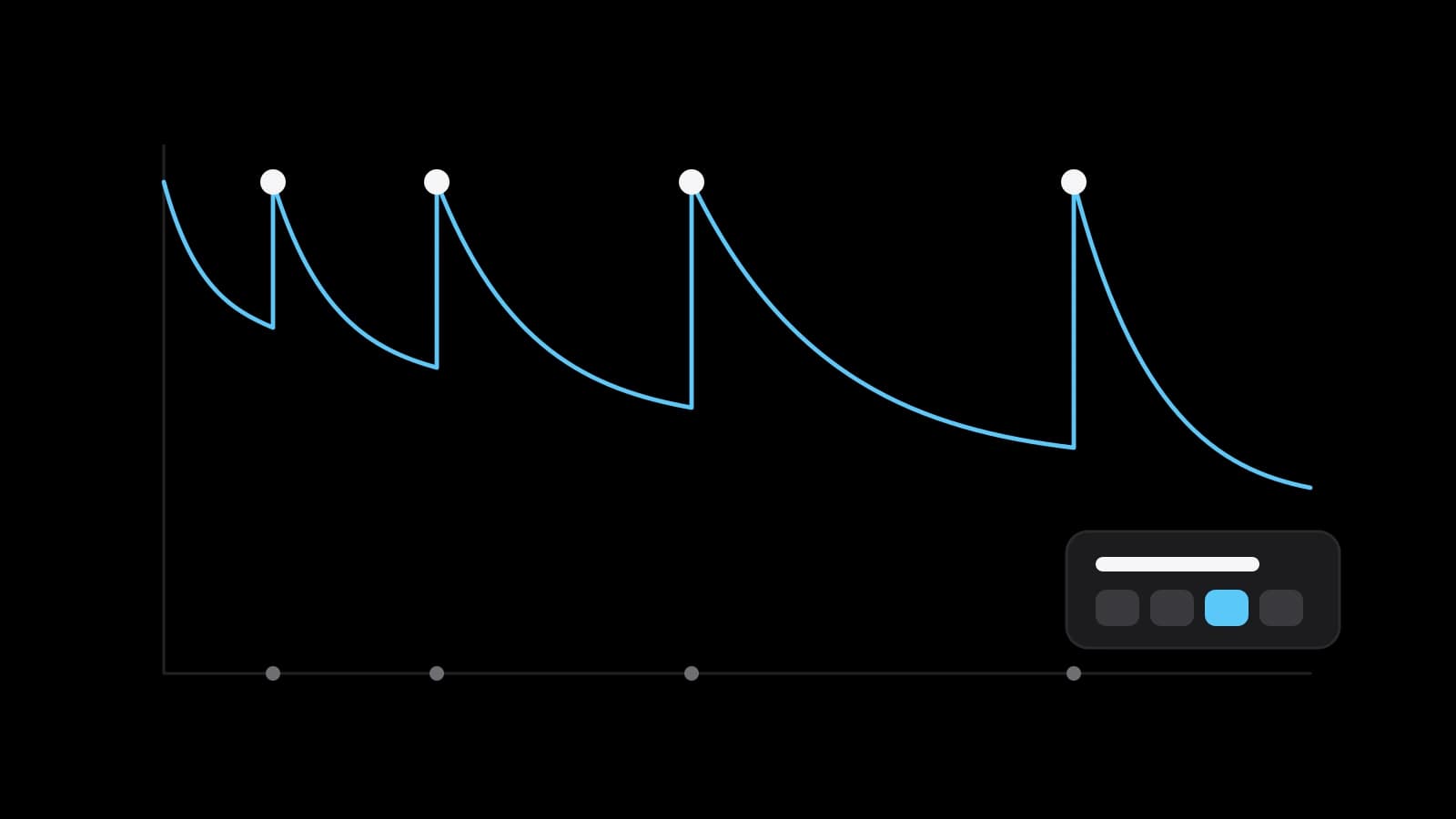
Spaced repetition means reviewing each fact at growing intervals, shortly before you would forget it, and answering from memory instead of rereading. Research on the spacing effect and the testing effect supports both halves. A Leitner box, SM-2 or FSRS sets the dates; your part is short one-fact cards and a daily review time you can keep up.
Spaced repetition means reviewing just before you forget
Spaced repetition is a way of reviewing material at growing intervals, so that each review lands shortly before the memory would fade. Wikipedia's article calls it an evidence-based technique usually done with flashcards: new and difficult cards come up often, older and easier ones less and less. The idea is older than software. In his 1932 book Psychology of Study, C. A. Mace advised spacing revision at gradually increasing intervals of roughly one, two, four and eight days.
Two findings make the method work. The spacing effect says the same amount of study is remembered longer when it is spread out than when it is crammed. The testing effect, or retrieval practice, says that pulling an answer out of memory strengthens it more than reading it again. A card you answer before turning it over uses the second; the schedule deciding when you see it uses the first. Drop either half and you are left with rereading on a calendar or quizzing at random.
What Ebbinghaus actually measured in 1879 and 1880
The forgetting curve is usually drawn as a smooth line of how much people remember. Its source is narrower. Hermann Ebbinghaus tested one subject, himself, on series of nonsense syllables. His book Memory, published in 1885 and translated into English by Henry Ruger and Clara Bussenius in 1913, reports 163 double tests run in 1879 and 1880. He learned each series until he could recite it twice without error, relearned it after a delay and counted the work saved.
So the numbers are savings, not recall. After about 19 minutes he saved 58 percent of the original work, after 24 hours about a third, after six days about a fourth, and after a month fully a fifth. A series he could no longer recite was not gone: it was cheaper to learn again. He also compared spreading with massing: for 12-syllable series, 38 repetitions spread over three days did as much as 68 in one sitting the day before. He judged distribution “decidedly more advantageous”, while stressing the very limited conditions.
The spacing and testing effects in later research
Cepeda and colleagues, in Psychological Bulletin in 2006, pooled 839 assessments of distributed practice from 317 experiments in 184 articles and found that the best gap between sessions grows as the test moves further away. Their 2008 study in Psychological Science taught facts to more than 1,350 people and tested them up to a year later. With the test a week after the review, the best gap was about 20 to 40 percent of that week; with a year, about 5 to 10 percent of it. In plain terms, review material needed in seven days one and a half to three days after first study, and material needed in a year after roughly 18 to 36 days.
On retrieval, Roediger and Karpicke (Psychological Science, 2006) had students restudy prose passages or take free-recall tests. Five minutes later restudying won; after two days and a week, testing gave substantially better retention, although restudying made students more confident. Their 2008 paper in Science found that once a word had been recalled, more study did nothing for delayed recall while more testing helped a lot. The 2013 monograph by Dunlosky and colleagues rated practice testing and distributed practice as high utility, and rereading and highlighting as low.
How schedulers work: the Leitner box, SM-2 and FSRS
The simplest scheduler is a box. In the Leitner system, as Wikipedia describes it, a card moves to the next compartment when you answer correctly and back to the first when you miss, and each compartment waits longer than the one before. Leitner's partitions were 1, 2, 5, 8 and 14 centimetres wide, and a section was reviewed when it filled up. Easy cards drift away, hard ones keep coming back.
SM-2, which Piotr Wozniak described in 1990 after using it in his programs from December 1987, adds arithmetic. The first interval is one day, the second six, and each later one is the previous interval times an easiness factor that starts at 2.5 and never drops below 1.3. You grade each answer from 0 to 5, and a grade under 3 sends the card back to the start. In his first year with it, Wozniak reports memorising 10,255 English vocabulary items at 41 minutes a day, with 89.3 percent retention overall.
FSRS, the Free Spaced Repetition Scheduler of the open-spaced-repetition project, gives each card three numbers. Its wiki defines retrievability as the probability of recall at a given moment, stability as the days it takes for that probability to fall from 100 to 90 percent, and difficulty as how hard stability is to raise. You grade Again, Hard, Good or Easy, and dates follow from the desired retention you set; the wiki calls 70 to 97 percent reasonable and warns that higher retention means more reviews. FSRS-6 fits 21 parameters to your history, and the project's simulations show 20 to 30 percent fewer reviews than SM-2 for the same retention.
Writing spaced repetition flashcards that stay cheap to review
A scheduler cannot rescue a bad card. Wozniak's twenty rules of formulating knowledge, listed in order of importance, start before any card exists: do not learn what you do not understand, and build the overall picture before splitting it into questions. Then comes the minimum information principle: one simple question, one short answer. Cloze deletion, a sentence with a gap, turns textbook prose into such items, and graphic deletion hides one region of a diagram or map. Sets and enumerations, such as all members of a union of countries, are expensive; if a list is unavoidable, overlapping gaps split it into small steps.
The other rules pay off over years. Tie a card to your own life, the way a word for a kind of sofa sticks once linked to a sofa you know. Separate look-alikes that interfere with each other. Add a source and a date to facts that change. Wozniak notes that about half of review time usually goes on just 3 to 5 percent of the material, so a card that keeps failing needs rewriting, not harder drilling.
New cards a day and a two-week spaced repetition schedule
What limits you is reviews, not new cards, because every card comes back several times. Take SM-2 at its starting values and a learner who adds 20 new cards a day and gets every one right. Cards learned on day 1 return on day 2 and day 8; the next gap is 15 days, so day 23. The first day has 20 cards to see, the second 40, each day from day 8 has 60, and day 23 has 80, before a single lapse.
Lapses raise the load, since a failed card restarts at one day and SM-2 also repeats, at the end of each session, every card graded below four. So plan in minutes, not cards: pick a daily review time you can keep in a bad week, hold it for a fortnight, then raise the intake. Formulas such as the 2-3-5-7 revision rule are rules of thumb; Wikipedia notes that meta-analyses often find expanding and evenly spaced schedules give similar results. After a break, stop adding cards and clear the overdue pile over several days. The FSRS wiki says its scheduler handles such delayed reviews much better than SM-2.
Spaced repetition for language learning, exams and work
Languages are the classic fit: words, genders, irregular forms and set phrases are small facts that must come back in a fraction of a second. Wozniak notes that a card asking you to produce a foreign word does not guarantee you will recognise it, so ask both ways. For exams, start early enough for gaps to grow. Kornell, in Applied Cognitive Psychology in 2009, found one large stack of flashcards beat four small stacks, and spacing beat cramming; spacing won for 90 percent of participants, yet after the first session 72 percent believed massing had worked better. Work knowledge, from product codes to regulations, fits too, with dated cards.
The limits are clear. The method stores what you already understand; it does not create understanding. Nor does it replace practice of a skill: speaking, writing, solving an unfamiliar problem or playing an instrument improve by doing the task, though Wikipedia notes that spacing practice sessions has helped there too, for example in a pilot study of surgical simulation training. Cards hold the facts a skill draws on, never the skill.
Paper cards, a free app or a course with its own deck
You can practise all of this alone this week with index cards and a few boxes. Write twenty one-fact cards from material you understand, answer each aloud before turning it, and move it along the boxes as Leitner did. Any app with a scheduler removes the counting, and a modern one lets you set a desired retention. The method costs nothing; it asks for a daily habit and time to write good cards.
A structured course adds the deck and the plan around it. In VITON13 SCHOOL's English in 213 Days, every word of a level and every phrase of the day's bank joins the learner's deck, out of 13,845 words and phrases in all. Five kinds of card cover what a word means, translation from the learner's language, a gap in a sentence, pairs, and listening. After each answer the learner grades it, and FSRS schedules the next review for the day the card is about to be forgotten, with the real intervals on the grade buttons.
The schedule comes from ts-fsrs, the FSRS-6 library of the open-spaced-repetition project, under the MIT licence. The daily plan includes 45 to 60 minutes of reviews, and the account shows what is due today, how much is firm and the accuracy. The first three days are free, a fair way to compare a ready deck with one you build yourself.
Practical checklist
- Choose material you already understand and write one fact per card, using a cloze gap for sentences.
- Answer every card from memory before turning it over, then grade the answer honestly.
- Fix a daily review time you can keep in a bad week and add new cards only within it.
- After a break, pause new cards and clear the overdue pile over several days.
- Rewrite any card that keeps failing instead of drilling the same wording again.
Questions and answers
Is there research behind the 2-3-5-7 revision rule?
Not as a named rule in the studies discussed here. It is a fixed expanding timetable, and Wikipedia's summary of the meta-analyses is that expanding and evenly spaced reviews often perform about the same. What the evidence does support is spacing reviews out at all, with longer gaps when the exam or the use of the knowledge lies further ahead.
How many reviews does a flashcard need before it sticks?
There is no fixed count. Under SM-2 a card you always know is seen on day 1, day 2 and day 8, and after that the gaps keep multiplying, so a handful of reviews covers months. A hard card starts over each time it fails. FSRS sets every next gap from the card's own history and the retention you ask for.
Do paper flashcards work as well as a scheduling app?
The principle is identical: recall from memory plus growing gaps. A Leitner box does the scheduling by moving cards between compartments. An app does the counting for you, can add sound and pictures and, with FSRS, lets you pick a target retention. Paper is a good way to build the habit before you choose software.
Why does a card feel familiar when I reread it but fail me later?
Familiarity is not recall. In Roediger and Karpicke's experiments restudying raised students' confidence while giving worse retention after two days and after a week. Kornell saw the same illusion with flashcards: most learners believed massing worked better even though spacing won for nearly all of them. Answer before you look.
Can flashcards teach me to speak a language or solve maths problems?
Not on their own. Cards keep vocabulary, forms, formulas and definitions ready for use, which makes speaking and problem solving easier. The skill itself grows through doing the task: conversations, written answers and fresh problems. A sensible plan pairs a short daily deck with regular practice of the real thing.