
Answer in brief
Tech shares fell from 22 October to 2 November 2026 because investors doubt that AI spending of hundreds of billions of dollars will earn enough, while some companies now spend more than they take in. Whether this is an AI bubble is disputed: the IMF and the Bank of England warn of stretched valuations and debt, Goldman Sachs sees an earnings risk rather than a valuation bubble.
Two weeks of falling tech shares, from 22 October to 2 November
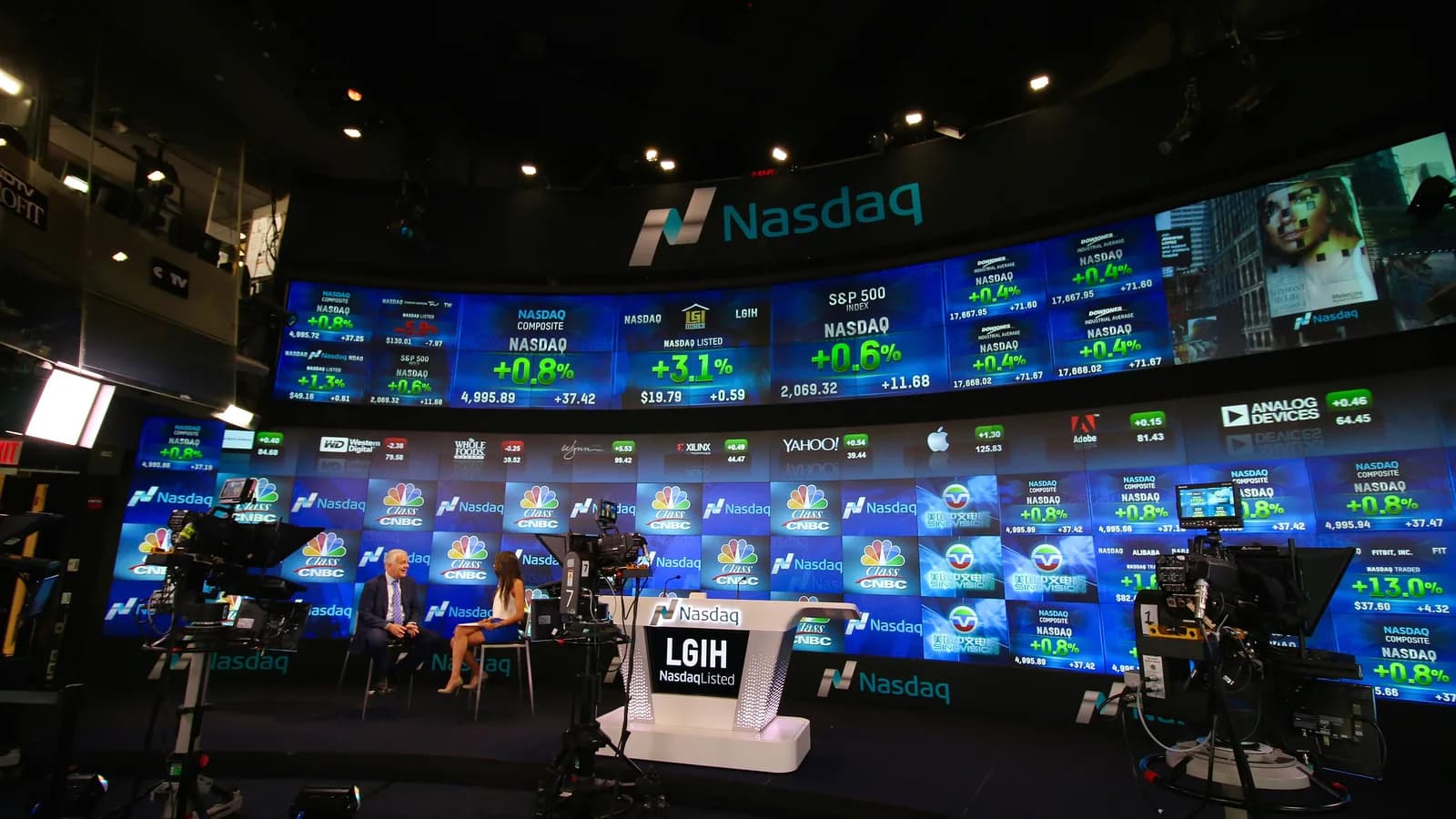
The ai bubble question moved from opinion pages to market screens over the last two weeks, and the market has not settled it. On Thursday 22 October the Nasdaq Composite fell 2.6%, its steepest daily drop since 5 June, and the S&P 500 lost 1.2%, Al Jazeera reported. Meta fell nearly 7% that day after raising its projected 2026 capital spending to between $135 billion and $145 billion. Jay Goldberg of Seaport Research Partners told Al Jazeera the swings looked driven by sentiment.
The selling deepened a week later. Alphabet reported a third-quarter free cash flow of minus $9.1 billion, according to XTB, and NBC News reported that its shares lost about $500 billion of market value on Thursday 29 October. On Friday 30 October more than $1 trillion of tech value was erased, NBC said, with the Philadelphia semiconductor index down 7.2% and Intel down 29%, its worst day in data going back to the 1980s. On Monday 2 November the Nasdaq Composite closed down 1.07% and the S&P 500 down 0.51%, CNBC reported, as investors moved money out of technology.
How big the AI spending is: $800.6 billion, $2.7 trillion or more
The headline figure depends on who is counted. The BBC, in coverage summarised on Slashdot, reported that Meta, Alphabet, Oracle, Amazon and Microsoft have together committed $800.6 billion to AI spending in 2026, under a headline saying the total nears $1 trillion. The research firm Gartner forecasts a much wider total, global AI investment of $2.7 trillion in 2026 and $3.6 trillion in 2027, Al Jazeera reported. The two numbers measure different things and should not be added together.
Company plans make up the largest part. Meta expects 2026 capital spending of $135 billion to $145 billion. Amazon expects about $220 billion of cash capital spending this year, and chief executive Andy Jassy told shareholders it would spend meaningfully more in 2027, NBC reported. Alphabet's July guidance was $195 billion to $205 billion for the full year, XTB wrote.
The International Monetary Fund puts the scale in historical terms. In a blog post published on 15 October it said AI investment will likely exceed the sums that built the railroads, the electricity grid and the internet. Much of it goes into data centres, led by the large cloud companies known as hyperscalers.
Paying for it: cash flow, bonds and circular deals
At some of the largest spenders the bills now outrun the cash coming in. Alphabet's capital spending reached $51.4 billion in the third quarter, more than double a year earlier, and XTB reported that it raised about $28.7 billion in bonds and $12.4 billion in shares. Amazon's free cash flow over the last twelve months was minus $42.4 billion, against plus $14.7 billion a year earlier, Constellation Research reported, citing its AI investment.
Oracle shows the pattern most plainly. On 2 November it announced plans to sell $10 billion of stock and $10 billion of bonds to fund its AI build-out, and its shares fell 8%, CNBC reported. The IMF says the hyperscalers' share of investment-grade bond issuance has risen more than tenfold, from under 1% to 10% and growing. NBC noted that AI companies borrowing hundreds of billions of dollars have competed for capital and helped push Treasury yields up in recent months.
Circular deals are the second concern. The IMF counted 14 circular transactions since 2023, involving about $300 billion of equity investment and $650 billion of debt, in exchange for $1.4 trillion of future revenue commitments. In such a deal a strong company funds a weaker partner, which then buys the funder's services. The IMF warns that if the weaker partner stumbles, lower revenue forecasts and valuations could weaken the debt tied to the deals.
The argument that an AI bubble is forming
The IMF's Global Financial Stability Report, presented in mid-October, names AI, bond yields and cyberattacks as the rising risks. Its blog says faltering AI investment and profitability could challenge optimistic expectations. According to The Guardian, as summarised by Resultsense, the seven largest US tech stocks now make up more than 35% of the S&P 500, up from 12% ten years ago, and the Fund sees growing evidence that AI may need less investment than the hyperscalers are committing.
The Bank of England's July Financial Stability Report makes a similar case in plainer words. It says valuations have become more stretched on some measures and that a small group of AI-related companies has driven part of the rally, raising concentration in global indices. It calls the pace of AI investment unprecedented historically, with credit use growing fast across public markets and private credit. A reassessment of long-term earnings, the Bank says, could trigger a sell-off that concentrated positions and rising leverage would amplify.
Individual doubts add to this. Wikipedia's article on the AI bubble, which carries a note that its accuracy is disputed, records that JPMorgan chief executive Jamie Dimon said in October 2025 that some of the money invested in AI will be wasted, and that OpenAI has committed $1.4 trillion over eight years against revenue of about $13 billion. NBC reported that some major AI customers have tightened their AI budgets.
The argument that this is not a bubble
Goldman Sachs strategists led by Peter Oppenheimer wrote in a note reported on 3 August that across technology there does not appear to be a valuation bubble, though there may be an earnings bubble. Their reasoning is that the premium of the five largest US stocks over the rest of the S&P 500 has almost disappeared, and that software's premium is around 20%, far from nearly 200% at the start of the century.
The revenue is real so far. Alphabet's Google Cloud brought in $30.7 billion in the third quarter, up 103%, XTB reported. Amazon Web Services sold about $46 billion, up 39%, and Jassy projected growth above 40% in both 2027 and 2028, which is his forecast and not a result. Samsung reported an operating profit of 107.44 trillion won for July to September, up 783.1%, with its chip business supplying 99.1% of it. Reuters reported that US growth was the fastest in a year, helped by business AI investment.
Al Jazeera reported that some analysts call current spending on data centres and chips unsustainable, while others argue AI will change society enough to justify it. The IMF estimates that AI could add on the order of half a percentage point a year to global growth over the next decade, but says transformations rarely happen overnight. Kathleen Brookes of XTB said that if AI shares keep struggling, it could suggest the AI trade is past its peak.
The dot-com crash in real numbers, and how today differs
Wikipedia's account of the dot-com bubble gives the scale. The Nasdaq Composite peaked at 5,048.62 on 10 March 2000 and had fallen 78% by October 2002. The index reached a price-earnings ratio of about 200 in late 1999. Telecom equipment companies had invested more than $500 billion, mostly borrowed, in the five years after 1996, and capacity outran demand. Stocks lost about $5 trillion of market capitalisation by 2002, and 48% of dot-com companies survived through 2004.
So far the ai bubble of 2026 shows a different size of loss. On 22 October the Nasdaq was 5.8% below its record of 6 October, Al Jazeera reported, a long way from a 78% fall. Goldman's strategists say valuations peaked higher in 2000 and fell as prices collapsed, while this time earnings have stayed strong. The resemblance that the Bank of England and the IMF point to is borrowing, and the difference Goldman points to is profit. Which of the two matters more is the open question, and none of the sources claims to know.
Who would be hit first if the AI bubble burst
Sellers of equipment feel a change in orders first. The semiconductor index fell 7.2% on 30 October, NBC reported, and Nebius and CoreWeave each lost more than 10%. Samsung's chip business made 106.5 trillion won of its 107.44 trillion won operating profit, and its HBM4 chip revenue more than tripled from the previous quarter, according to IANS.
The financial system is the second channel. The IMF says pension funds and insurers have increased holdings of illiquid assets and derivatives and rely on the same asset managers, which raises the risk of simultaneous sales. In its adverse stress scenario, banks holding 22% of global banking assets would fall below regulatory capital limits, up from 18% a year earlier, though banks stay resilient overall. That is a modelled shock, not a forecast.
Jobs and growth are the third. Reuters reported that business AI investment helped US growth reach its fastest pace in a year, so a pullback would remove some of that support, which is an inference and not a forecast. The IMF says the boom lifts growth now, especially in the US and Asian hardware suppliers, and that in a severe correction the losses could spread around the world. After the dot-com crash, Wikipedia records programmer layoffs. No source here puts a number on jobs lost in a new downturn.
What happens next, and the dates to watch
Tuesday 3 November is the day of the US midterm elections. Reuters reported on 30 October that Democrats were widely predicted to win the House, and Rick Meckler of Cherry Lane Investments said a strong blue wave would be seen as negative for AI names, and the report noted that a Democratic sweep could bring more scrutiny of data centres. Reuters listed AMD, Qualcomm and Palantir among the companies due to report this week. The October US jobs report is due on Friday 6 November.
As of 3 November 2026 nobody knows whether spending will slow, whether revenue will catch up or whether the Nasdaq will keep falling. The IMF and the Bank of England agree that risks are elevated, while Goldman's strategists dispute that prices are too high. This story is not investment advice, and a personal portfolio or pension is a question for a licensed adviser.
Practical checklist
- Read the capital-spending guidance in the next quarterly filings of Alphabet, Amazon, Meta and Microsoft.
- Check which measure a headline uses: five companies, Gartner's worldwide forecast, or one quarter.
- Note whether a claim comes from a regulator, a bank's strategists or a commentator, and what each stands to gain.
- Watch the IMF and Bank of England financial stability reports for changes in their wording on AI.
- Take a personal portfolio or pension question to a licensed adviser, not to a news story.
Questions and answers
Is the AI bubble about to burst?
No source read for this story forecasts a burst. The IMF and the Bank of England call the risk elevated, Goldman Sachs sees no valuation bubble but a possible earnings bubble, and the market fell for two weeks. As of 3 November 2026 the question is open.
Why is the stock market down today?
On 2 November the Nasdaq Composite closed down 1.07% and the S&P 500 down 0.51%, as CNBC reported, with money moving out of tech. Reasons given recently include doubts over AI spending returns, Alphabet's cash flow, Intel's results and oil prices. Check a live source for today.
How much is spent on AI in 2026?
The BBC counted $800.6 billion committed by Meta, Alphabet, Oracle, Amazon and Microsoft. Gartner forecasts $2.7 trillion of global AI spending in 2026. Both are estimates, and they measure different things.
Is this the same as the dot-com bubble?
Not so far in size. The Nasdaq fell 78% from its March 2000 peak by October 2002, while it was 5.8% below its record on 22 October. Analysts differ on whether the debt or the profits matter more.
Should I sell my tech shares or pension holdings?
This story cannot say. It reports what regulators, companies and analysts said, and it gives no advice to buy or sell. Your age, goals, taxes and the rules of your pension decide that, so ask a licensed adviser.