
Answer in brief
Amber in a perfume is rarely the stone. Most often it is an accord of resins such as labdanum and benzoin with vanilla, sometimes it names ambergris, a sperm whale secretion with a complicated legal status, and often it points to ambroxan, a molecule that carries the ambergris note. Each smells different: sweet, resinous, or dry and salty.
Why amber perfume means three different things
Search for amber perfume and you meet one word that points at three different materials. One is a stone, one is a secretion of a whale, and one is a warm, sweet smell that perfumers assemble on purpose from resins. The names coincide because of history, not chemistry. Wikipedia explains that the English word amber first meant ambergris, and that it comes from the Arabic ʿanbar through Middle Persian, Medieval Latin and Middle French.
The same page suggests why the meanings merged: both substances wash up on beaches, so people may have taken one for the other. Fossil resin kept the name in the end, and ambergris became a separate word. A perfume box inherits the confusion, because it uses amber for a colour, a note and a mood all at once.
This story separates the three, since the difference decides what you will smell on your skin. The amber accord is what most buyers mean. Ambergris is a rare natural material wrapped in legal questions. Ambroxan is the modern ingredient that carries an ambergris-like note into bottles you can actually buy.
Fossil amber smells of almost nothing
Wikipedia defines amber as fossilized tree resin. It forms when resin survives long enough to be changed by heat and pressure under sediment, first into copal and then into amber. The oldest amber it mentions dates to about 385 million years ago, and people have worn it as jewellery since the Stone Age, some 13,000 years ago.
Its scent is the surprise. According to the same article, burning amber gives off a pinewood-like fragrance, but fossilized amber produces very little scent of its own. Modern perfumes labelled amber usually do not contain real amber at all: they imitate its warm, rich character with other materials, mainly labdanum, with benzoin, vanilla and more. A golden stone on an advertisement is therefore a colour, not an ingredient.
The amber accord: resins and vanilla built to feel warm
In perfumery, an accord is a blend made to be read as one smell, and amber is the best-known example. Its backbone is labdanum, a sticky brown resin from two rockrose shrubs, Cistus ladanifer in the western Mediterranean and Cistus creticus in the eastern. Wikipedia notes that in ancient times the resin was combed from the beards and thighs of goats and sheep that had grazed on cistus, and that in nineteenth-century Crete shepherds swept the shrubs with a rake-like tool instead.
Today labdanum is produced mainly for perfumery. The same article says the raw resin is usually extracted by boiling leaves and twigs, then turned into an absolute by solvent extraction or an essential oil by steam distillation. Its smell is listed as rich, complex and tenacious, with descriptors that run from amber, sweet and woody to powdery, animalic, leathery and, tellingly, ambergris-like.
Benzoin adds the sweetness. It is a balsamic resin from the bark of Styrax trees; Siam benzoin comes from Styrax tonkinensis in Thailand, Laos, Cambodia and Vietnam, and Sumatra benzoin from trees grown mainly on Sumatra. Wikipedia describes the aroma as vanilla-like and sweet, and says perfumers also use it as a fixative, because it slows the way other materials disperse into the air. Add vanilla and you have the classic recipe: dry resin, sweet balsam and a soft, creamy finish.
Ambergris: the whale material that gave the word its first meaning
Ambergris is described by Wikipedia as a solid, waxy, flammable substance of a dull grey or blackish colour, produced in the digestive system of sperm whales. It forms from a secretion of the bile duct in the intestines, takes years to form, and is found either in the abdomens of dead whales or floating at sea. The article gives an estimate that only about one percent of sperm whales produce it, which explains why it has always been rare.
The fresh material looks nothing like the prized one. It is pale, soft and has a strong faecal smell. Over months or years in the ocean it hardens and darkens, and the odour changes into something the article calls sweet and earthy. Perfumers valued it as a fixative, a material that holds other scents in place.
The chemistry explains the transformation. Ambrein, the main terpenoid in the fresh material, is relatively scentless; as it oxidises over time it breaks down into ambroxide and ambrinol, which Wikipedia names as the main odour compounds. The smell people associate with ambergris is therefore a product of ageing, not of the raw secretion.
Is ambergris legal? It depends on the country
There is no single answer, and sources date quickly. Wikipedia lists Australia, the United States and India as places where trade or possession is illegal, and the United Kingdom, EU member states, Switzerland and the Maldives as places where it is legal. It also notes that some of its own references are old, so treat that list as a map of where to look, not as legal advice.
For the United States the clearest statement quoted in Honolulu Magazine comes from a special agent of NOAA’s Office of Law Enforcement, who says it is unlawful to possess, sell or transport ambergris. The magazine adds that people who find it on a beach are told to leave it or report it to that office. If you ever handle the material itself, ask the authority of your country before anything else.
Part of the reason for the patchwork is international. Wikipedia says that naturally excreted ambergris is treated as a waste product rather than as a part or derivative of a species listed under CITES, so that convention does not cover it and each country decides for itself. For a buyer of ordinary perfume this matters less than it sounds. The same article records that synthetic ambroxide has largely replaced the natural material in perfumery.
Ambroxan: the molecule behind the ambergris note
Ambroxide, sold under trade names that include Ambroxan, is a terpenoid and, in Wikipedia’s words, one of the key constituents behind the odour of ambergris. Its smell is listed as woody, musky and slightly salty, with dry, cedar, pine and green facets. It is used to create ambergris notes and as a fixative, and it appears most often in the base of a fragrance.
The scientific literature agrees on its role. A 2024 article in the chemistry journal CHIMIA calls (–)-Ambrox the most prominent olfactive component of ambergris and one of the most widely used biodegradable fragrance ingredients. It was traditionally produced from sclareol, a diterpene found in clary sage, and the authors describe a newer route from fermentation-derived farnesene that, by their account, wastes less and needs less solvent and energy.
For the reader, the practical point is this: the ambroxan note is not sweet. It is dry, woody and a little salty, like warm skin after the sea. That makes it a very different partner from vanilla, and explains why two perfumes that both say amber can feel like opposites.
How to read amber on a box and choose your shade
Treat the word amber as a question, not an answer, and look at its neighbours in the note list. Vanilla, benzoin, tonka bean or a gourmand note beside it points to the sweet, resinous shade. Woods, spices and ambroxan point to the dry shade. A mention of ambergris, with a mineral or salty description, points to the third, skin-like shade.
The shade matters more than the family label. Someone who dislikes sweet perfumes may still enjoy a dry amber woody composition, and someone who loves sweetness may find the same bottle austere. Describing what you like in a perfume you already wear, in plain words such as warm, dry, powdery or salty, is more useful than naming a favourite note.
Finally, judge on skin, not on paper. A fragrance changes as the top notes leave and the base settles, and amber materials sit in that base. Wear it for an ordinary day, notice what you smell when you come back to it later, and decide then. If you have sensitive skin, test a small area first and ask a doctor about any reaction.
Three VITON XIII fragrances to try if you like amber
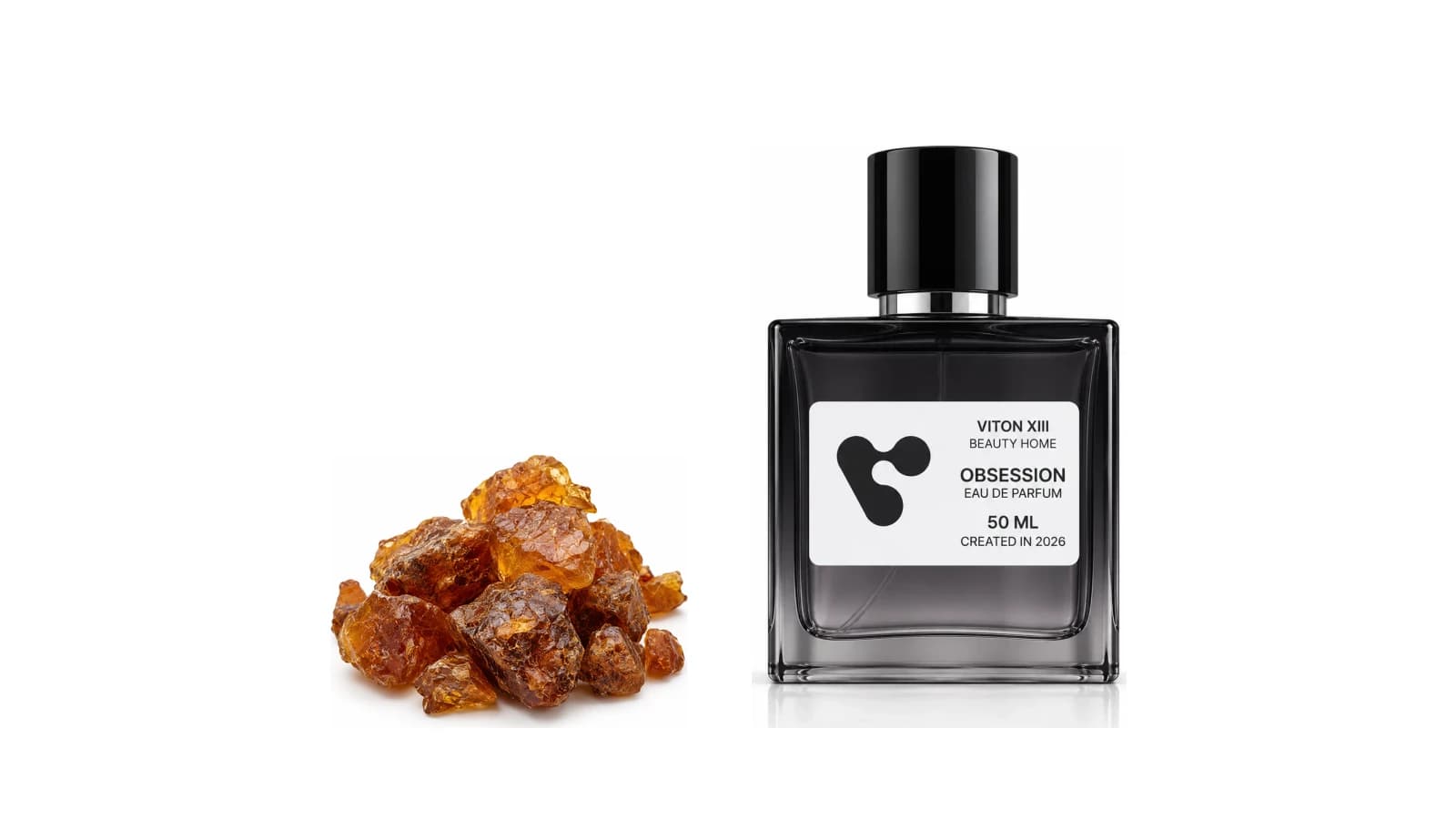
Three of the five VITON XIII fragrances, each an Eau de Parfum in a 50 ml bottle, show the shades above. OBSESSION is for him and belongs to the amber woody spicy family: Calabrian bergamot opens it, Sichuan pepper follows, and the base holds ambroxan and an amber-woody accord, which the store describes as dry wood and clean warm skin. It sits at the dry end of amber.
MILANO, unisex, is a floral amber gourmand. It opens on black cherry, almond and red wine, moves to red rose and white flowers, and ends on amber resin and tonka bean, the almond and warm vanilla of the trail. That is the resinous, sweeter end. GELO, for him, is a fruity chypre with ambergris and vanilla in the base under oakmoss, a salty-skin finish warmed from below.
To find which suits you, paste the notes of a perfume you already love into the scent finder; it compares notes and families and names the closest of the five, without naming other brands. The kitchen test on each fragrance page gives three everyday hints, such as a vanilla pod for vanilla, which are hints rather than copies. Every bottle is sold sealed with a sample of the same fragrance outside the seal: wear the sample first, open the bottle only if the scent is yours, and a bottle with an intact seal can be returned within 14 days of delivery.
Practical checklist
- Read the neighbours of amber in the note list: sweet resins, dry woods or a salty skin note.
- Name the shade you like in plain words: warm, dry, powdery or salty.
- Wear a sample for a full ordinary day before opening a bottle.
- If you have sensitive skin, test a small patch first and ask a doctor about reactions.
- Try OBSESSION, MILANO or GELO from the sample outside the seal, then decide.
Questions and answers
Does a bottle labelled amber contain real amber?
Usually not. The fossil resin has almost no scent of its own, so perfumers imitate its warmth with resins such as labdanum and benzoin, vanilla and modern molecules. The word on the box describes a smell and a colour.
Is ambroxan the same thing as ambergris?
No. Ambergris is a natural secretion of sperm whales. Ambroxan is a molecule made in a laboratory that carries one of the key odour notes of ambergris, which is why it is used as its modern stand-in in perfumery.
Is every amber perfume sweet?
No. Amber built on vanilla and benzoin is sweet, but amber built on woods, spices and ambroxan is dry and slightly salty. Check the other notes before you decide that amber is not for you.
Can I buy and own ambergris legally?
It depends on where you live. Some countries ban possession or trade and others allow it, and sources date quickly. Ask your national authority before buying or keeping any, and note that ordinary perfume does not need it.
Which amber fragrance should I try first if I am unsure?
Choose by the shade you like: dry and woody, resinous and sweet, or salty and skin-like. Samples make this cheap to learn, because you can wear one for a day and see how the base settles before committing to a full bottle.