
Answer in brief
Bergamot is a citrus fruit grown almost entirely on the southern coast of Calabria, and its peel oil is one of the most used top notes in perfumery. It smells of orange peel with a floral and green edge, and it is the flavour of Earl Grey tea. The oil contains bergapten, so IFRA caps it in products for sun-exposed skin.
What bergamot is, and what it is not
A bergamot perfume begins with a fruit most people have only tasted in tea. Wikipedia describes the bergamot orange, Citrus bergamia, as a fragrant citrus roughly the size of an orange, yellow or green like a lime depending on ripeness. Its juice is less sour than a lemon’s but more bitter than a grapefruit’s, and genetic research suggests it is probably a hybrid of lemon and bitter orange.
Nobody drinks that juice for pleasure, and that is the point. The fruit is grown for its peel, which holds the oil perfumers want. A 2015 review in Frontiers in Pharmacology says the fruit is mainly used to extract the essential oil, which goes into perfume, cosmetics, food and confectionery.
Calabria and the oil in the peel
The same review calls the plant endemic to the Calabria region of Italy and says it is grown almost exclusively along its southern coast, from where more than 90 percent of the world’s bergamot comes. Wikipedia places the large-scale production on the Ionian Sea coast of Reggio di Calabria province, and lists southern France and Ivory Coast as other sources of the oil.
The oil is not distilled. According to the Frontiers review it is obtained by rasping and cold pressing the fruit peel, and Wikipedia adds the yield: the rinds of 100 bergamot oranges give about 85 grams. That low yield helps explain why the oil has long been valued, and why it has long been faked.
Wikipedia reports that Italian authorities introduced testing and purity certificates after adulteration problems, and that the Reggio Calabria experimental station controls the protected oil. It also notes that about 3,000 tonnes of essence of bergamot are sold each year while genuine production is no more than 100. The bottle in your hand cannot tell you which kind it holds.
The smell: orange peel, flowers and Earl Grey
Wikipedia’s two descriptions agree. One gives the scent as citrus, floral, green, spicy, orange peel and ginger; the other as sweet, light orange peel with a floral note. It is a citrus that does not stop at sourness, which is why a single drop changes the character of a composition.
Everyday life has already taught you the smell. An essence from the peel flavours Earl Grey and Lady Grey teas, so anyone who has held a warm cup of one knows the green, slightly bitter brightness. The Frontiers review lists what the oil is made of: 93–96 percent volatile fraction, with limonene at 25–53 percent, linalyl acetate at 15–40 percent and linalool at 2–20 percent.
Why bergamot opens so many fragrances
Wikipedia calls bergamot one of the most commonly used perfume ingredients and notes that its essential oil is a top note. In the same encyclopedia’s account of the perfume pyramid, top notes are small, light molecules that evaporate quickly; middle notes appear as they fade, and base notes are rich and deep. Bergamot suits the first role because it smells bright at once and gets out of the way.
Its history is long. The article on the essential oil says the earliest record of its use as a perfume fragrance is from 1714, and that it was a major component of the original eau de cologne. A citrus that works as an opening has not changed its job in three centuries.
That job explains why it fades first. A top note is chosen to be the first impression, not the last, so a perfume that opens on bergamot and then settles into flowers, woods or musk is behaving exactly as designed. If you want bergamot to stay, look for it in the sample on your skin in the first minutes, then for what replaces it.
Bergapten: why bergamot and sunlight need care
The oil contains bergapten, a linear furanocoumarin related to psoralen that Wikipedia identifies as phototoxic. Applied to skin and then exposed to UV light, the oil can cause severe reactions that depend on its concentration. Wikipedia notes that such reactions were described as early as 1916 and named berloque dermatitis in 1925.
The 2015 Frontiers review gives the numbers behind the caution. It says bergapten, also called 5-methoxypsoralen or 5-MOP, makes up about 0.2 percent of the oil, and that the International Fragrance Association recommends capping bergamot oil at 0.4 percent in products applied to sun-exposed skin. Wikipedia confirms the same limit for leave-on skin products.
There is also a way around the problem. The review says a furocoumarin-free oil has been prepared for perfumery and cosmetics, and that vacuum distillation of the peels yields oil free of 5-MOP. Neither source tells you which oil sits in a particular bottle. If you have sensitive skin or plan a day in strong sun, patch-test a small area first, follow the label, and ask a doctor about any reaction.
Bergamot with flowers, spice and wood
Because the oil has floral, green and spicy facets, it joins easily with other families. Next to white flowers or roses, the floral facet seems to lift them and keep them airy. Next to pepper and ginger-like spice, the green and peppery sides meet. Over woods, it gives a bright first minute before the dry base arrives. These are descriptions of how the listed facets combine, not rules.
That versatility is also why the word bergamot on a note list says little by itself. It tells you the opening, and nothing about the middle or the end. Read the next two lines of the pyramid before judging whether you will like a bottle.
How to judge a bergamot opening on your skin
Spray once and notice the first minute, then wait. The citrus you like in the first minute is the part that leaves first, so the real decision is about the heart and base that follow. A perfume that you enjoy at minute one and at hour two has passed the test that matters.
Compare it with something you already know. Describe the bergamot in plain words, such as Earl Grey, green rind or sparkling, and then describe the later scent. A sample worn for an ordinary day tells you more than a card in a shop, because skin changes how citrus opens and how the base settles.
Three VITON XIII fragrances that open on bergamot
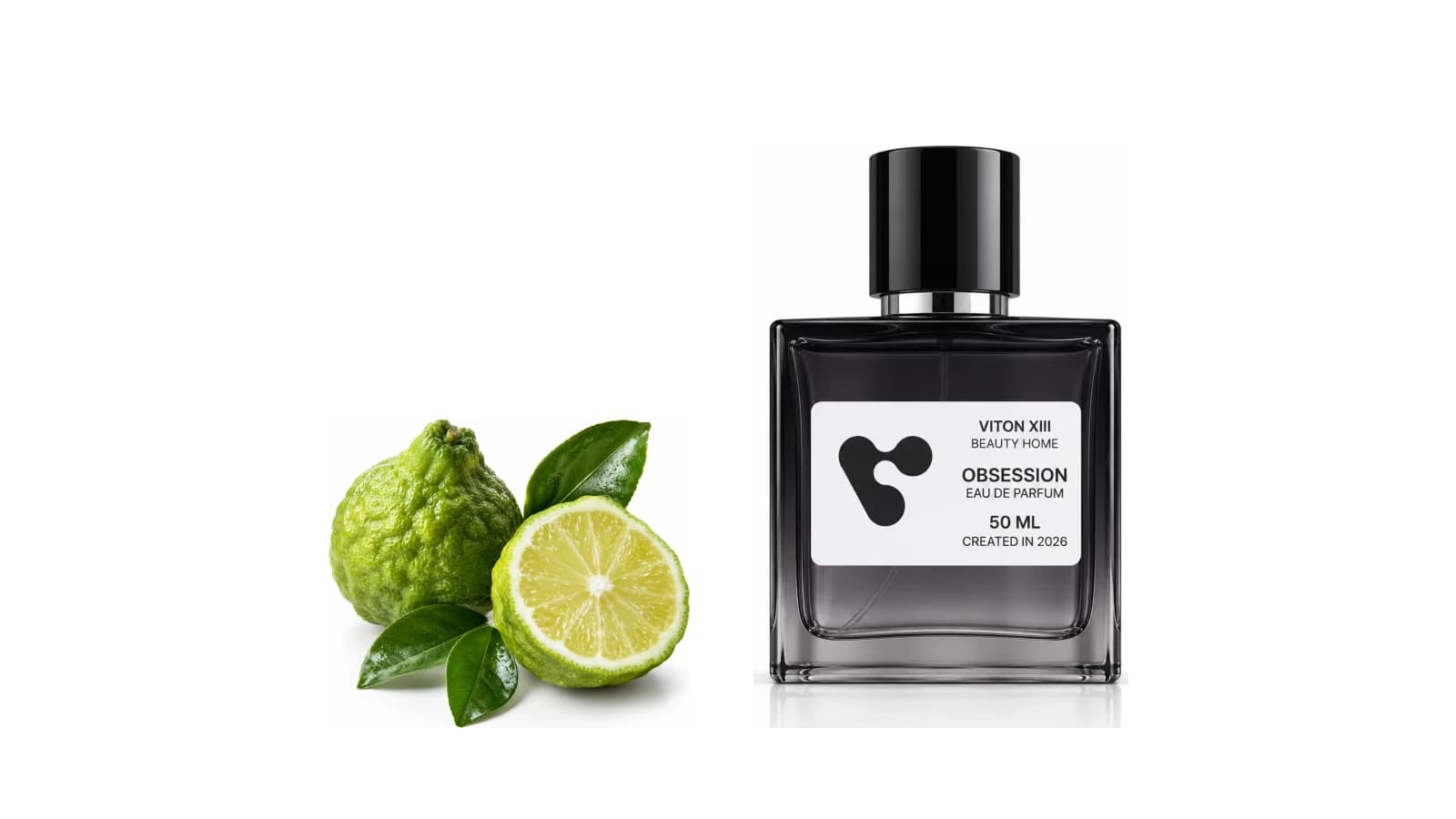
Three of the five VITON XIII fragrances, each an Eau de Parfum in a 50 ml bottle, open with bergamot, and they show three ways to use it. OBSESSION, for him, opens with Calabrian bergamot, a green, slightly bitter flash like the bergamot of Earl Grey tea, followed by Sichuan pepper that is more citrus than heat, over ambroxan and an amber-woody accord. The trail is dry wood and clean warm skin.
FLEUR POLLEN, for her, is a citrus floral musk: the opening is clean and airy on bergamot, then sweet pea, peony and Damask rose read as a fresh pink bouquet with a soft, honeyed petal edge, never as jam, ending on white musk close to the skin. GELO, for him, is a fruity chypre in which bergamot sits among apple, blackcurrant and pineapple over a cold, almost unripe fruit opening.
To find your own, paste the notes of a perfume you already love into the scent finder; it compares notes and families and names the closest of the five, without naming other brands. Each fragrance page also offers a kitchen test, three everyday hints such as Earl Grey tea for bergamot, which are hints and not copies. Each bottle is sold sealed with a sample of the same fragrance outside the seal: wear the sample first, open the bottle only if the scent is yours, and return it within 14 days of delivery while the seal is intact.
Practical checklist
- Judge the bergamot opening after the first minute: look at what the heart and base become.
- Read the next two lines of the note pyramid before you decide whether you like a bottle.
- Follow the label on sun exposure, and patch-test a small area if your skin is sensitive.
- Describe the citrus in plain words, such as Earl Grey, green rind or sparkling.
- Wear the sample of OBSESSION, FLEUR POLLEN or GELO outside the seal before opening a bottle.
Questions and answers
Does bergamot in perfume smell like Earl Grey tea?
It can, because an essence from the same peel flavours Earl Grey. In a perfume it is usually mixed with other notes, so you may catch only the green, slightly bitter brightness in the first minutes.
Why does the bergamot smell disappear so fast?
It is a top note, built from small, light molecules that evaporate quickly. The perfume is designed to move on to its heart and base, so the vanishing is part of the design rather than a flaw.
Is bergamot perfume dangerous in the sun?
Untreated bergamot oil contains bergapten, which is phototoxic, and IFRA recommends a cap for products on sun-exposed skin. Bergapten-free oils also exist. If you are sensitive, test a small patch and ask a doctor.
Where does the best bergamot come from?
The sources agree that more than 90 percent of the world’s bergamot is grown on the southern coast of Calabria. They do not rank quality by origin, and they warn that adulteration is common, so no label can promise more.
Which fragrance families usually use bergamot?
Many of them, because its floral, green and spicy facets pair with flowers, spice, woods and musk. The name alone tells you the opening, so read the heart and base notes before choosing.