
Answer in brief
A pineapple note is a cluster of fruity esters, the same family of molecules that fills the real fruit. It sits at the top of a scent, so it is bright for the first minutes and then gives way. Whether it stays fresh, turns tropical or meets smoke and moss depends on the notes around it.
What a pineapple note is asked to do in a scent
A buyer who searches for pineapple perfume usually wants one of two things. Either a bright, juicy, slightly sour opening that wakes the scent up, or a sweet holiday smell that fills a room. The same word covers both, and a perfume can lean either way. What the note cannot do is stay: pineapple is an opening, a flash of fruit that sets the mood for what follows.
Wikipedia’s article on perfumery notes explains why. Top notes are perceived immediately and consist of small, light molecules that evaporate quickly, and the same article says middle notes fade within about an hour while base notes are usually not noticed until half an hour in. Pineapple is a fruit built for the first stage, and good composition uses that on purpose.
The real fruit is a cluster of esters
Researchers writing in the journal Molecules studied Smooth Cayenne pineapples and identified 44 aroma compounds across pulp and core, among them 18 esters. In the pulp, esters made up 84.07 percent of the volatile compounds and the single largest was ethyl hexanoate at 106.21 micrograms per kilogram. Across the whole fruit esters came to 73.76 percent. Pineapple smell is mostly an ester smell.
The fruit is not one smell, however. In the same study the core held a different balance from the pulp: esters were 56.15 percent there and terpenes 31.33 percent, against 13.03 percent terpenes in the pulp. So a note drawn from the sweet flesh and a note drawn from the tough centre would not read the same, and a perfumer can aim for either.
A second paper in the International Journal of Molecular Sciences compared two pineapple varieties grown in China, Tainong No. 4 and No. 6. It reported 33 volatile compounds in all, 28 in No. 6 and only 11 in No. 4, and total concentrations of 380.66 and 1,080.44 micrograms per kilogram. Its authors suggest that the apple-like character of No. 6 may explain its nickname, which is a neat reminder of why pineapple and apple get along on a scent strip.
One molecule can serve several fruits
Wikipedia says allyl hexanoate occurs naturally in pineapples and that its main use is in pineapple flavour blends. It also appears in peach and apricot essences, in apple blossom, peach blossom and wisteria perfume compositions, and adds a sweet juicy note to citrus flavours. The article lists hazard statements for the pure liquid, which is a reminder that a raw material and a finished perfume are different things.
Ethyl butyrate is another example. Wikipedia describes its odour with words such as fruity, juicy fruit and pineapple, and says it occurs naturally in many fruits at lower concentrations. The same article lists flavourings that contain it: orange, the most common, then cherry, pineapple, mango, guava, peach and others, and it notes use as a solvent in perfumery. The line between one fruit and the next is, in chemical terms, thinner than it looks on the label.
Fresh fruit for the day or a sweet tropical blend
Wikipedia’s article on perfume describes the fruity family as scents featuring fruits other than citrus, such as peach, blackcurrant, mango and passionfruit. Pineapple belongs there, and it can be written in two very different ways. Beside citrus and a dry wood it reads fresh and slightly sharp, the kind of fruit that wakes a scent up. Beside sugar and vanilla it reads as a tropical dessert.
There is no rule that gives pineapple a gender. It turns up in fresh fruity scents sold to men and in sweet blends sold to women, and it is the surroundings that decide the style. When you read a list of notes, look at what stands next to the pineapple, and ask whether the neighbours are sharp, dry and green or soft, sweet and creamy.
Pineapple with smoke, birch and moss
A third way to treat the fruit is to put it among dark, dry materials. Wikipedia describes birch tar as the product of dry distillation of birch bark, used in perfumery for a leathery, smoky note. Next to it, a pineapple loses its holiday mood: the fruit turns cold and almost unripe, and the smoke makes it look like something seen through a window in winter.
Oakmoss is the other classic partner. Wikipedia says this lichen is harvested in South-Central Europe, that its extracts act as perfume fixatives and base notes and that they are key components of fougère and chypre perfumes. It describes the smell as woody, sharp and slightly sweet. Under a bright fruit it provides a damp, shaded floor.
A caution belongs here. The same article advises avoiding oakmoss if you have known skin sensitisation problems and states that its use in perfumes is now highly restricted by International Fragrance Association regulations. If your skin reacts to scents, patch-test a small area, wait a day and ask a doctor, who is the one to judge your case.
Why the fruit fades and what is left
A real pineapple is picked and does not improve. Wikipedia notes that the fruit is non-climacteric and never becomes any riper than it was when harvested, which is a reminder that its smell is fixed at one moment. A perfume does the opposite: it moves, and the pineapple is only the first picture in a slide show.
What stays is whatever sits beneath it. In a fruit-and-wood scent the fruit thins out in the first minutes and the wood, moss or resin takes over, and in a sweet blend the vanilla or musk does. That is why the opening of a pineapple perfume tells you almost nothing about the end, and why two scents with the same fruit on top can finish as different as day and night.
How to test a pineapple scent without being fooled
Test a pineapple perfume on skin, one scent at a time, and note what you smell at five minutes, at thirty and at sixty. Pineapple is loudest in the first of them and a poor guide to the last. If the fruit is the only thing you like, ask yourself whether you would wear the scent once the fruit has gone, and judge the thing that remains.
Also check the mood, not only the fruit. Fresh, dry, smoky and sweet pineapple scents suit different days, and a scent that seems wrong in a warm room can seem right in a cold street. Wear it for an afternoon and come back to it the next day before deciding.
GELO: pineapple under birch, juniper and oakmoss
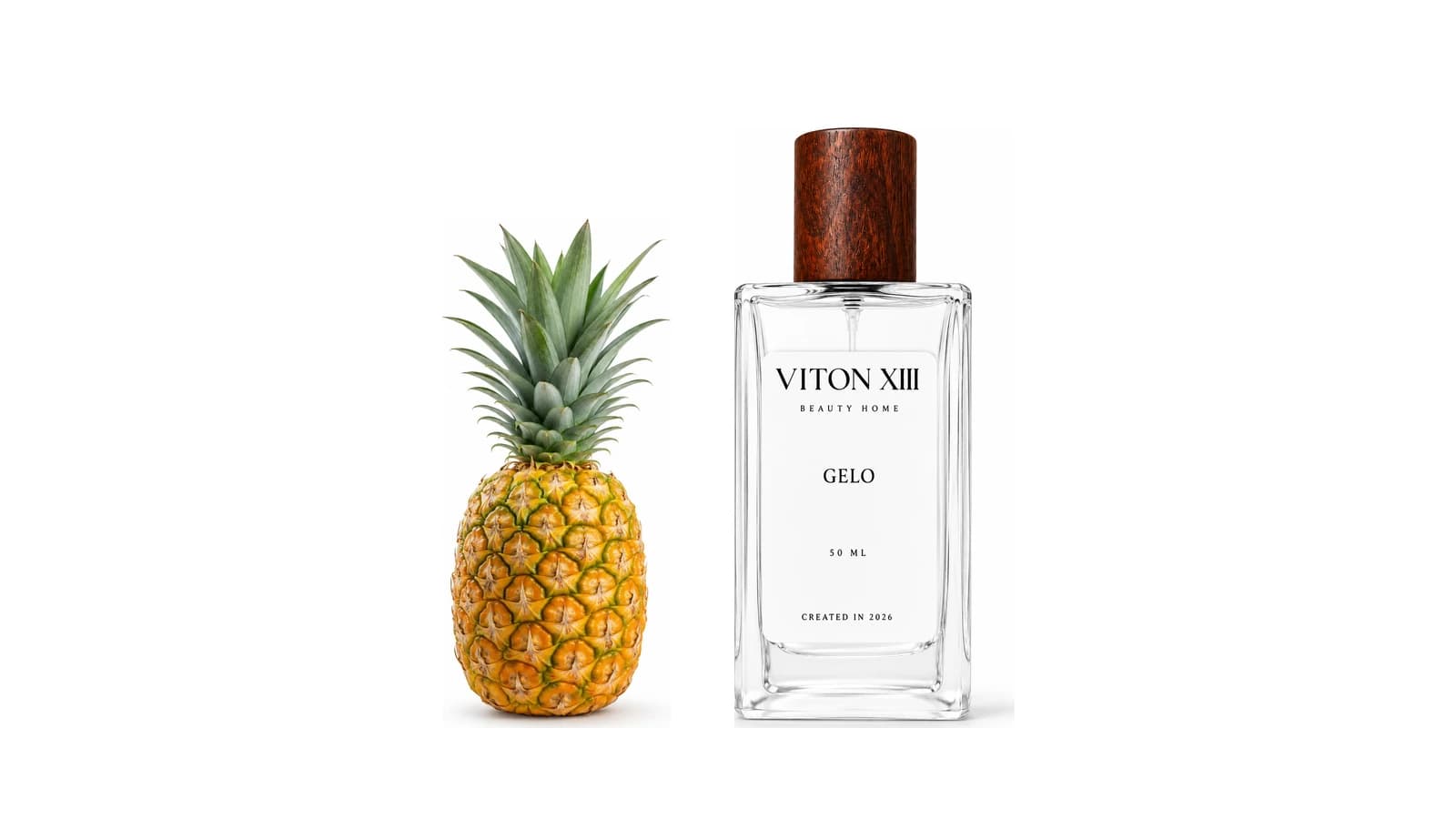
In the VITON XIII line, the pineapple is in GELO, a fruity chypre listed for him, sold as an Eau de Parfum in a 50 ml bottle. The top notes are apple, blackcurrant, pineapple and bergamot; the heart is birch, jasmine and juniper; the base is oakmoss, vanilla and ambergris. The store describes it as opening on cold, almost unripe fruit with a dark resinous edge, never sweet at the start; in the heart, smoke from birch and cold juniper turn it from fruit into a chypre; the base is damp forest from oakmoss and salty skin from ambergris, warmed from below by vanilla.
That is the smoke-and-moss pineapple described above. To find out whether it suits you, paste the notes of a perfume you already love into the scent finder, which compares notes and families and names the closest of the five. The GELO page lists three ordinary kitchen things that stand in for its top, heart and base; they are hints, not copies. Every bottle is sold sealed with a sample of the same fragrance outside the seal: wear the sample first and open the bottle only if the scent is yours. While the seal is intact, the bottle can be returned within 14 days of delivery.
Practical checklist
- Look at what stands beside the pineapple in the list: citrus and wood mean fresh, sugar and vanilla mean tropical.
- Wear one scent on skin and note what you smell at five, thirty and sixty minutes.
- Judge the scent by the base, because the fruit will be gone within the first hour.
- If your skin reacts to moss or woody notes, patch-test a small area and ask a doctor.
- If you like a cold fruit with smoke and moss, wear the GELO sample before opening the sealed bottle.
Questions and answers
What is in a pineapple note besides pineapple?
A cluster of esters first of all: studies on the fruit found esters to be most of its volatile compounds. A perfumer builds the note from materials that carry that fruity signal, and may add citrus or green facets to sharpen it.
Why does pineapple perfume fade so quickly?
Because it is a top note. Wikipedia describes top notes as small, light molecules that evaporate quickly. The fruit makes the first impression, and the heart and base take over as the minutes pass.
Is pineapple a men’s or a women’s note?
Neither. Pineapple appears in fresh fruity scents sold to men and in sweet blends sold to women. What matters is the company it keeps: dry wood, smoke and moss lean one way, vanilla and cream lean the other.
Can a pineapple scent smell dark or smoky?
Yes. Placed beside birch tar, which Wikipedia says gives a leathery, smoky note in perfumery, and a mossy base, the fruit turns cold and dry. It stops reading as a holiday and starts reading as a forest.
Should I worry about oakmoss on my skin?
Wikipedia says oakmoss is highly restricted in perfumes under International Fragrance Association rules and advises avoiding it if you have known sensitisation problems. If your skin is sensitive, test a small area first and ask a doctor about your case.