
Answer in brief
Woody fragrances are built around materials such as sandalwood, cedarwood, vetiver, patchouli, birch tar and oakmoss. They come in dry and clean, smoky, mossy and earthy shades, and they sit in the base of a perfume, where they hold lighter notes in place. For men is a market label rather than chemistry, so choose the shade you like, not the picture on the box.
What woody means on a perfume label
A woody perfume for men is, first of all, a woody perfume. Wikipedia describes the family as one dominated by woody notes, typically agarwood, sandalwood, cedarwood and vetiver, with patchouli, which has a camphor-like smell, often appearing alongside. Nothing in that definition mentions gender; it lists materials.
Classification wheels give the family a map. In the 2010 version of the fragrance wheel, Wikipedia reports, the woody group is split into woods, which means aromatic woods and vetiver, mossy woods, which means oakmoss and amber, and dry woods, which means dry woods and leather. The same page says that the groupings are rough and overlap, so a single bottle can sit between two of them.
Sandalwood and cedar: the smooth, creamy side
Sandalwood is the best-known smooth wood. Wikipedia describes Indian sandalwood, Santalum album, as a medium-sized hemiparasitic tree whose essential oil has a warm, creamy, milky, precious-wood scent. The oil needs trees of at least about 15 years to be commercially useful, and the article calls the species threatened, partly because of over-exploitation.
That rarity has a side effect. A 2021 study in the journal Molecules, which tested six commercial sandalwood oils against the ISO standard, found that only one was genuine Santalum album oil; three were from another plant and two were synthetic mixtures. The authors note that sandalwood oil is one of the most expensive volatile oils and one of the most often counterfeited, so a note called sandalwood on a label tells you the smell, not the tree.
Cedarwood appears in Wikipedia’s list of the typical woody materials, next to sandalwood. Together they are what many people have in mind when they ask for clean, dry woods. Because the article defines the family through these materials, the words cedar and sandalwood in a note list tell you more about it than any adjective on the box.
Vetiver and patchouli: roots, leaves and earth
Vetiver is a different texture. It is a perennial bunchgrass, Chrysopogon zizanioides, and its fragrant oil comes from the roots, which grow two to four metres deep. According to Wikipedia, Haiti, India, Indonesia and Réunion are major producers, the roots are dried, chopped and soaked before a distillation that can take up to 24 hours, and the oil is described as deep, sweet, woody, smoky, earthy, amber and balsam. The same page notes that vetiver is more common in men’s fragrances.
Patchouli comes from the leaves, not the wood. It is a bushy herb of the mint family, Pogostemon cablin; Wikipedia says its dried leaves and twigs are steam distilled, that Indonesia produces over 90 percent of the world’s oil, and that the scent is heavy, strong, woody, earthy, balsamic and spicy. In a woody composition it adds depth and a dark, damp edge.
Smoke and moss: the darker woody shades
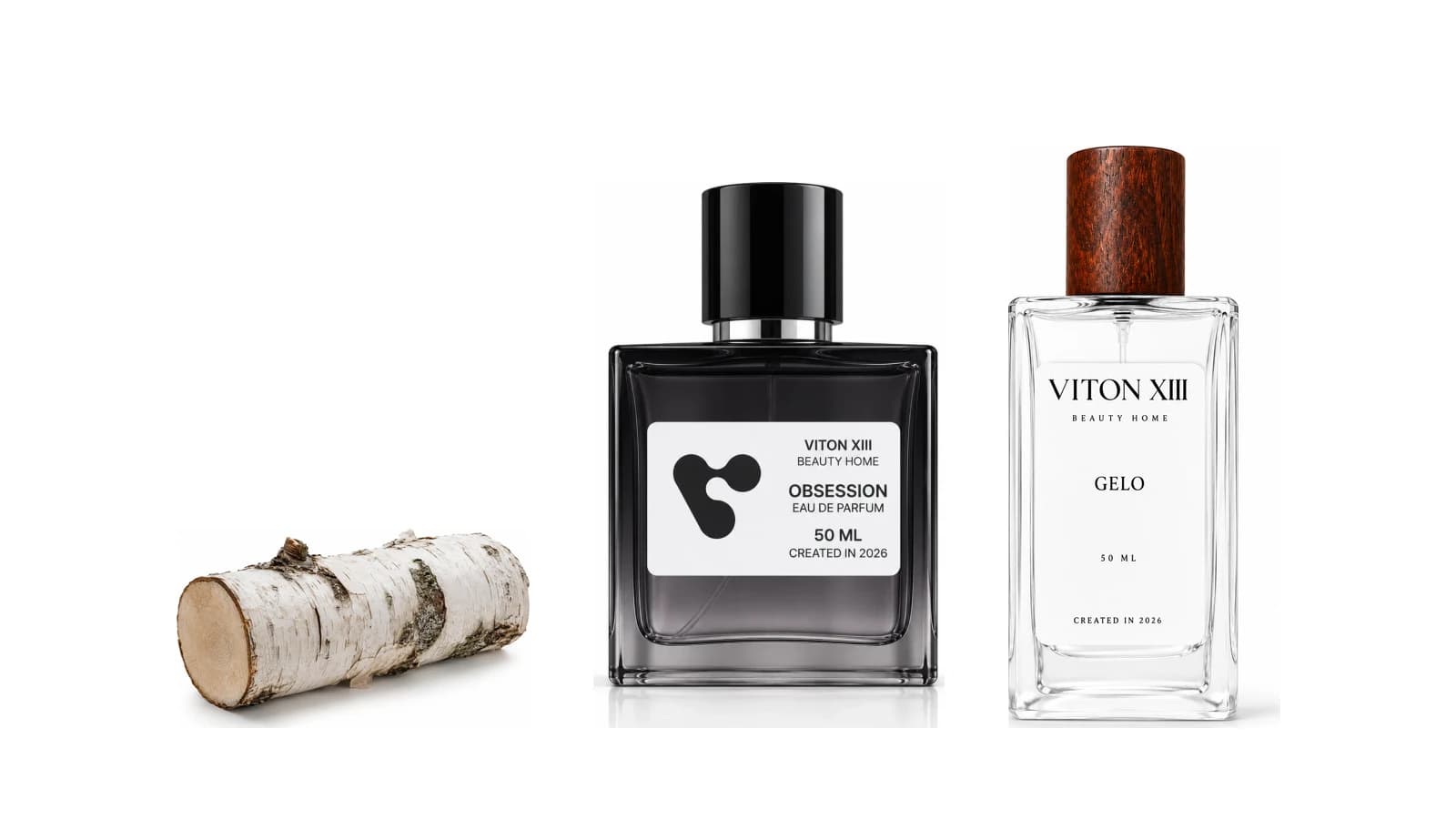
Birch bark tar is made by dry distillation of birch bark, heating it in airtight conditions. Wikipedia says it gives perfumes a smoky, leathery note, especially in leather and tobacco compositions, and that it was used as a base note. Russia leather, oiled with birch bark oil, was prized for its aroma. A woody scent with this ingredient reads as a campfire at a distance rather than a lumberyard.
Oakmoss is a lichen, Evernia prunastri, that grows mainly on oak bark. Wikipedia describes its scent as woody, sharp and slightly sweet, and says its absolutes are used as fixatives and base notes. They are also key to fougère and chypre perfumes. The same article warns that oakmoss should be avoided by people with known skin sensitisation issues, and that its use is highly restricted under International Fragrance Association rules, so many fragrances have been reformulated with substitutes.
Why woods live in the base
Wikipedia’s account of the perfume pyramid explains the position. Top notes are small, light molecules that evaporate quickly, such as citrus. Heart notes appear as the top fades. Base notes are rich and deep and are usually not perceived until about 30 minutes after application.
Woody materials suit that last layer. The article on sandalwood says its oil gives perfumes a long-lasting woody base and acts as a fixative that extends the life of more volatile ingredients, and the vetiver article calls the oil a valued fixative too. The word fixative means a material that slows the departure of lighter ones. A wood is therefore less a note you smell for a moment than the floor the whole composition stands on.
Is a woody scent only for men?
No molecule is male. Wikipedia’s perfume article notes that perfume is often used generically for fragrances marketed to women and cologne for those marketed to men, that women’s products historically tended to be stronger concentrations, and that this is changing as fragrances become more unisex. In other words, the labels follow marketing and habit.
Woody notes are often placed on men’s shelves, and the vetiver article calls that material more common in men’s fragrances. That is a pattern of use, not a property of the molecule. A fragrance wheel page even quotes an informal suggestion that very masculine personalities prefer the woody family, and presents it as a remark, not as established fact. A woman who likes cedar or a man who likes rose are both choosing among smells, and neither choice needs permission from a label.
Choosing a shade for the office, the evening and the season
Start from where you will wear it. For close quarters such as an office, the dry and creamy shades, built on sandalwood and cedar, tend to read as clean and quiet. For an evening, smoke, leather and moss add depth and a sense of occasion. These are rules of thumb from how the notes smell, not measurements, so treat them as a starting point.
Season changes how a scent feels more than what it is. Try the same woody fragrance on a warm day and on a cool one, and let your own nose decide which suits which. Whatever you choose, judge a woody fragrance after its base has settled, not in the first minute, and test a small area of skin first if yours is sensitive.
Two woody VITON XIII fragrances to try at home
Two of the five VITON XIII fragrances, each an Eau de Parfum in a 50 ml bottle, are for him and woody in different ways. OBSESSION belongs to the amber woody spicy family. Calabrian bergamot, with the green, slightly bitter flash of the bergamot in Earl Grey tea, opens it; Sichuan pepper follows, more citrus than heat; the base holds ambroxan and an amber-woody accord, and the trail is dry wood and clean warm skin.
GELO is a fruity chypre. It opens on cold, almost unripe fruit with a dark resinous edge, and in the heart birch smoke and cold juniper turn the fruit into a chypre. The base is damp forest, from oakmoss, and salty skin, from ambergris, warmed from below by vanilla. It is the smoky and mossy end of the family.
To find your own, paste the notes of a perfume you already like into the scent finder; it compares notes and families and names the closest of the five, without naming other brands. The kitchen test on each fragrance page gives three everyday hints, which are hints and not copies. Each bottle is sold sealed with a sample of the same fragrance outside the seal: wear the sample first, open the bottle only if the scent is yours, and return it within 14 days of delivery while the seal is intact.
Practical checklist
- Look at the notes, not the picture or the for men line: sandalwood, cedar, vetiver, birch or moss.
- Decide the occasion first: a quiet dry wood for the office, smoke or moss for the evening.
- Judge the scent after the base has settled, not in the first minute on skin.
- If your skin is sensitive, test a small area first and ask a doctor about any reaction.
- Wear the sample of OBSESSION or GELO outside the seal before you open a bottle.
Questions and answers
Which woods are used in woody fragrances?
Wikipedia lists agarwood, sandalwood, cedarwood and vetiver as the typical ones, often with patchouli. Perfumers also add birch tar for smoke and oakmoss for a mossy base, so a woody label covers several different smells.
Is a woody fragrance suitable for women too?
Yes. The notes are not male or female: the for-men label comes from marketing. Check the sandalwood, vetiver or cedar in the note list, then try a sample and see whether the dry-down is what you enjoy.
Why do some woody perfumes smell smoky?
Smoke usually comes from birch tar or similar materials, made by heating bark without air. They give a smoky, leathery edge. Other woody perfumes use clean, creamy sandalwood or cedar and have no smoke at all.
Is oakmoss safe to wear?
It depends on your skin. Wikipedia reports that IFRA rules restrict oakmoss heavily and that people with known skin sensitisation should avoid it. If you are unsure, patch-test a small area and ask a doctor, who can judge your case.
How do I know whether I will like a woody scent?
Name a woody smell you already enjoy, such as a pencil, a cedar chest or a campfire, then look for notes that match it. A sample on skin for a full day shows far more than a quick spray on paper.