
Answer in brief
White musk is the everyday name for synthetic musk, the clean, smooth, slightly sweet base note that replaced the gland of the musk deer in perfumery. It is not one molecule but several families of them. Some people smell certain musks weakly because of their genes, so test a musk scent on your own skin and give it time.
Where the word musk comes from and why a deer is in the story
Anyone who searches for white musk perfume meets the word musk before the word white. Wikipedia traces it through Late Greek and Persian to a Sanskrit word for testicle, because the small pouch it came from was thought to look like one. That pouch is a gland under the skin of the abdomen of the male musk deer, and the article notes that the gland is found only in adult males.
Getting the material out usually means trapping and killing the animal. The dried paste is granular and is then dissolved in alcohol to make a tincture. The smell is hard to pin down: animalistic, earthy and woody, or like a baby’s skin, and pleasant only after heavy dilution. The compound mainly responsible is muscone, a name that comes back later, because chemists learned to make it in a laboratory long before it became cheap.
Why perfumers stopped buying musk from animals
Natural musk was used extensively in perfumery until the late nineteenth century. Then, as Wikipedia puts it, economic and ethical motives led to the adoption of synthetic musk, which is now used almost exclusively. The reason is blunt: obtaining the deer musk requires killing an endangered animal.
The natural material has not disappeared from the world. Trade in it is controlled under CITES, the Convention on International Trade in Endangered Species of Wild Fauna and Flora, yet the same article says illegal poaching and trading continues. The page on the animal adds that musk deer have been hunted for their scent glands and that illegal hunting has sharply reduced their numbers in many of the provinces they live in.
The first man-made musk came from a different search entirely. The Wikipedia page on synthetic musk says a chemist made the first artificial musk in 1888 while trying to produce a better form of TNT. A perfume ingredient was born as a by-product of explosives research, which says something about how much of perfumery is chemistry.
Four kinds of man-made musk and what separates them
That first group, the nitro musks, had faults. They were photochemically reactive and unstable in alkaline media, so researchers worked on musks without nitro groups. These are the polycyclic musks. One early member smelled weaker but survived harsh detergents, and that stability is why it came into common use.
The macrocyclic musks are built on a single large ring of carbon atoms, often ten to fifteen. Muscone, the main odorant of deer musk, was synthesised in very small quantities in 1926, but macrocyclic musks were not produced commercially until the late 1990s, because the synthesis was difficult and expensive. A fourth, newer group, the alicyclic or linear musks, appeared with the first example in 1975 and the first commercial-scale one in 1990.
Safety is part of the story. The article on musk says that the first two groups were found in human and environmental samples, and that their carcinogenic properties started a public debate, with bans or reduced use in many regions. Macrocyclic musks are expected to replace them because they appear to be safer. Rules differ from country to country, so a bottle on sale follows the rules of the place that sells it.
What the label white musk really tells you
Wikipedia’s wording is plain: nearly all musk fragrance used in perfumery today is synthetic, sometimes called white musk. So the phrase is a trade and shopper’s name for the man-made musks as a group. It does not name an ingredient you could buy by itself, and the same article divides synthetic musks into three major classes, which means two bottles that both say white musk can rest on different molecules.
The smell is easier to describe than to define. The page on synthetic musk calls these molecules clean, smooth and sweet, without the faecal notes of animal musks. Set that against the earthy, animalistic deer musk and the reason for the adjective white becomes clear: the animal side has gone and a soft, skin-like quality is left.
Many people also hear laundry in it. One likely reason: the same page lists detergents, cosmetics and foods among the places where synthetic musks are used, so the nose has met these molecules on clean fabric for decades. It is an impression, not a rule, and it varies from person to person.
Why some people smell musk faintly or not at all
Specific anosmia means that a person lacks the ability to perceive one particular odorous compound while smelling everything else normally. A 2022 paper in PLOS Genetics, which opens with that definition, notes that some individuals have specific anosmias to one or some, but not all, musks. So musk is a family of smells, and a person can be quiet to one member and fully aware of another.
The authors worked with a discovery group of 1,000 Han Chinese adults aged 18 to 55 and a validation group recruited in New York City. Participants rated the intensity of a polycyclic musk. Two linked changes in a receptor gene called OR4D6 went with lower intensity ratings. People carrying two copies of the variant ranked the musk between about 17 and 35 percent lower on average, depending on the variant and the group. The study measured rated intensity, not whether anyone smelled nothing.
A second paper, in Chemical Senses in 2023, looked at another receptor gene, OR5AN1. People with two copies of a more sensitive variant had lower detection thresholds for muscone and rated macrocyclic musks as more intense. The lesson for a buyer is modest. If a musk perfume seems faint to you, the cause may be your receptors, not the bottle, and a second nose in the room is a fair test.
How to test a musk scent on skin instead of paper
Wikipedia’s article on perfume lists what changes a scent once it is worn: skin dryness, diet and medication all alter how a fragrance reads. A paper strip carries none of that, so it can only tell you whether you like the first impression. Put one scent on one spot of one wrist, keep the other wrist for a second scent, and do not mix the two in one afternoon.
The same article says that base notes are usually not perceived until about thirty minutes after application, and musk belongs to the base. A verdict reached in the first minute is therefore a verdict on the top of the scent. Smell the spot at the start, again after half an hour, and again later in the day. If your skin is sensitive, try a small patch first and ask a doctor about any reaction instead of guessing at the cause.
Where musk sits between the top, heart and base
Wikipedia describes the usual order of a perfume. Top notes are small, light molecules that evaporate quickly, the heart emerges as they fade, and the base appears last and gives depth. The article on musk describes it as a base note and a fixative, and the article on perfume describes musks as a neutral background to the middle notes, present in all forms of commercial perfume.
That tells you how to read a note list. When white musk is written last, it is what you are left with, not what you smell first. Family labels follow the same logic: Wikipedia gives floral-woody-musk as an example of a hybrid label. A floral musk perfume is a flower story that ends in a quiet, clean background, which is a different thing from a loud musk that opens the show.
Which VITON XIII fragrance ends on white musk and how to try it
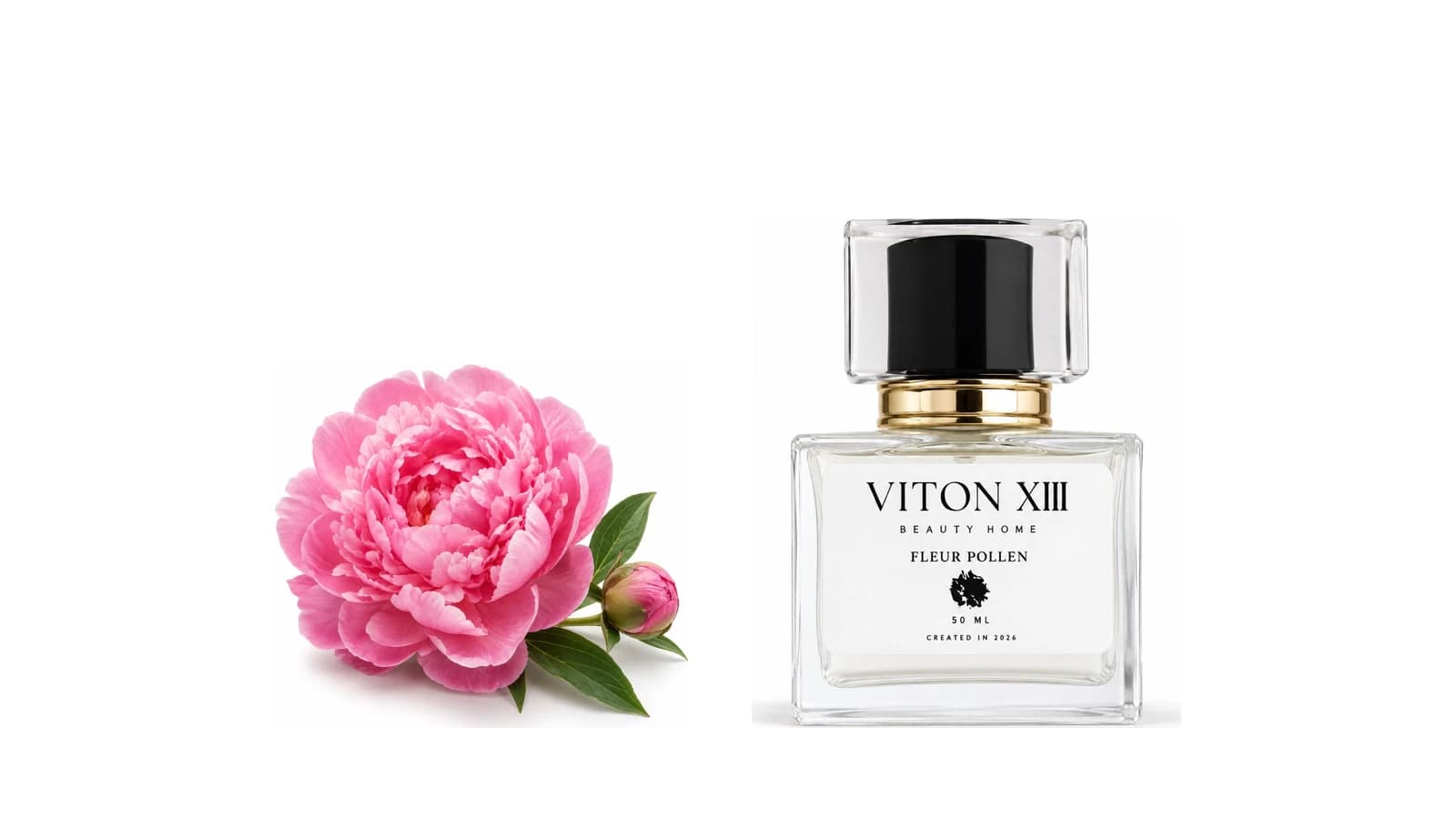
Of the five fragrances in the VITON XIII line, FLEUR POLLEN is the one that ends on white musk. It is a citrus floral musk Eau de Parfum for her: bergamot at the top, sweet pea, peony and Damask rose in the heart, white musk in the base. The store describes it as opening clean and airy, with a fresh pink bouquet and a soft honeyed petal edge that never reads as jam.
The finish is the point of this story. The store describes the white musk as the closeness of clean laundry, near the skin. Each fragrance page also carries a kitchen test, three everyday things that stand in for the top, heart and base. Treat them as hints, not copies; for the musk here, the hint is a clean towel from the dryer. The scent finder works from the other side: paste the notes of a perfume you already love, and it compares notes and families and names the closest of the five.
Every VITON XIII bottle is sold sealed, with a sample of the same fragrance outside the seal. Wear the sample the way described above, on skin and over a few hours, and open the bottle only if the scent is yours. While the seal is intact, the bottle can be returned within 14 days of delivery. If the musk seems quiet on you, remember the genes before you blame the perfume.
Practical checklist
- Look for white musk in the base of the note list, not in the top, and read the family name on the box.
- Test one scent on one wrist and wait about thirty minutes before you judge a musk.
- If a musk seems faint, ask another person to smell the same spot before you decide.
- With sensitive skin, try a small patch first and ask a doctor about any reaction.
- Start with the sample of FLEUR POLLEN and keep the bottle sealed until the scent feels like yours.
Questions and answers
Is white musk perfume still made from animals?
In perfumery, almost never. Wikipedia states that nearly all musk fragrance used today is synthetic, because the natural material needs a killed animal. The natural trade is controlled under CITES.
Why can’t I smell the musk that my friend smells?
People differ in the receptors that detect musk molecules. A 2022 PLOS Genetics study linked variants of one receptor gene to lower intensity ratings for a common musk, so the quiet may be yours, not the perfume’s.
Does white musk smell like soap or like skin?
Both are fair descriptions. Synthetic musks are called clean, smooth and sweet, and old deer musk was likened to a baby’s skin. The soapy or laundry impression is partly a memory of detergents, which use musks too.
Is synthetic musk worse than the natural kind?
Neither is simply better. Natural musk needs a killed animal. Older nitro and polycyclic musks were debated after they turned up in human and environmental samples, and macrocyclic musks are expected to replace them.
Can I test a musk perfume on a paper strip only?
A strip shows the first impression, nothing more. Skin dryness, diet and medication change a scent, and base notes such as musk come late. Use the strip to decline, and skin to decide.