
Answer in brief
A gourmand perfume is built on edible or dessert-like notes such as vanilla, tonka bean, almond, caramel and coffee. The modern family dates from 1992, when a sweet kitchen molecule first entered perfume. The best ones balance sugar with patchouli, woods or bitterness. Test on skin, wait half an hour, and read the ingredient list.
A gourmand perfume smells of something you could eat
Ask ten people what a gourmand perfume is and most will say it smells like dessert. That is close, and the encyclopedia is more exact. Wikipedia describes the family as scents with edible or dessert-like qualities, often built on vanilla, tonka bean and coumarin, together with synthetic materials that resemble food flavours. The name is borrowed from the table, and it fits: the first impression is of a kitchen, not a garden.
The word edible needs a warning. Wikipedia's article says most gourmand products are not meant to be eaten, although a few have been flavoured on purpose, and that the same sweet notes turn up in lip glosses, dusting powders and lotions. A gourmand is a smell, not a snack. The article also says the family can be feminine or masculine and can combine with the fruity family, so a cherry or a pear may sit inside one.
Where the sweet family came from and what made it possible
Sweet perfumes are older than the name suggests. The Wikipedia article on the family says the idea is not new, yet it credits a perfume released in 1992 as the first modern gourmand and says the trend has grown since. What changed that year was a material. The Wikipedia page on ethyl maltol says the compound was first used in perfume in 1992, after a patent granted in 1969, and that it began as a flavouring for confectionery. A molecule from the candy industry became a perfumer's tool.
Ethyl maltol smells of what you would expect from a sweet shop. The same page lists its aroma as sweet, caramellic, jammy and cotton-candy-like, and notes that it differs from maltol only by an ethyl group in place of a methyl group.
The laboratory had been feeding perfumery for a long time before that. Wikipedia's article on perfume says modern perfumery began with the commercial synthesis of aroma compounds such as vanillin and coumarin, which gave scents that natural materials alone could not. Coumarin was first synthesised in 1868, according to the page on the compound. So the sweet warmth of a gourmand rests on chemistry that is older than the trend.
Vanilla, tonka, almond, caramel and coffee: the edible notes
Five notes carry most of the family, and each has its own character. Vanilla is the best known, and its main compound, vanillin, is listed by Wikipedia as sweet, balsamic and pleasant. Tonka bean gives coumarin, which the same encyclopedia describes as smelling like vanilla beans, while the bean itself has a strong fragrance similar to sweet woodruff. Wikipedia lists tonka among the typical base notes of the family, which is where its warmth does its work.
Almond and cherry are close relatives. Benzaldehyde, which Wikipedia says smells like bitter almonds and cherry, is the compound behind both, and it is found in almonds and in the seeds of apricots, apples and cherries. That shared chemistry is why the two read as neighbours in a note list. Do not take the kitchen comparison too far: the same page says the glycoside in such seeds breaks down into a mixture that includes hydrogen cyanide, one more reason a perfume is for the skin and not the mouth.
Caramel, honey and chocolate complete the picture. Wikipedia names honey, chocolate, vanilla and candy as typical top and middle notes of the family, and ethyl maltol supplies the caramel. Coffee comes from roasting and brings bitterness where the others bring sugar; it has its own story and changes the whole mood of a composition.
Why the best sweet scents do not smell like pudding
A pure sweet smell tires quickly. Wikipedia's article says the top and middle notes of the family may be blended with non-edible base notes, and it lists patchouli, musk and tonka bean as typical bases. Patchouli is the useful one. Wikipedia describes its scent as heavy, strong, woody, earthy, balsamic and spicy, so it pulls sugar towards soil and wood. The result is sweetness with an edge.
Bitterness and dryness do the same job from another side. Coffee, bitter almond, a dark resin or a woody base give the nose something to chew on, and the sweet note stops being the whole story. A composition built like this reads as warm rather than sugary, which is why two vanilla perfumes can feel as different as milk and tea. If you dislike sweets in perfume, do not rule the family out.
Warm skin, cold air and how many sprays to use
Perfume is a liquid that wants to become a gas, and warmth helps it. Wikipedia's article says pure perfume is conventionally applied to pulse points so that they warm it and release fragrance continuously. It adds that diet, medication and skin dryness change how a fragrance performs, and that dry skin holds a scent for a shorter time than oilier skin. Nobody can promise you in advance how a sweet scent will behave on your wrist.
The same article says the base of a perfume is usually not perceived until about 30 minutes after application. A first sniff of a gourmand is therefore its top, not its character, and the sugary flash of the opening says little about what will remain on the skin later in the day.
No source consulted for this story measures sweet perfumes by season, so what follows is practical sense and not a result. In cold air a dense, warm scent is easy to carry and a second spray hardly shows. In summer heat the same dose can fill a small room, so one spray on the chest or wrist and a lighter hand on clothes is a fair start.
How to test a gourmand perfume before you commit
Start with the classification, and then do not rely on it. Wikipedia says the family classification is a starting point to describe a perfume but insufficient to fully characterise it. The label tells you the territory; the note list tells you the route. Read the list for the sweet material and for what stands beside it: woods, spice, flowers, bitterness. A gourmand perfume with no counterweight is the one that tires you by evening.
Test one scent at a time, on skin, and rest between tries. The nose adapts. Wikipedia defines olfactory fatigue as the temporary, normal inability to distinguish an odour after prolonged exposure to it, which means the fourth strip you smell in a row tells you little about the fourth scent.
Wear it for a full day before you decide. Look at three moments: the first minute, the first half hour and the evening. A scent that is pleasant at the start and cloying at the end is telling you the base is not yours. One that is plain at the start and lovely later is worth another day of testing.
Sweet notes, sensitive skin and the ingredient list
Some sweet materials deserve a careful reading. Wikipedia's page on coumarin says its use in perfumery is subject to restrictions because some people may become sensitised, and it adds that the evidence of allergic reactions in humans is disputed. That is an honest picture: a possible issue for some people, not a danger for everyone. The same page says coumarin was banned as a food additive in the United States in 1954, largely because of liver toxicity in rodents, which is a different matter from a few sprays on the skin.
The ingredient list is where you check. The European Commission explains that Regulation (EU) 2023/1545 introduces individual labelling for 56 additional fragrance allergens, to be listed when they exceed 0.001% in leave-on products or 0.01% in rinse-off products, and that from 31 July 2026 products that do not comply may no longer be placed on the EU market. Read the label. If you have reacted to a fragrance before, patch-test on a small area of skin and ask a doctor or pharmacist before you wear a new one.
Two gourmand fragrances from the VITON XIII line and a way to try them at home
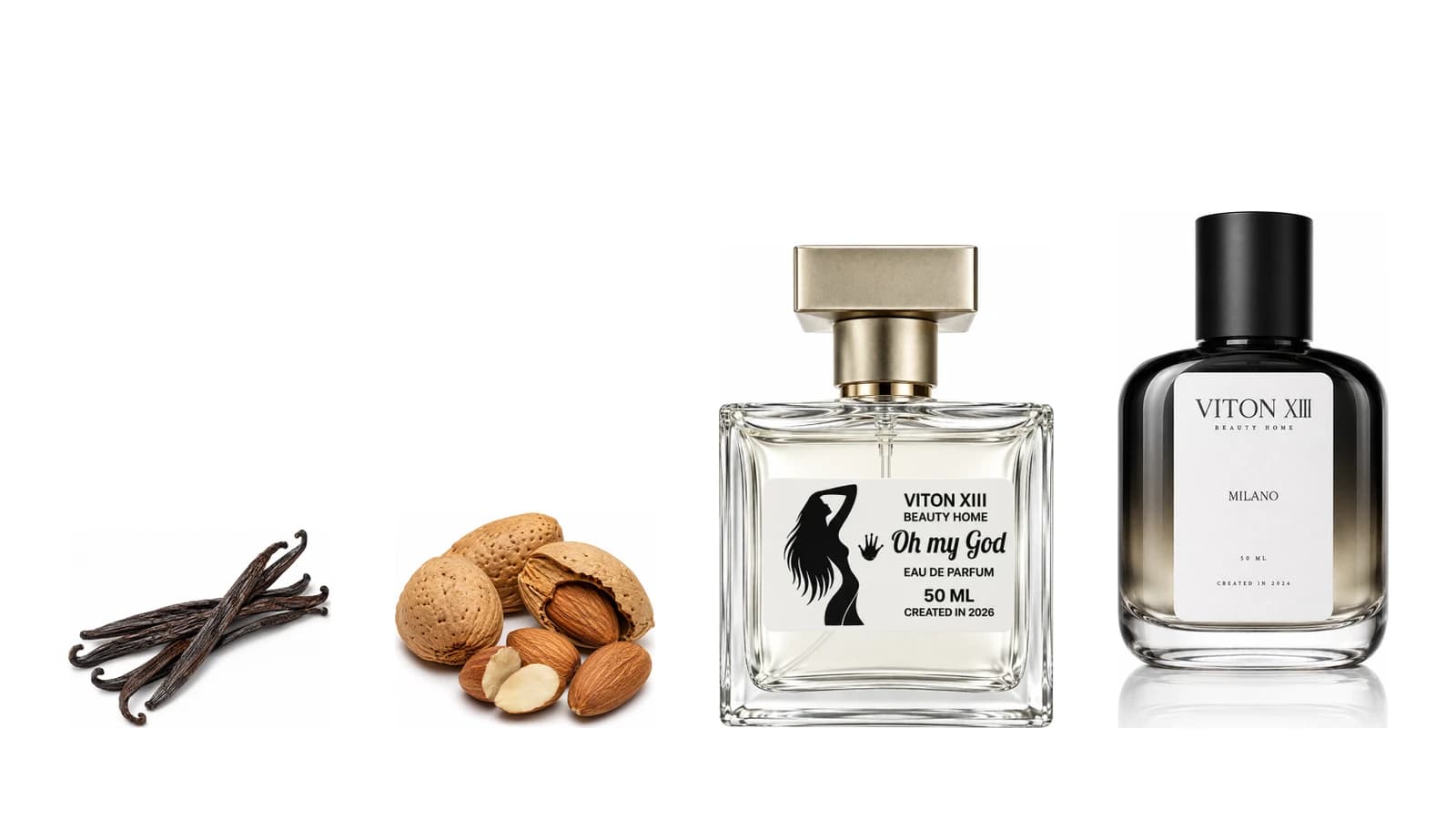
VITON XIII is the perfume line of the VITON13 store: five fragrances, each an Eau de Parfum in a 50 ml bottle. Two of them belong to the floral amber gourmand family. Oh my God is listed for her. Its top is pear, pink pepper and orange blossom, the heart is coffee, jasmine, bitter almond and licorice, and the base is vanilla, patchouli, cashmere wood and cedarwood. The store describes the coffee as roasted and softened by jasmine, with a dark licorice ribbon, and says patchouli keeps the vanilla elegant rather than sugary. That is the balance this story has been describing.
MILANO is unisex and sits in the same family. It opens on black cherry, almond and red wine, vivid rather than sugary. The heart is a velvety red rose lifted by white flowers, and the trail is tonka bean and amber resin. If sweet perfume has ever felt too much for you, these two show the darker, bitter side of the family, with almond running through both.
You do not have to guess. Every bottle is sold sealed, with a sample of the same fragrance outside the seal: wear the sample first, and open the bottle only if the scent is yours. While the seal is intact the bottle can be returned within 14 days of delivery. The scent finder takes the notes of a perfume you already love and names the closest of the five. The kitchen test on each fragrance page lists three ordinary things that stand in for the top, heart and base, as hints and not copies.
Practical checklist
- Read the note list for the sweet material and for the bitter, woody or spicy partner beside it.
- Test on skin, one scent at a time, and judge it after about half an hour, not at the first spray.
- Rest between tries and come back to the best candidate the next day, then wear it for a full day.
- Check the ingredient list for fragrance allergens, and patch-test if your skin has reacted before.
- Wear the sample of Oh my God or MILANO before you open a sealed bottle.
Questions and answers
Does a gourmand perfume always smell sweet?
Mostly, but the sweetness varies. Some lean on sugar, honey or caramel, others on coffee, bitter almond or dark resin, which smell edible without smelling sugary. The note list shows which kind you are holding.
Can men wear a gourmand perfume?
Yes. The Wikipedia article on the family says gourmand scents can be feminine or masculine. Edible notes are a material, not a gender, and what matters is the balance around them: woods, spice and dryness suit many wearers.
Is a gourmand perfume too heavy for summer?
It can be, but dose changes the answer. Warm skin releases fragrance more readily, so in hot weather one light spray is a sensible start. Try it on a warm day before you decide it is wrong for the season.
How do I find a sweet perfume that is not sugary?
Look for bitter or dry company in the notes: coffee, bitter almond, patchouli, woods or resin. They hold the sweet note in check. A short test on skin, left for half an hour, shows how the balance really turns out.
Are gourmand perfumes bad for sensitive skin?
Not by default. Some sweet materials, coumarin among them, are restricted because a few people become sensitised, and the label may list allergens. If your skin reacts easily, patch-test a small area and ask a doctor or pharmacist.