
Answer in brief
Fragrance families group perfumes that share a dominant structure. Two systems are in common use: a seven-family French list and the Fragrance Wheel with five main families and subgroups. A family predicts more than a single note, because the same note does different work in different families. Find yours from the perfumes you already wear.
What a fragrance family is and what it is not
Fragrance families are the shelves of the perfume world: groups of perfumes that share a dominant character. French Wikipedia says perfumes are traditionally sorted into seven great olfactive families and adds that the names can vary with fashion. The English article on perfume calls the classification a starting point to describe a perfume, but insufficient to fully characterize it. Both warnings are worth keeping, because a family is a useful first answer, not a full portrait.
A family is not a single note. It is a recognisable structure of notes that behave in a certain way together, which is why it tells you more than a shopping list of ingredients does. Two perfumes can both open on bergamot and still sit in different families, because what the bergamot leads to differs.
Two classifications in use and why they do not match
The first system is the French one. Quebec’s language office, the OQLF, notes that although several classifications coexist, the most common scheme names seven families: amber (also called oriental), woody, chypre, leather, floral, fougère and hesperidic, the last being the citrus family. French Wikipedia adds that the French perfumers’ society offers a classic classification of its own without detailing it, so this guide follows the seven-family list as the OQLF gives it and does not pin it on any single body.
The second is the Fragrance Wheel, a circular diagram of inferred relationships among groups of scents, based on similarities and differences in odour. Wikipedia says neighbouring groups are implied to share olfactory characteristics, and the English article on perfume names five main families: Floral, Amber, Woody, Aromatic Fougère and Fresh, each divided into subgroups. The wheel has been revised more than once; in 2008 it gained the Woods and Fruity subgroups, and in 2010 the aromatics moved between dry woods and citrus.
The two systems disagree at the edges, and Wikipedia admits that the groupings are rough and that sources overlap in how they group scents. Its article on chypre says chypres generally fit into the Oriental and Woody part of the wheel, while the French list gives them a family of their own. Neither list is wrong. They are maps drawn for different purposes, and a perfume can sit on both.
Floral and citrus: two wide families in a few sentences
Floral perfumes form the broadest family, and French Wikipedia defines them as perfumes built around one or several floral scents. The English article separates a single floral, dominated by one flower and called a soliflore in French, from a floral bouquet, a compound of several flower scents. French Wikipedia also lists blends such as floral-fruity, floral-woody and floral-green.
Citrus, called hesperidic in the French list, is built on citrus peel. The OQLF names lemon, orange, bergamot and mandarin as typical bases and says eaux de Cologne are hesperidics. The English article calls citrus the oldest fragrance family, the one that gave birth to lightweight eaux de Cologne. On the wheel it sits in the Fresh family beside the aromatic, water and green groups.
Woody, chypre, fougère and leather: the dry and mossy families
Woody perfumes are dominated by woody notes. The English article names sandalwood and cedarwood as typical, and French Wikipedia adds vetiver. On the wheel the Woody family holds three groups: woods, mossy woods and dry woods.
Chypre is named after a perfume of 1917, according to both Wikipedia articles, and the English article on perfume says that perfume was the first modern fragrance built on an accord of bergamot, oakmoss and labdanum. The article on chypre describes the shape: a citrus opening, a heart centred on labdanum and a mossy, animalic base. Fougère is built on a base of lavender, coumarin and oakmoss, with a sharp herbaceous and woody scent, and French Wikipedia’s glossary calls it a fantasy accord, a blend that defines the family more than any one smell does.
Leather is the smallest of the seven. French Wikipedia describes perfumes that recall tanned leather and notes that the family is often counted among the chypres because it is so small, while the English article lists honey, tobacco, wood and wood tars in the middle or base.
Amber, gourmand, fruity and musk: the warm and soft end of the wheel
Amber, formerly called oriental, is a large class of sweet, slightly animalic scents of ambergris or labdanum, according to the English article. French Wikipedia describes the family as dominated by a mixture of vanilla, balsam notes and resins, and lists oriental subfamilies: woody, vanilla, floral, spicy and gourmand. On the wheel, the Amber family holds soft amber, amber and woody amber.
Gourmand appears in the French list as a branch of the oriental family, not as a family of its own. Fruity was added to the wheel as a subgroup in 2008, according to Wikipedia, which makes it a recent arrival in a system with roots in the 1940s.
Musk has no family of its own in either list. It turns up as a base note inside the chypre structure and as a word in hybrid labels such as floral-woody-musk, an example the English article gives. Treat it as a character a perfume can have within any family, a soft background rather than a theme.
How to read a name like floral amber on a box
The English article on perfume says a single fragrance may be placed in more than one family and may carry a hybrid label such as floral-woody-musk or citrus-aromatic. The wheel does the same with its subgroup names: Floral Amber is a group where the Floral and Amber families meet, Woody Amber is where Woody and Amber meet, and Mossy Woods sits inside Woody. There is no universal rule for the order of the words, so check which word names a family and which one names an accent.
Take a label such as floral amber gourmand. Floral and amber are both families, Floral Amber is the wheel subgroup that links them, and gourmand is, in the French list, a branch of the amber family. The label therefore points to the area where flowers meet warm resins, with the sweeter side of amber added.
How to find your own family from perfumes you already wear
Start with the perfumes you already wear and enjoy. Write down three to five, find each one’s family on the box, in the shop’s description or in the note list, and look for the word or the neighbourhood that repeats. If two are woody and one is a chypre, the wheel tells you they are close relatives; if one is citrus and one is floral amber, your taste is wider than a single family.
Then look at the notes you cannot do without. A favourite note is a weaker clue than a favourite structure, because the same note does different jobs. Bergamot is the citrus opening of a chypre in the article on chypre, and citrus peel is the foundation of the hesperidic family in the French list. The family tells you what the note is opening onto, which is most of what you will smell.
Last, keep the limits in mind. Wikipedia calls the classification a starting point, and skin dryness, diet and medication all change how a fragrance reads once it is worn. A family narrows a wide shelf to a few candidates; your own skin decides among them. A test on the wrist remains the only final step.
The five VITON XIII fragrances sorted by family and how to try them
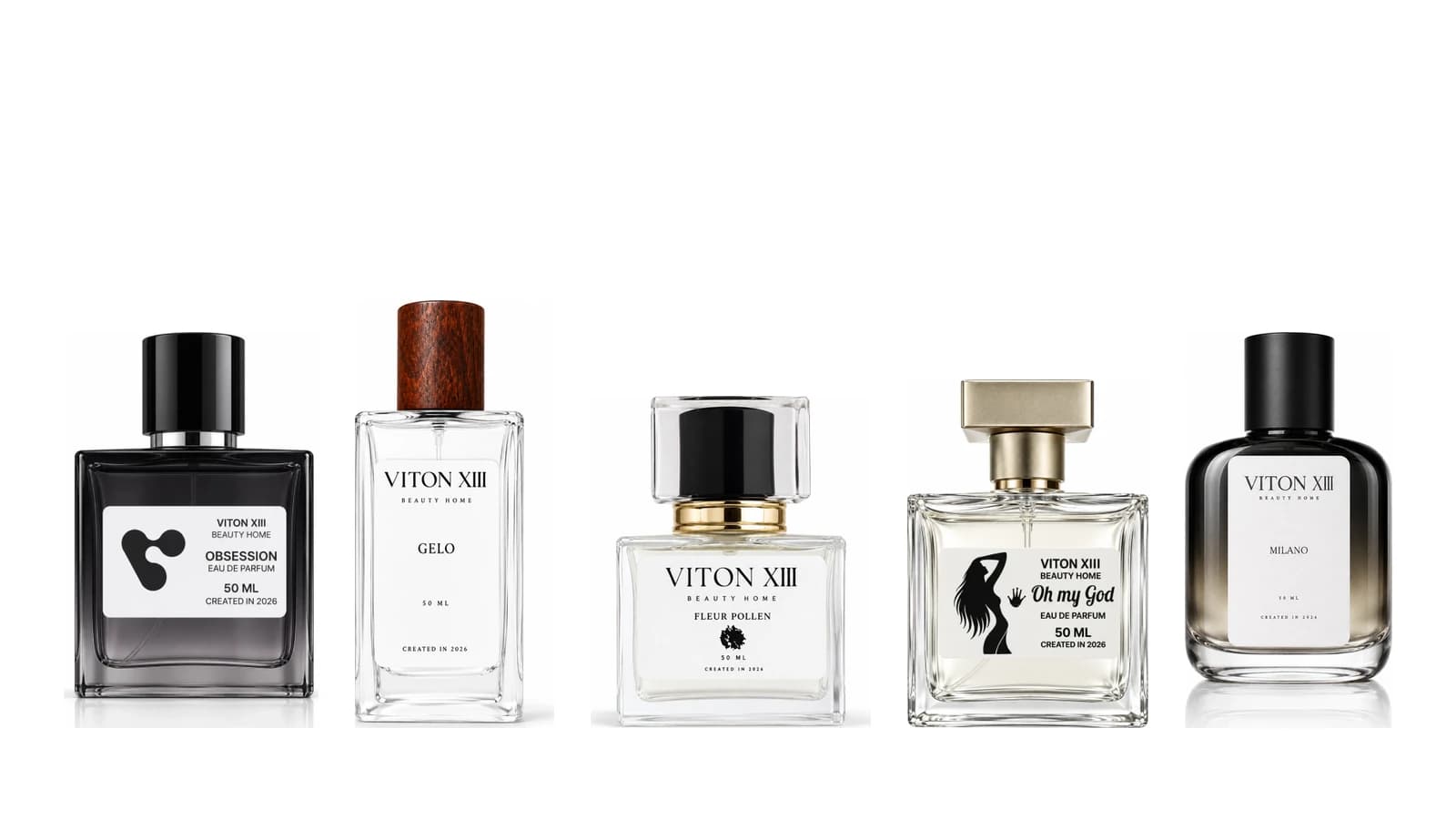
The five VITON XIII fragrances are Eau de Parfum in 50 ml bottles, and each shows its family on its page. OBSESSION, for him, is amber woody spicy, with Calabrian bergamot, Sichuan pepper, ambroxan and an amber-woody accord. GELO, for him, is a fruity chypre: apple, blackcurrant, pineapple and bergamot at the top, birch, jasmine and juniper in the heart, oakmoss, vanilla and ambergris in the base. FLEUR POLLEN, for her, is citrus floral musk, from bergamot through sweet pea, peony and Damask rose to white musk.
Oh my God, for her, is floral amber gourmand: pear, pink pepper and orange blossom, then coffee, jasmine, bitter almond and licorice, then vanilla, patchouli, cashmere wood and cedarwood. MILANO, unisex, carries the same family name, with black cherry, almond and red wine, red rose and white flowers, amber resin and tonka bean. Two bottles sharing a label and differing so much in their notes demonstrate this guide: the family gives the frame, the notes paint it.
To place yourself without guessing, open the scent finder, enter the notes of a perfume you love, and read which of the five it lands closest to; it weighs notes and families and does not name other brands. Each bottle arrives sealed, and a sample of the same fragrance sits outside the seal. Wear it first on skin, and break the seal only if the scent is yours. Until then, the bottle can go back within 14 days of delivery. The kitchen test on each page helps too: three everyday things, such as Earl Grey tea for bergamot or a vanilla pod for vanilla, that hint at the top, heart and base, as hints and not copies.
Practical checklist
- List three to five perfumes you already like and note the family printed on each box.
- Look for the family or the neighbouring wheel group that appears more than once in your list.
- Read a hybrid label word by word and check which words are families and which are accents.
- Test on one wrist, one scent at a time, before deciding whether a family really suits you.
- Enter the notes of your favourite in the scent finder, then try the sample of the closest fragrance first.
Questions and answers
How many fragrance families are there in total?
It depends on the system. The commonly cited French list has seven families, and the Fragrance Wheel has five main ones with subgroups. Wikipedia notes that sources overlap in how they group scents, so the count is a convention.
Is the family on the box the same as the notes in the pyramid?
No. The pyramid lists ingredients by time: top, heart and base. The family describes the overall structure they form together. Use the notes to check what you like and the family to predict how they will behave.
Where do gourmand and fruity perfumes belong?
It depends on the map. French Wikipedia lists gourmand as a branch of the oriental family, and the wheel added fruity as a subgroup in 2008. Many labels combine them with a main family, such as floral or amber.
Can one perfume belong to two families?
Yes. Wikipedia says a single fragrance may be placed in more than one family and may carry hybrid labels such as citrus-aromatic. Neighbouring groups on the wheel share characteristics, so the overlap is expected.
Does knowing my family guarantee I will like a perfume?
No, it only narrows the choice. Wikipedia calls the classification a starting point, insufficient to fully characterize a perfume. Skin, concentration and personal taste still decide, which is why a test on the wrist matters.