
Answer in brief
Coffee perfume borrows the smell of roasted beans, which comes from heat: raw beans smell green and pea-like. Roasting builds hundreds of compounds, and a perfume note is an impression of them. Coffee pairs well with vanilla, bitter almond, licorice, flowers and woods. Sniffing coffee beans at the counter did not improve smell in the one study consulted here.
Coffee perfume smells of the roast, not of the raw bean
Coffee perfume sounds like a drink, but the smell it borrows is the smell of heat. A raw coffee bean does not smell the way a cup does. A 2000 study of raw Arabica coffee, indexed on PubMed, found that the compound with the highest odour activity was 3-isobutyl-2-methoxypyrazine, which its authors linked to the peasy note of raw coffee. Wikipedia's article on the coffee bean says green beans carry a green, herbaceous, earthy odour, and that roasting creates the pleasant aroma.
The same PubMed study followed what roasting did to twelve odorants already present in the raw beans. The pea-like compound stayed at the same level, while methional, a furanone, vanillin, damascenone and two guaiacols rose markedly. Roasting does not only add smells. It makes the bean richer in the ones that read as sweet, smoky and spicy, and it is those that a perfumer tries to suggest.
What roasting builds: browning, hundreds of compounds and a sulphur edge
Wikipedia defines the Maillard reaction as a reaction between amino acids and reducing sugars that produces the compounds responsible for the flavour of browned food, one that runs fast at around 140 to 165 °C. It lists coffee roasting among the foods whose colour and flavour come largely from it, and says that, depending on conditions, the reaction can produce hundreds of flavour compounds, many of which break down into still more. Coffee roasting is a controlled version of the same chemistry as browning bread or searing meat.
The roast then changes the picture. Wikipedia's article on coffee roasting gives first crack at about 196 °C and second crack at about 224 °C, and notes that beans lose 15 to 18 percent of their mass, mainly water. Light roasts show grassy or fruity notes, medium roasts caramelised sweetness, and dark roasts bittersweet, caramel and burnt flavours. A coffee in a perfume can lean to any of these, and a dark-roast impression will feel heavier than a light one.
A few single compounds explain the character. The encyclopedia lists furfuryl mercaptan as a key component of the aroma of roasted coffee, with a roasted coffee, caramel, sulphurous and waxy odour. A 2003 PubMed study identified 3-mercapto-3-methylbutyl acetate as responsible for the strong roasty odour of a roasted Arabica brew and found that it rose sharply once the beans reached a dark roast.
How a coffee note gets into a bottle, and what the label can tell you
A list of notes is a description of impressions, not an inventory. Wikipedia's article on perfume says modern perfumery began with the commercial synthesis of aroma compounds, which gave scents that natural materials alone could not. The page on furfuryl mercaptan shows how far that goes for coffee: it is prepared from furfuryl alcohol and thiourea, a laboratory route to a molecule that smells of roasted coffee.
Natural routes exist too. The same article on perfume describes steam distillation, solvent extraction and supercritical carbon dioxide extraction as ways to capture odorants, and the page on absolutes explains that solvent extraction suits materials too delicate for steam. None of the pages consulted for this story says how a particular perfume builds its coffee, and a label does not either, so judge the note by nose and not by the claim on the box.
What you can do is read where the coffee is placed in the pyramid. Top notes evaporate quickly, according to Wikipedia, while heart notes form the body of the perfume and base notes arrive last. A coffee written in the heart or the base is therefore meant to stay, and one written in the top is meant to open the scent and step aside.
Vanilla, bitter almond, licorice, flowers and woods: what coffee pairs with
Vanilla is the natural partner, for a chemical reason. Wikipedia's page on vanillin notes that heat treatment generates vanillin in coffee, and the 2000 study found it rising during roasting. A vanilla note beside coffee therefore echoes something already in the roast, and it rounds off the bitterness without turning it into sugar.
Bitter almond and licorice sharpen it from the other side. Benzaldehyde, which Wikipedia says smells like bitter almond and cherry, adds a marzipan edge. The encyclopedia says anethole is a large part of the odour of anise and fennel, is also found in liquorice and star anise, and is about 13 times sweeter than sugar, so the licorice and anise side adds a dark sweetness that is not sugary. Together they pull coffee away from the cup and towards a dessert shop with a bitter streak.
Flowers lift it and woods ground it. A white flower in the heart gives coffee some air, and patchouli, which Wikipedia describes as heavy, strong, woody, earthy, balsamic and spicy, gives it ground to stand on. When a note list pairs coffee with one of each, the result is rarely one-dimensional.
Do coffee beans at the perfume counter really reset your nose?
Many shops keep a jar of coffee beans for customers to sniff between fragrances. The idea is that coffee clears the nose. A study in Perceptual and Motor Skills by Grosofsky, Haupert and Versteeg tested it. College students smelled three fragrances repeatedly and rated them, then sniffed coffee beans, lemon slices or plain air, and tried to say which of four fragrances they had not smelled before. According to the PubMed abstract, coffee beans did not improve performance compared with lemon or air.
The reason the nose needs a rest in the first place is olfactory fatigue. Wikipedia defines it as the temporary, normal inability to distinguish an odour after prolonged exposure, a kind of neural adaptation that protects the nervous system from overload. A jar of beans does not reverse that. If your nose has gone quiet, step outside for a few minutes, give it a break, and come back to the strongest candidate on another day. One small study cannot prove the opposite for every nose, but it gives no reason to rely on the jar.
When a coffee scent works and when it is too heavy
Coffee works when the dark side has a light partner. A roasted note beside pear, a white flower or a cool citrus keeps its bitterness without turning smoky. It works in the evening, on a cold day, and in places where a warm, enveloping smell is welcome. It works less well where the air is hot and still and the room is small.
It turns heavy when everything around the coffee is also dark: smoky resin, sweet caramel, heavy woods. Wikipedia's article on perfume says that pure perfume is traditionally applied to pulse points so that they warm it and release fragrance continuously, and that dry skin holds fragrance for a shorter time than oilier skin. The advice that follows is practical sense, not a measured result: in warm weather use less, apply to one spot, and give the scent time before adding more.
How to test a coffee perfume and what to know about sensitive airways
Test on skin and wait. Wikipedia's article on perfume says base notes are usually not perceived until about half an hour after application, and a coffee note often lives in the heart and base. Smell it at the start, after thirty minutes, and again in the evening. Take a break between samples, since the nose adapts, and do not judge more than two or three in a row.
A note about health. The same article says some fragrances can trigger asthma reactions, especially in people with severe or atopic asthma. A strong gourmand can be more noticeable in a closed room than a light citrus. If you have asthma or reactive skin, test a small amount in a ventilated place, patch-test on a small area of skin, and ask a doctor or pharmacist before you commit to a bottle.
A coffee heart in the VITON XIII line and a way to try it at home
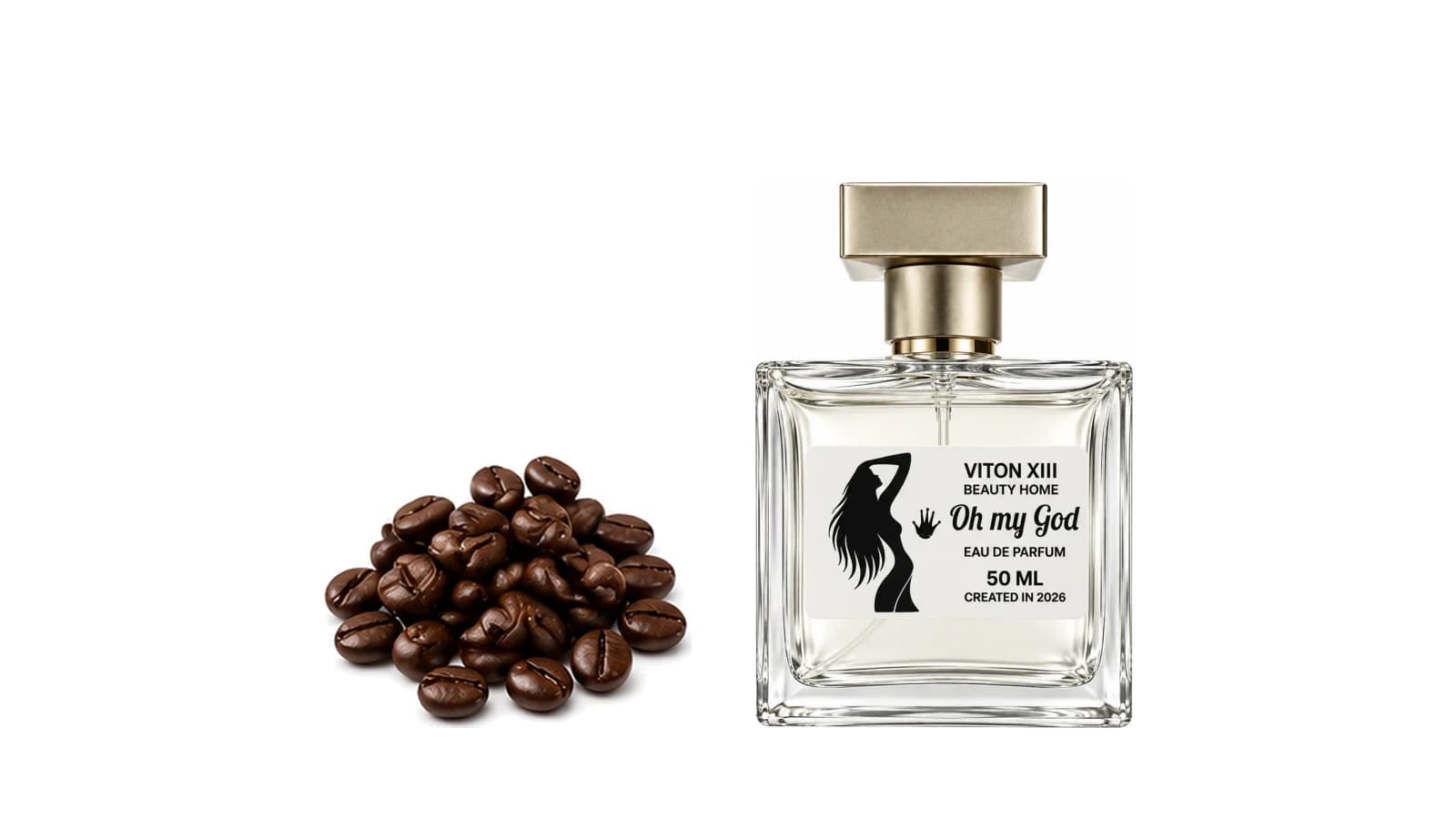
VITON XIII is the perfume line of the VITON13 store: five fragrances, each an Eau de Parfum in a 50 ml bottle. Oh my God is the one built around coffee. It is a floral amber gourmand listed for her. Its top is pear, pink pepper and orange blossom, its heart is coffee, jasmine, bitter almond and licorice, and its base is vanilla, patchouli, cashmere wood and cedarwood. The store describes the coffee as roasted and softened by jasmine and orange blossom, with a dark ribbon of licorice, and says patchouli keeps the vanilla elegant rather than sugary.
Everything this story described is there: a roasted note, a vanilla partner, bitter almond, licorice, a flower, and a wood to stand on. The kitchen test on its page names three ordinary things from a kitchen: ground coffee, jasmine tea and star anise appear on the list, as hints and not copies. The other four fragrances of the line are on the collection page if you prefer a different mood.
You do not have to guess. Every bottle is sold sealed, with a sample of the same fragrance outside the seal: wear the sample first, and open the bottle only if the scent is yours. While the seal is intact the bottle can be returned within 14 days of delivery. The scent finder takes the notes of a perfume you already love and names the closest of the five.
Practical checklist
- Decide which roast you like: light and fruity, caramel and medium, or dark and bittersweet.
- Look at where the coffee sits in the notes, and what stands beside it: vanilla, almond, licorice, flowers, woods.
- Test on skin, give it half an hour, and rest your nose between samples instead of sniffing beans.
- In warm weather use fewer sprays of a coffee scent and add more only after the first has settled.
- Wear the Oh my God sample for a day before you open a sealed bottle.
Questions and answers
Does a coffee note in perfume come from real coffee?
Not necessarily. A note describes how a perfume smells, and the label rarely says whether it was built from an extract or from laboratory molecules. Judge the coffee note by what you smell on your own skin.
Why does coffee smell different raw and roasted?
Roasting changes the chemistry. Raw Arabica beans carry a green, pea-like odour, and roasting raises compounds such as vanillin and guaiacols. The sweet, smoky, bitter aroma you know is a product of heat, not a property of the raw bean.
Is sniffing coffee beans a good way to reset my nose?
The study consulted for this story found no advantage over lemon or plain air. Olfactory fatigue is temporary, so the safer habit is to pause, step into fresh air, and test only two or three scents in a row.
Can men and women both wear coffee perfume?
Yes. A coffee note is a material and has no gender. What changes the impression is the company it keeps: flowers make it softer, woods and spice make it drier. Choose by how the whole composition feels on you.
Is a coffee scent too heavy for summer?
It can be, particularly in a closed room. Warm skin releases fragrance readily, so apply less and keep to one spot. Try it on a mild day before deciding. Coffee paired with light pear or a white flower wears lighter than a dark smoky blend.