
Answer in brief
Vanilla perfume borrows the scent of a cured orchid pod, whose main compound is vanillin. Perfumers also reach the vanilla effect with synthetic vanillin, tonka bean and sweet resins. It is usually written in the base, and its neighbours decide the result: patchouli makes it dry, fruit makes it dessert, moss and salt make it skin-like. Test it on skin for half an hour.
Vanilla perfume starts with a pod and rarely ends with one
When people ask for vanilla perfume they usually mean a warm, soft, sweet smell that feels like home. The raw material behind it is a spice. Wikipedia describes vanilla as the product of orchids of the genus Vanilla, mainly the seed pods of Vanilla planifolia, and names two other species grown for it, Vanilla tahitensis and Vanilla pompona. By weight it is the second most expensive spice in the world after saffron.
A perfume does not need a pod in the bottle to smell of vanilla. The same encyclopedia says that vanilla is used in perfume production, and that lower-grade cured fruits often go to flavouring extract and the fragrance industry. Beside the pod there are molecules and resins that carry the same sweetness. The honest way to read a note list that says vanilla is as an effect, not a promise about an ingredient.
From flower to pod: why natural vanilla takes months
A vanilla flower must be pollinated before it will make a pod. According to Wikipedia, each flower has to be pollinated within 12 hours of opening, and wild vanilla has only about a 1% chance of success. The method still used on farms was developed in 1841 by Edmond Albius, a twelve-year-old enslaved boy on Réunion: the flowers are pollinated by hand, one at a time.
Then the pod has to be cured, because a green pod has little smell. Wikipedia lists four steps. Killing stops the growth and starts the enzymatic reactions behind the aroma. Sweating is traditionally 7 to 10 days at 45 to 65 °C under high humidity. Drying brings the moisture down to 25 to 30 percent and is called the most problematic stage. Conditioning stores the pods for five to six months while the fragrance develops.
The geography is narrow. The page gives world raw vanilla production in 2023 as 7,433 tonnes, of which Madagascar produced 3,113 tonnes, 42 percent, and Indonesia 1,833 tonnes, 25 percent. Together those two countries account for roughly two thirds of the world total.
Vanillin, the molecule that does most of the talking
Wikipedia's page on vanillin calls it the main component of the ethanolic extract of the vanilla bean and says cured pods contain about 2% of it by dry weight. Green pods store it as glucovanillin, and curing releases it. High-quality pods may show a white frost of relatively pure vanillin crystals. The page describes the odour as vanilla, sweet, balsamic and pleasant. The orchid does not own it: a 2000 study of Arabica coffee, indexed on PubMed, found that vanillin rose markedly during roasting.
Vanillin is not the whole smell, though. The page on vanilla says real extract holds several hundred compounds and that vanillin is one of 171 identified aromatic components. That is why a pod can smell rounder, darker or more smoky than a simple vanillin note, and why a perfumer who wants the full effect has to add something to the bare molecule.
The molecule has a long history of its own. Théodore Nicolas Gobley isolated it from vanilla extract in 1858. In 1874 Ferdinand Tiemann and Wilhelm Haarmann worked out its structure and found a route to it from coniferin, a glucoside in pine bark, and in 1876 Karl Reimer made it from guaiacol. Today, according to the vanillin page, roughly 85 percent is synthesised from petrochemical guaiacol and glyoxylic acid and about 15 percent comes from lignin. As of 2001 annual demand was 12,000 tons, of which only 1,800 tons were natural.
Tonka, benzoin and balsam: other ways to a vanilla effect
Tonka bean is the best-known stand-in. Its seeds contain about 1 to 3 percent coumarin, says Wikipedia, and the compound is described as smelling like vanilla beans. The page on tonka bean adds that after synthetic coumarin was developed it became one of the first artificial flavourings used as a vanilla substitute, and that the flavour has been described as a mix of vanilla, almond, clove and cinnamon. So tonka brings vanilla and something dry and nutty on top of it.
Resins add a different kind of sweetness. Wikipedia describes benzoin, the resin of several Styrax species, as sweet and vanilla-like and valued in perfumery, with the Siam type listed as sweet, vanilla, balsamic, woody and powdery. The article says benzoin works as a fixative, slowing the dispersion of fragrance materials into the air. Balsam of Peru is described as sweet, balsamic, vanilla, woody, powdery and resinous, and the page lists vanillin among its roughly 25 substances.
That last material shows the other side of the story. The same page says crude balsam of Peru has been banned by the International Fragrance Association as a fragrance compound since 1982, that extracts and distillates remain allowed up to 0.4% in products, and that it is among the top five allergens in patch-test referrals. A sweet, vanilla-like material is not automatically a gentle one.
Where vanilla sits in the pyramid and why the wait matters
Perfumes are described in three layers. Wikipedia's article on perfume explains that top notes are small, light molecules that evaporate quickly, that heart notes form the body as the top fades, and that base notes are rich and deep and usually not perceived until about 30 minutes after application. Many perfumes write vanilla in the base, yet the encyclopedia's article on gourmand scents lists it among typical top and middle notes, with patchouli, musk and tonka bean as the usual bases. The pyramid is a description, not a law.
When vanilla is written low, it has a consequence: everything above it has already spoken before it arrives, so the nose meets it as a destination rather than an opening. A vanilla perfume that starts with a sugary blast can settle into something quiet and dry, and one that starts quietly can be sticky by the evening. Wait for the base before you judge it.
How the company vanilla keeps changes the way it smells
Vanilla is a chameleon. Put it beside fruit, and the encyclopedia's article on gourmand scents notes that the family combines with the fruity one, and you get the impression of a dessert. Put it beside patchouli, which Wikipedia describes as heavy, strong, woody, earthy, balsamic and spicy, and the sweetness dries out and darkens. The vanilla itself has not changed. Its company has.
Moss and salt send it somewhere else again. Oakmoss, a lichen that Wikipedia calls woody, sharp and slightly sweet, is used as a fixative and as the base of chypre and fougère perfumes, and its use is now highly restricted by industry rules. Ambergris, the whale-derived substance, smells marine when fresh and sweet and earthy when aged, and its main odour compound, ambroxide, is now made synthetically. Under moss and ambergris, vanilla stops reading as food and starts reading as warm skin.
This is the practical lesson of the family. The word vanilla in a note list tells you very little by itself. Read the neighbours: woods and resins for dryness, fruit and cream for dessert, moss and amber for skin. Two perfumes can both list vanilla and have almost nothing in common, which is why the whole list rewards slow reading more than the headline note does.
How to choose a vanilla that is not sugary
Start by deciding what you dislike. If sugar tires you, look for vanilla with something dry or bitter beside it: patchouli, woods, spice, coffee, or a resin. If a powdery, soft effect is what you want, tonka and white flowers do it. If you want vanilla to be barely noticed, pick a perfume where it sits under moss, amber or wood rather than in the heart.
Test it for what vanilla does in time. Spray it on skin, not on paper, and come back after half an hour and again in the evening, because the base is vanilla's territory. Do not test more than two or three in a row, since the nose tires, and leave your wrist alone between sprays. If your skin reacts to fragrance in general, patch-test on a small area first and ask a doctor or pharmacist, and read the ingredient list for allergens.
Three VITON XIII fragrances built on vanilla and a way to try them at home
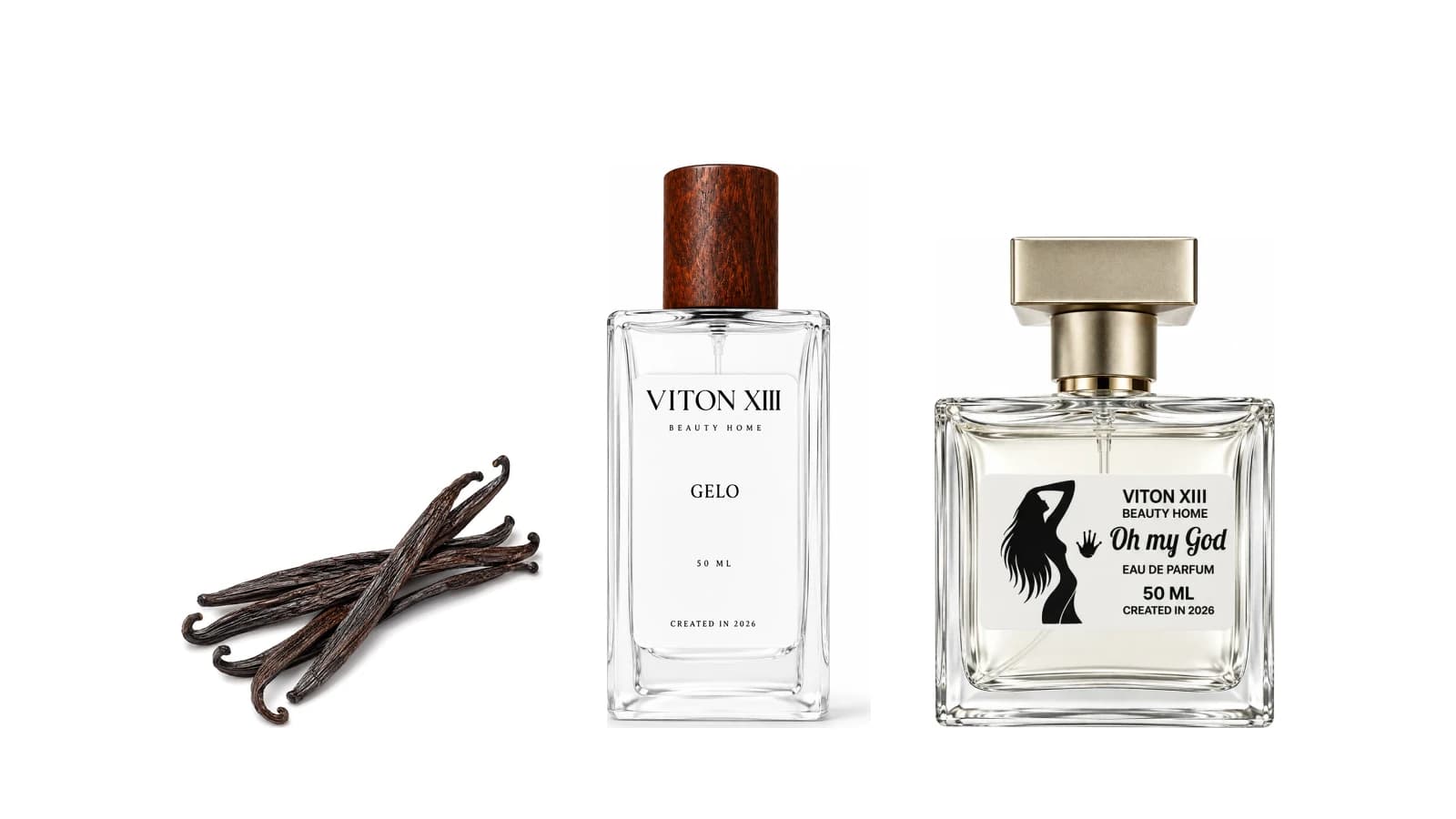
VITON XIII is the perfume line of the VITON13 store: five fragrances, each an Eau de Parfum in a 50 ml bottle. Three of them take up the vanilla theme. Oh my God, a floral amber gourmand for her, ends on vanilla, patchouli, cashmere wood and cedarwood, and the store says the patchouli keeps the vanilla elegant rather than sugary. GELO, a fruity chypre for him, lists vanilla after oakmoss and ambergris, and the store describes it as damp forest and salty skin warmed from below by vanilla.
MILANO, a unisex floral amber gourmand, takes the other road and gets its vanilla effect from tonka. Its trail is tonka bean and amber resin, which the store describes as almond and warm vanilla, after a red rose heart and an opening of black cherry, almond and red wine. Placed side by side, the three show the lessons above: vanilla made dry by patchouli and wood, vanilla made salty and mineral by moss and ambergris, and a vanilla effect that comes from tonka and resin.
Try before you commit. Every bottle is sold sealed, with a sample of the same fragrance outside the seal: wear the sample first, and open the bottle only if the scent is yours. While the seal is intact the bottle can be returned within 14 days of delivery. The kitchen test on each page names three ordinary things that stand in for the top, heart and base, a vanilla pod for vanilla among them, as hints and not copies, and the scent finder names the closest of the five to a perfume you already love.
Practical checklist
- Read the neighbours of the vanilla note: woods and resins for dry, fruit and cream for dessert, moss and amber for skin.
- Spray on skin and judge the perfume after half an hour and again in the evening, when the base has settled.
- Test no more than two or three scents in a row, and rest your nose between them.
- If your skin reacts to fragrance, patch-test a small area and check the ingredient list for allergens.
- Wear the sample of GELO, Oh my God or MILANO before you open a sealed bottle.
Questions and answers
Is vanilla perfume made from real vanilla?
Sometimes in part. Perfumers also use vanillin made in a factory, tonka bean and sweet resins to get the effect. A note list that says vanilla describes a smell, and rarely tells you which of these produced it.
Why does vanilla perfume smell different on different people?
Skin matters. Wikipedia's article on perfume says diet, medication and skin dryness change how a fragrance performs, and dry skin holds a scent for a shorter time than oilier skin. Test on your own skin before buying.
How is tonka bean different from vanilla?
Tonka bean gives coumarin, which smells of vanilla beans but is described as a mix of vanilla, almond, clove and cinnamon. It reads drier and nuttier than a pure vanilla note, and perfumers often combine the two.
Can men wear vanilla perfume?
Yes. Vanilla is a material, not a gender. When it sits under woods, moss or ambergris it reads as warm and quiet instead of sweet. Read the neighbouring notes and judge the result on your own skin.
Is vanilla perfume safe for sensitive skin?
It depends on what surrounds the vanilla. Some vanilla-like materials, balsam of Peru among them, are restricted because they are common allergens. If your skin reacts to scent, patch-test a small area and ask a doctor or pharmacist.