
Answer in brief
A cherry note in perfume is a built accord, not an extract of the fruit. Its backbone is benzaldehyde, a molecule whose smell is described as almond and cherry at once. Whether the result reads as candy or as dark fruit depends on what stands beside it: tart, wine-like, floral or resinous partners make it adult.
What people picture when they ask for a cherry scent
Ask ten people for cherry perfume and you will get at least two pictures. One is a glossy red sweet, the cherry of a lollipop or a fizzy drink. The other is a dark fruit with a skin that splits, juicy and a little sour, eaten in summer with stained fingers. Both are called cherry on a label, and a bottle can sit anywhere between them.
Wikipedia’s article on perfume files edible and dessert-like scents under the gourmand family, and fruits other than citrus under the fruity one, and it adds that a scent can belong to more than one family. Cherry usually lives on that border. Knowing which side a particular bottle leans to is most of the skill of choosing one, and the rest of this story is about reading that lean.
Why a cherry note is built and not pressed
You cannot buy cherry oil the way you buy lemon oil. Purdue University’s agriculture news service reports that cherry flavour in candy and soda is likely a mix of aromatic and flavour compounds found by studying plants in the laboratory, not cherry trees. The same piece says that only 1.5 percent of the benzaldehyde produced worldwide is obtained from plants. The cherry you smell in sweets, and often in scent, is assembled, not squeezed.
That is not a flaw to hide. An accord is a deliberate blend in which several materials are combined until the nose reads one thing. The cherry that results is a picture of cherry painted in the aroma chemicals that carry the strongest signal, and a good painter can make it dark, tart, glossy or dry. What matters is not whether the material came from a fruit but what the painting looks like when the minutes have passed.
Benzaldehyde: the molecule that cherry shares with almond
Wikipedia describes benzaldehyde as a colourless liquid with an almond-like smell, similar to that of bitter almonds and cherry. It is a component of bitter almond oil, it gives almond flavour to foods and scented products, and it is used in cherry-flavoured sodas. Purdue calls it a key compound in cherry, almond and raspberry flavours and says that it is second only to vanillin in economic value to the food industry.
In nature, the link sits inside the stone. Wikipedia explains that almonds, apricot seeds, apple seeds and cherry seeds contain amygdalin, which enzymes break down into benzaldehyde, hydrogen cyanide and glucose. The article on cherries adds that the kernels release hydrogen cyanide when eaten, in amounts that matter only after several crushed pits. So the almond smell of a cherry stone is real, and it is also a reason not to taste one.
None of this makes a bottle dangerous. Wikipedia reports that the US Food and Drug Administration and FEMA consider benzaldehyde generally regarded as safe when used in food, cosmetics, pharmaceuticals and soap. It is also a reminder of why a cherry scent so often turns toward marzipan: the molecule that makes one makes the other.
Sweet candy cherry against dark tart cherry
Wikipedia’s article on cherries separates two cultivated species. The sweet cherry, Prunus avium, is the most common and is often eaten fresh. The sour cherry, Prunus cerasus, is grown mainly for cooking. Per 100 grams of raw fruit the article lists 12.8 grams of sugars for the sweet cherry and 8.5 grams for the sour one, which is a fair summary of the two scent moods: one soft and sugared, the other sharp and slightly dry.
A candy cherry keeps the sugar and the almond, and its smell is that of the sweet itself. A dark cherry keeps the tartness and puts something grown-up beside it, such as a vinous depth, a velvety red rose, a resinous base or a touch of spice. The fruit is the same note; the company it keeps changes its age.
When you read a notes list, look at what is next to the cherry. If the neighbours are vanilla, caramel and more sweetness, expect candy. If they are wine, flowers, woods or resins, expect depth. The word cherry on the label tells you the fruit, and the other words tell you the mood.
What tonka adds underneath the fruit
Tonka bean is the seed of Dipteryx odorata, a tree of northern South America, and Wikipedia says the seeds typically hold about 1 to 3 percent coumarin, occasionally up to 10 percent. Coumarin gives the seed its pleasant odour and is used in the perfume industry, and the article describes the flavour as a blend of vanilla, almond, clove, cinnamon and amaretto. The almond in that list is the reason tonka sits so comfortably under cherry.
Wikipedia’s article on coumarin gives the history: it was first isolated from tonka beans in 1820 and first synthesised in 1868, and its odour is sweet and resembles vanilla. In the article on perfume, scents built on vanilla, tonka bean and coumarin are named as typical of the gourmand family. Under a tart fruit, tonka works as a warm floor that stops the cherry from ending sharply.
There is a regulatory side too. Wikipedia notes that the US Food and Drug Administration has treated foods containing tonka beans as adulterated since 1954, because coumarin is toxic at extremely high concentrations, and that many governments regulate coumarin as a food additive. That is a food rule rather than a perfume one. The coumarin article adds that its use in perfumery is restricted because some people may become sensitised to it, so if you react to scents, patch-test and ask a doctor.
How to wear a cherry scent without it reading childish
A cherry perfume turns childish when the fruit and the sugar are the only things in it. The remedy is contrast: something dry, bitter, wine-like or woody that makes the cherry look like one ingredient instead of the whole idea. Take that into account when you choose, and then in how you wear it: one or two applications, in the evening or in cool weather, rather than a cloud for the office.
Occasion matters as much as composition. A dark cherry with floral and resinous depth suits dinner and winter coats, while a pure candy cherry suits a warm afternoon and a light mood. Neither is wrong. What reads as childish is usually a mismatch between the scent and the moment, not the fruit itself.
How to test a cherry-almond scent before you buy
Wear it on skin, one scent at a time, and write down three moments: the first ten minutes, half an hour and an hour. In the first ten the cherry is loudest and the almond comes with it. At the hour you meet the base, and that is where tonka, amber or wood tell you whether the cherry ends sweet and gentle or dry and warm. If you like the end, you like the cherry perfume.
Two cautions belong here. If you have a nut allergy, ask your doctor before you choose a scent with an almond note, because only a doctor can judge your case. And if your skin is sensitive, test a small area first and wait a day, because tonka’s coumarin is the very material that perfumery restricts for that reason.
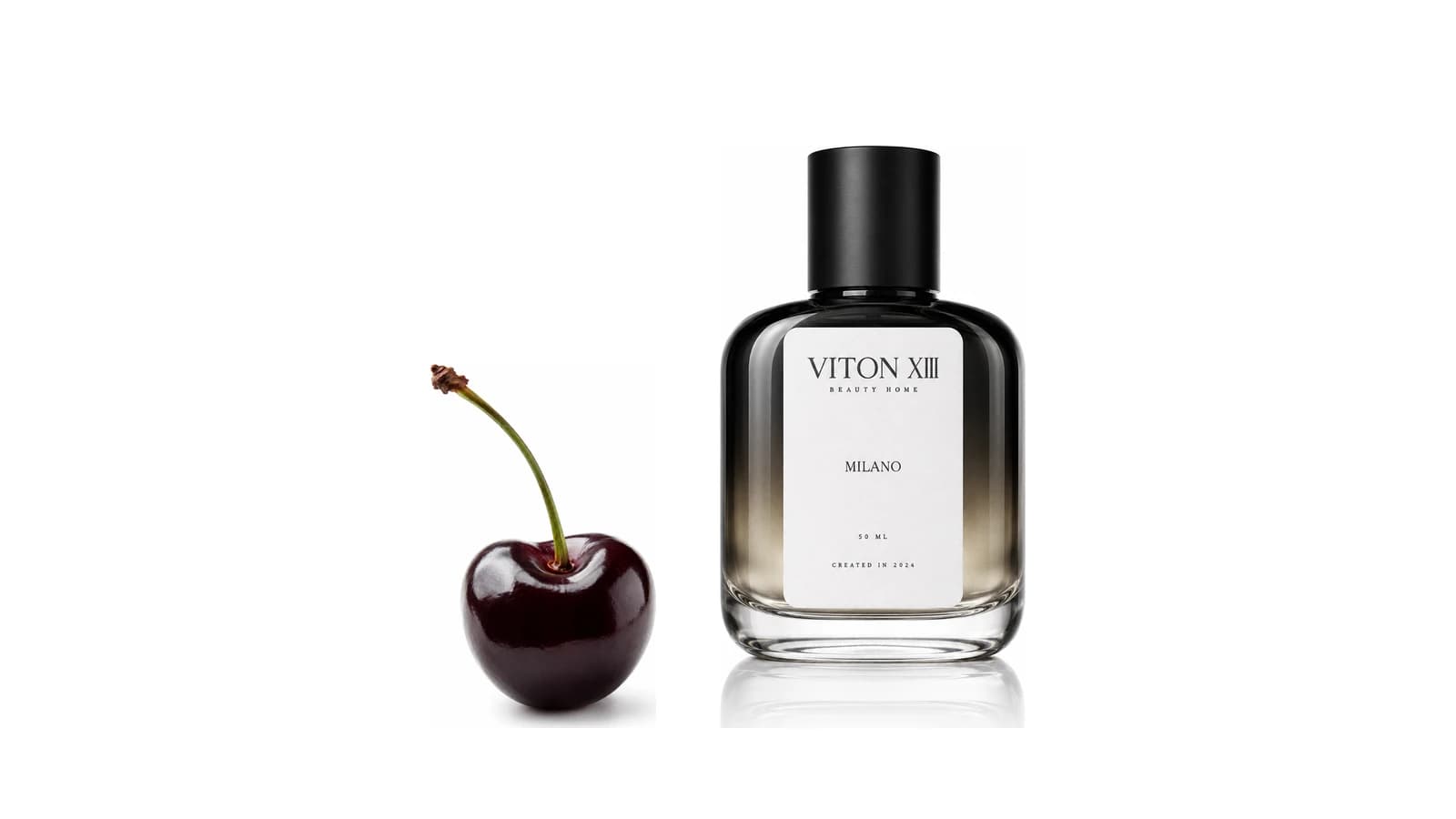
MILANO: black cherry, almond and red wine over amber
The cherry in the VITON XIII line is MILANO, a unisex floral amber gourmand sold as an Eau de Parfum in a 50 ml bottle. Its top notes are black cherry, almond and red wine; the heart is red rose and white flowers; the base is amber resin and tonka bean. The store describes it as opening on dark, tart cherry with a vinous depth, vivid rather than sugary; the heart as a velvety red rose lifted by white flowers; and the trail as tonka, almond and warm vanilla, with amber resin.
Everything this story has described is in that list: the almond beside the cherry, the wine and rose that keep it away from candy, the tonka underneath. To test it, paste the notes of a perfume you already love into the scent finder, which compares notes and families and names the closest of the five. The MILANO page lists three ordinary kitchen things that stand in for its top, heart and base, which are hints rather than copies. The bottle is sold sealed with a sample of the same fragrance outside the seal: wear it first, and open the bottle only if the scent is yours. While the seal is intact, it can be returned within 14 days of delivery.
Practical checklist
- Look at the notes next to the cherry: wine, flowers and resin mean depth, vanilla and caramel mean candy.
- Wear one scent on skin and write down what you smell at ten minutes, thirty and sixty.
- If you have a nut allergy, ask a doctor before choosing a scent with an almond note.
- Patch-test a small area first if your skin reacts to sweet, warm or tonka scents.
- If you want a dark, vinous cherry, wear the MILANO sample before you open the sealed bottle.
Questions and answers
Why does cherry perfume smell like almond?
Both are linked to benzaldehyde. Wikipedia describes its smell as similar to bitter almonds and cherry, and Purdue lists it as a key compound in cherry and almond flavours. A scent that pushes one of them forward often brings the other along.
Is cherry perfume made from real cherries?
In practice, no. Purdue says cherry flavour in candy and soda likely comes from compounds identified in plant research and not from cherry trees, and perfume cherry follows the same logic. The note is assembled to smell like the fruit.
What makes a cherry scent sweet or dark?
The notes beside the fruit. Vanilla, caramel and sugary partners lean toward candy; wine, rose, woods and resin lean toward depth. The fruit supplies the cherry, and the company it keeps supplies the mood and the age.
Can I wear a cherry scent in the daytime?
Yes, with a light hand. A bright, tart cherry with a dry or floral partner works in daylight, while a rich, resinous one is more at home in the evening. Test for an hour at the time of day you plan to wear it.
Is tonka bean a nut?
No, it is a seed. Wikipedia says tonka beans come from Dipteryx odorata, a tree in the pea family. If you have a nut allergy or sensitive skin, ask a doctor about any scent before you wear it, since only a specialist can judge your case.