
Answer in brief
Rose perfume is built from the Damask rose, whose oil is distilled and whose absolute is extracted with a solvent. The smell is a chorus of compounds, so its partners decide the mood: citrus, peony and musk make it fresh and pink, while fruit, wine and amber make it dark and velvety. Rose is not old-fashioned by nature.
Rose in a perfume is a chorus, not one note
Rose perfume sounds like a single idea, yet the smell of a rose is built from many parts. The Wikipedia article on rose oil gives the makeup of Damask rose oil: mostly citronellol, at 20 to 34 percent, and geraniol, at 15 to 22 percent, with a waxy hydrocarbon called nonadecane at 8 to 15 percent. Then comes the surprise. The same article says that trace compounds such as beta-damascenone account for slightly more than 90 percent of the odour content, because their odour thresholds are so low.
Other pieces have their own character. Wikipedia describes phenethyl alcohol as a pleasant floral odour, soft and rose-like, found in rose oil but also in carnation, hyacinth, orange blossom, ylang-ylang, geranium, neroli and champaca. Rose oxide is described as the source of the typical floral green rose fragrance, and only one of its isomers is responsible, with an odour threshold of 0.5 parts per billion. So the word rose on a bottle names a family of facets, not a fixed smell.
The Damask rose, the flower perfumers actually grow
Most of what perfumery calls rose comes from one plant. Wikipedia says the Damask rose, Rosa × damascena, is a hybrid descended from Rosa gallica and Rosa moschata, with DNA analysis suggesting a third species also contributed. It is a deciduous shrub up to 2.2 metres tall with light to moderate pink to light red flowers, and it is not found in the wild. The article suggests an origin in the foothills of central Asia or Iran, and the name refers to Damascus.
It has many local names, among them Bulgarian, Turkish, Taif and Isparta rose. Iran, Bulgaria and Turkey are the major producers, with France and India also contributing significantly. Bulgarian oil comes from the area around Kazanlak and Karlovo, known as the Valley of Roses, and in Turkey a state cooperative in the Isparta region regulates commercialisation and quality control. Harvest is labour-intensive and lasts up to a month in cooler conditions, or 16 to 20 days in hotter seasons.
From petal to bottle: otto, concrete and absolute
Rose is expensive for plain reasons. Wikipedia explains that the flowers contain little oil and are picked by hand before sunrise, then distilled the same day, so the low yield and the labour drive the price. A flower that gives little oil and a harvest that cannot wait are, in short, the whole story of the price.
The classic route is steam distillation, which gives rose otto, also called attar of roses. Large copper stills are fired for 60 to 105 minutes, and the first distillate, the direct oil, is only about 20 percent of the final product. The water is redistilled, a step called cohobation, to recover water-soluble fractions such as phenethyl alcohol.
The other route is a solvent, typically hexane, which produces a waxy concrete. Treating the concrete with alcohol yields rose absolute, a deep reddish-brown product. The article says the low-temperature process may better preserve the scent of fresh roses. A third method uses supercritical carbon dioxide at low temperature and leaves no residue, but the equipment is expensive.
Why distilled rose never smells exactly like the garden
A perfumer starts from an extract, not from a petal. According to Wikipedia, the heat of distillation can break down some of the compounds in rose, so attar does not smell exactly like fresh roses. That is one reason the absolute, made at lower temperature, is valued, and why rose in a perfume is always an interpretation: a few compounds are chosen, balanced and often supported by others.
The same article notes that rose oils are perhaps still the most widely used essential oil in perfumery, despite their high price and the existence of synthetic alternatives. It also warns that dealers often dilute rose oil with citronellol, geraniol, geranium or palmarosa oils, with some products up to 90 percent geranium or palmarosa. The word rose in a list of notes therefore tells you what you will smell, not how the material was obtained.
Fresh and green, honeyed and fruity, or dark and velvety
Because rose contains several facets, its neighbours decide which one you hear. The green facet comes from rose oxide, so a rose set beside bright citrus and a watery peony leans toward the garden. Add a soft musk underneath and the flower becomes a clean, pink bouquet close to the skin.
A second facet is fruity and honeyed. Wikipedia lists the damascones, a family of rose ketones present in small amounts, with descriptors including fruity, floral, black currant, plum, rose and honey, and says they have high odour strength. It follows that cherry, plum-like fruit or a red-wine accord beside a rose echo something the flower already contains, which may be why the pairing feels natural rather than sweet.
The third direction is dark and velvety. Warm resins and amber, vanilla-like tonka and almond turn the same flower into something heavier, closer to evening than to morning. Nothing about the rose changes. The base around it lowers the light, and the green and fresh facets move into the background.
The old-fashioned rose myth and what really dates a scent
Many people say they dislike rose because it smells of powder, of soap or of a relative's dressing table. That is a real impression, but it describes particular compositions, not the flower. Yet the article on rose oil suggests the material has never gone away, since it may still be the leading essential oil of perfumery, and it keeps being written in new ways.
What dates a scent is the company the rose keeps. A rose with heavy powder reads as an older style; the same rose with cold fruit, a thin citrus top or a clean musk reads as current. When you try one, ask which of the three facets you hear first, and which fades last. If the answer is green or fruity, you are probably not smelling the rose you remember.
How to wear rose by day and by evening
For daytime, look for roses with a lighter frame: citrus at the top, a peony or similar petal-like floral beside the rose and a soft musk at the base. They stay close, suit office and travel and rarely feel heavy. For the evening, a rose with fruit, wine, resin or amber gives the flower more weight and warmth, and it holds up against heavier clothes and cooler air. These are habits of taste, not rules.
Test on skin, not on paper. The Wikipedia article on perfume explains that top notes are perceived at once, middle notes emerge as the tops fade, and base notes appear later, usually around half an hour after application. When rose is a heart note, it appears after the top has faded, so give it time. The European Commission's public summary of its safety committee's opinion says allergic reactions typically appear about a day after use, so judge your skin the next day too, and see a doctor if it reacts.
FLEUR POLLEN and MILANO: two roses, two moods
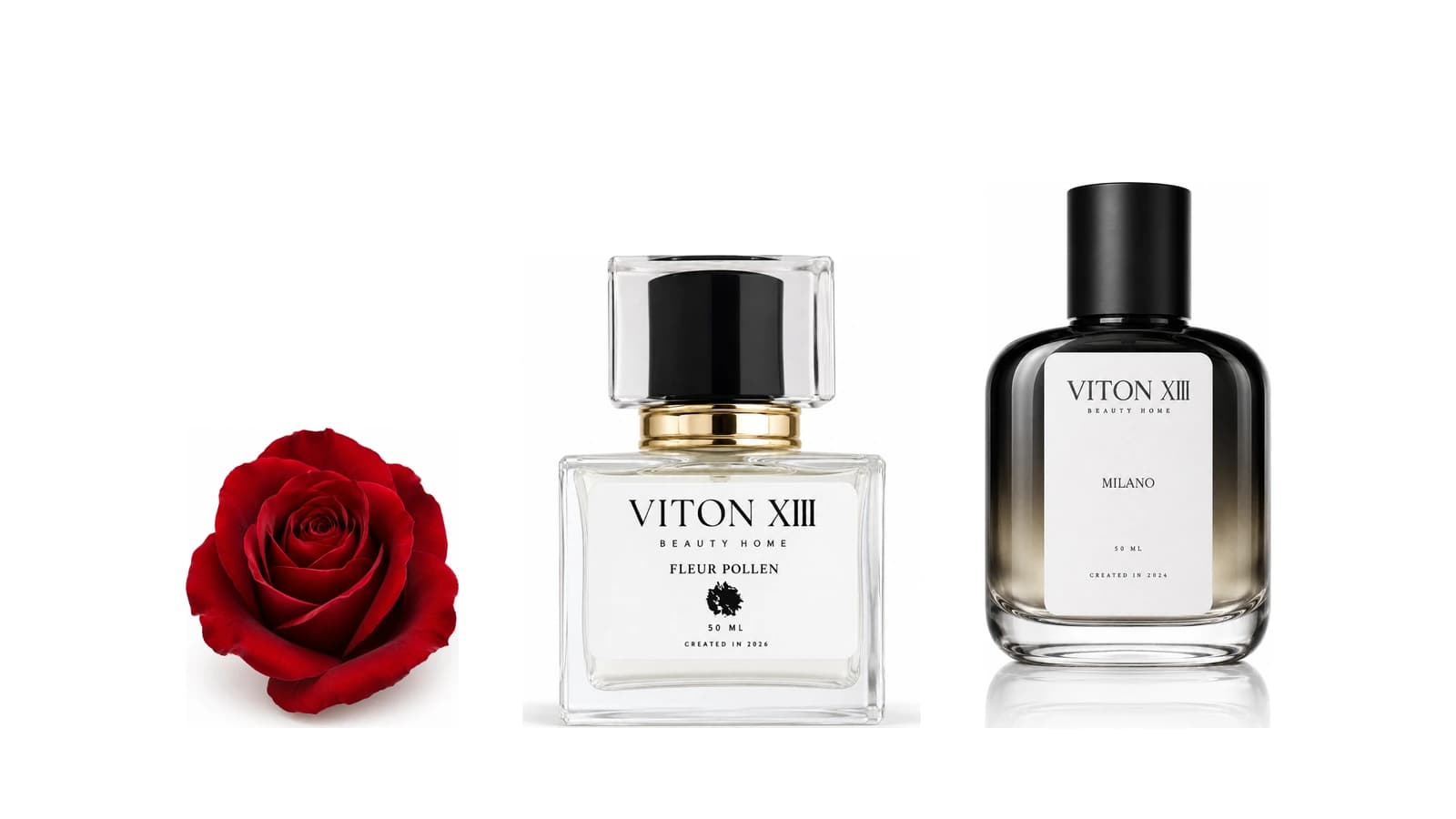
Two of the five fragrances in the VITON XIII line put rose in the heart. FLEUR POLLEN, a citrus floral musk for her, opens with bergamot, then brings sweet pea, peony and Damask rose, and ends on white musk. The store describes it as clean and airy at the start, a fresh pink bouquet with a soft, honeyed petal edge in the heart and never jam, finishing as the closeness of clean laundry near the skin.
MILANO, a floral amber gourmand listed as unisex, goes the other way. It opens with black cherry, almond and red wine, with a heart of red rose and white flowers and a base of amber resin and tonka bean. The store describes the opening as dark, tart cherry with a vinous depth, vivid rather than sugary, the rose as velvety and lifted by white flowers, and the trail as almond-like tonka with warm vanilla and amber.
To choose between them without guessing, start with the sample. Each bottle is sold sealed, with a sample of the same scent placed outside the seal, so you can live in it for a day before breaking the seal; unopened, the bottle can go back within 14 days of delivery. The scent finder takes the notes of a perfume you already love and names the closest of the five. The kitchen test on each page gives three everyday hints for top, heart and base, and they are hints, not copies. Patch-test first if your skin is sensitive.
Practical checklist
- Decide which mood you want: fresh and pink, honeyed, or dark and velvety, and read the other notes for it.
- Check what stands beside the rose: citrus and musk lighten it, fruit, wine and amber deepen it.
- Spray on skin and wait for the heart; rose rarely shows its character in the first minutes.
- Judge your skin the next day as well, and see a doctor if you notice a reaction.
- Compare FLEUR POLLEN and MILANO through their samples before you open either sealed bottle.
Questions and answers
Is rose the same as Damask rose in a perfume?
Not always. The Damask rose is the plant most often used for rose oil and absolute, but perfumers also use other roses and rose-like materials, and a note called rose says what you smell, not which flower it came from.
What is the difference between rose absolute and rose otto?
Rose otto, or attar, is obtained by steam distillation. Rose absolute comes from a waxy concrete made with a solvent and then treated with alcohol. Wikipedia says the lower-temperature process may preserve the scent of fresh roses better.
Why does one rose perfume feel fresh and another heavy?
Rose has green, soft, fruity and honeyed facets. Citrus, peony and musk bring out the fresh side, while fruit, wine and amber add depth. The flower stays the same; what changes is the company it keeps.
Can a rose perfume be worn in the daytime?
Yes, particularly one with citrus on top and a soft musk underneath, which tends to stay close to the skin. Heavier roses with resin or amber suit evenings better. This is taste, not a rule, so test on your own skin.
Why is real rose oil so expensive?
Wikipedia says the flowers contain little oil and are picked by hand before sunrise and distilled the same day. Low yield and labour raise the price, and dealers sometimes dilute rose oil with cheaper materials.